


A stock due diligence checklist is a systematic framework for evaluating potential investments by examining financial health, competitive position, management quality, and risk factors before committing capital. It typically covers 15-30 essential items including financial statement analysis, valuation metrics, business model assessment, competitive advantages, and qualitative factors that help investors make informed decisions based on comprehensive research rather than speculation.
Key Takeaways
- A comprehensive due diligence checklist reduces emotional decision-making by providing a structured evaluation process covering financial, operational, and qualitative factors
- Financial analysis should include at least 3-5 years of historical data for revenue, earnings, cash flow, and key ratios to identify trends and consistency
- Qualitative factors like management track record, competitive moats, and industry position often matter as much as financial metrics for long-term success
- Due diligence timelines vary—spend 2-4 hours on initial screens, 8-12 hours on detailed analysis for significant positions, and ongoing monitoring after purchase
- Most investment mistakes stem from skipping checklist items rather than lacking information, making systematic completion more important than checklist length
Table of Contents
- What Is Stock Due Diligence?
- Why Do Investors Use Checklists?
- Essential Due Diligence Checklist Items
- Financial Statement Analysis
- Valuation Assessment
- Evaluating Qualitative Factors
- Risk Evaluation and Red Flags
- How to Implement Your Checklist
- Common Due Diligence Mistakes
- Frequently Asked Questions
- Conclusion
What Is Stock Due Diligence?
Stock due diligence is the comprehensive research process investors use to evaluate a company before buying its shares. It involves analyzing financial statements, assessing business quality, evaluating management, understanding industry dynamics, and identifying potential risks. The goal is to build conviction about an investment thesis based on facts rather than hunches.
The term "due diligence" comes from securities law, specifically the Securities Act of 1933, which established that broker-dealers must exercise "due diligence" when researching investments. While retail investors don't face the same legal requirements, the principle remains valuable—thorough research reduces the chance of expensive mistakes.
Due Diligence: The investigation and analysis an investor performs before making an investment decision to verify facts, assess risks, and understand what they're buying. It transforms investing from speculation into informed decision-making.
Effective stock research combines quantitative analysis (numbers from financial statements) with qualitative assessment (business model, competitive position, management quality). Most professional investors spend 80% of their research time on understanding the business itself and only 20% on valuation calculations, though beginners often reverse this ratio.
Why Do Investors Use Checklists?
Checklists prevent overlooking critical information during the research process. A 2009 study published in the Journal of Behavioral Decision Making found that investors using systematic checklists made 23% fewer errors in their analysis compared to those relying on memory and intuition alone.
The human brain struggles with consistency when evaluating complex information. You might thoroughly analyze management quality for one stock but forget to check it for the next. Checklists ensure every investment receives the same rigorous scrutiny regardless of how excited or skeptical you feel about it initially.
Behavioral finance research shows that confirmation bias—the tendency to seek information supporting existing beliefs—affects even experienced investors. A structured checklist forces you to examine unfavorable data and potential weaknesses, not just reasons to buy. This balanced approach leads to better long-term results.
Checklists also create an audit trail. When you revisit an investment six months later, your documented due diligence shows what you knew when you bought and whether your original thesis still holds. This makes it easier to decide when to sell or add to positions based on changing facts rather than emotions.
Essential Due Diligence Checklist Items
A practical stock due diligence checklist covers five main categories: business understanding, financial analysis, valuation, qualitative factors, and risk assessment. Each category contains specific items that can be verified through public documents and data sources.
Core Due Diligence Categories
- ☐ Business model and revenue sources clearly understood
- ☐ Industry structure and competitive dynamics mapped
- ☐ 3-5 years of financial statements reviewed
- ☐ Key financial ratios calculated and compared to peers
- ☐ Cash flow generation verified (not just accounting profits)
- ☐ Balance sheet health assessed (debt levels, liquidity)
- ☐ Valuation metrics compared to historical ranges and competitors
- ☐ Management track record and capital allocation reviewed
- ☐ Competitive advantages (moats) identified and evaluated
- ☐ Growth drivers and catalysts documented
- ☐ Major risks and potential problems identified
- ☐ Regulatory or legal issues researched
Your checklist length depends on your investment approach. Value investors might emphasize financial strength and discount valuation with 20+ line items in those areas. Growth investors often have more detailed sections on competitive position and market opportunity. There's no single "correct" checklist—the best one matches your strategy and helps you avoid your personal blind spots.
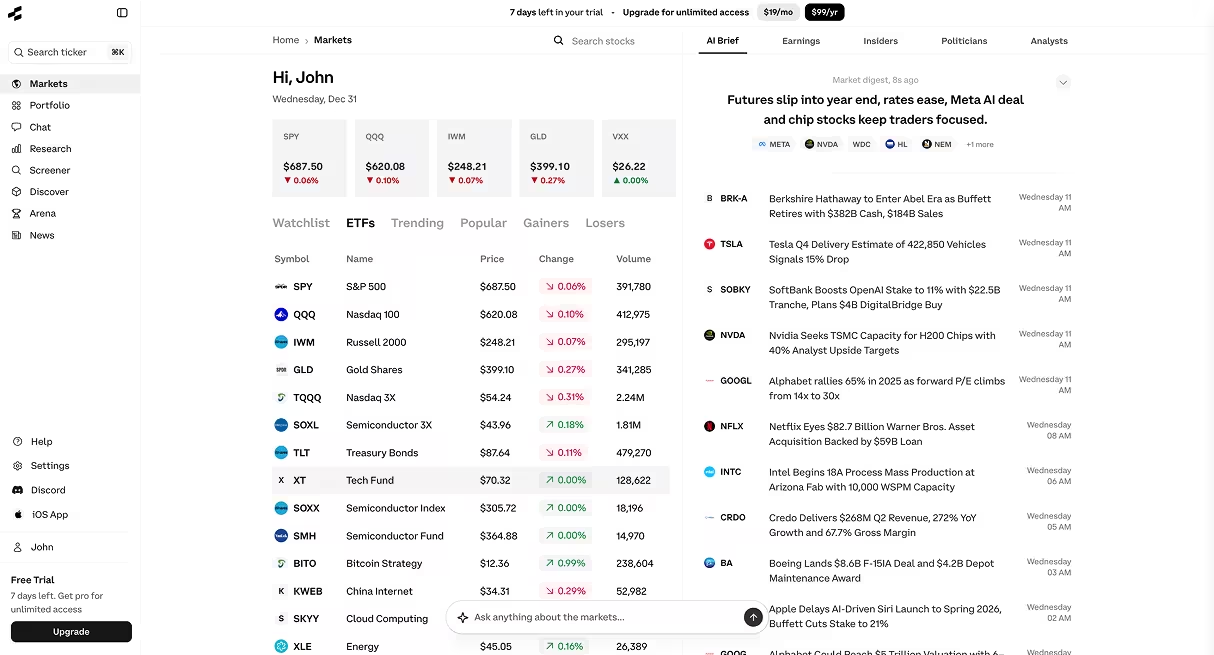
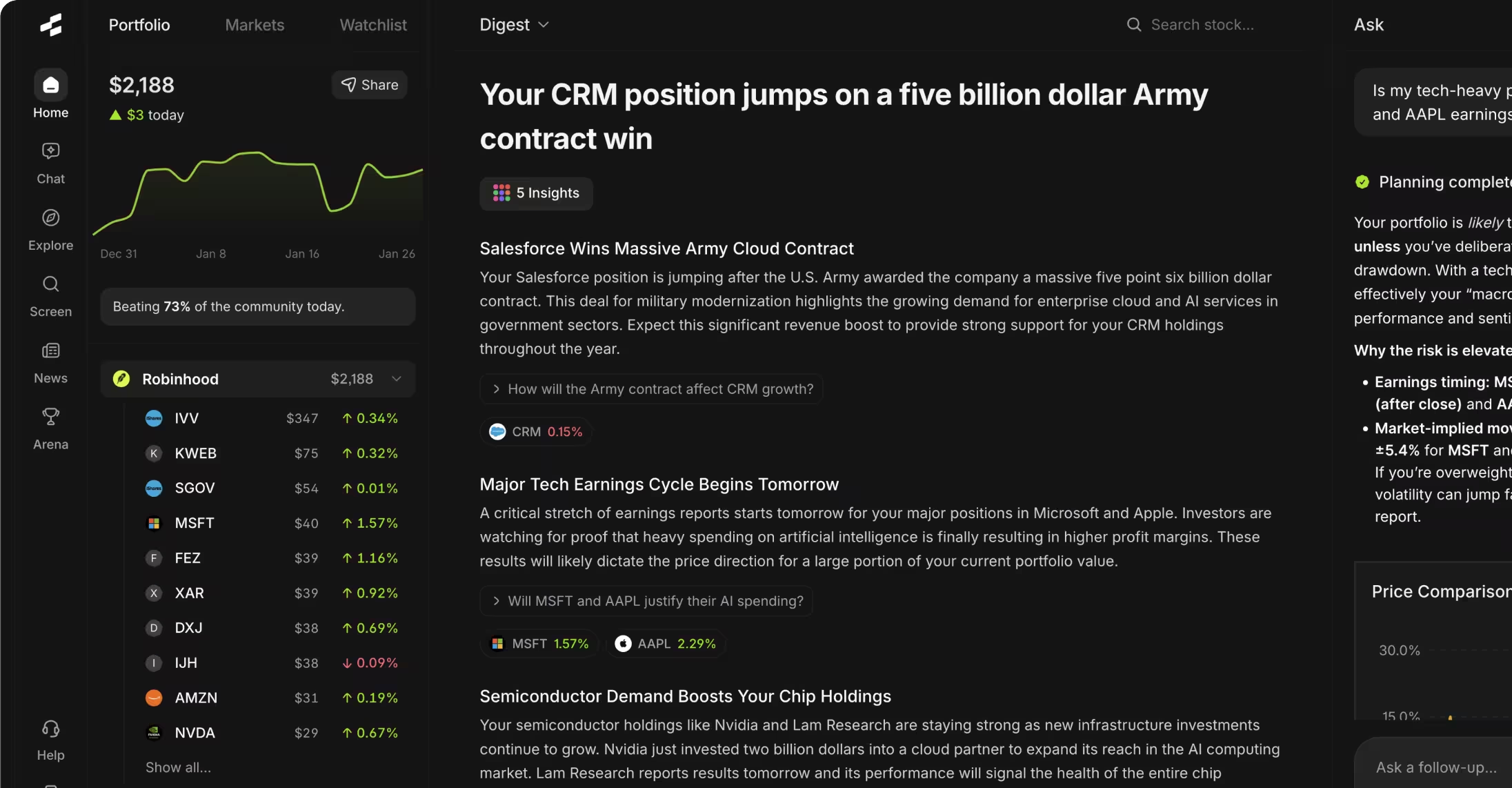
Start with a manageable list of 15-20 items. As you gain experience, you'll discover which factors matter most for your decision-making and can refine accordingly. Tools like Rallies.ai's AI Research Assistant can help you quickly gather information for checklist items without manually searching through hundreds of pages of financial filings.
Financial Statement Analysis
Financial statement review forms the quantitative foundation of stock analysis. You need to examine three core statements—the income statement, balance sheet, and cash flow statement—for at least three to five years to identify trends, consistency, and potential warning signs.
Income Statement Analysis
Start with revenue trends. Look for consistent growth or at least stability, not wild fluctuations. Calculate the compound annual growth rate (CAGR) over 3-5 years. A company growing revenue 15% annually for five years is very different from one that grew 75% one year and declined 50% the next, even if the average looks similar.
Examine profit margins—gross margin, operating margin, and net margin. Compare these to historical levels and industry peers. Declining margins often signal increased competition or rising costs that might continue. Expanding margins can indicate pricing power or operational improvements, both positive signs.
Operating Margin: Operating income divided by revenue, showing what percentage of sales becomes profit before interest and taxes. It reveals operational efficiency independent of capital structure and tax situations, making it useful for comparing companies.
Balance Sheet Examination
The balance sheet shows what a company owns (assets) and owes (liabilities) at a specific point in time. Pay special attention to the debt-to-equity ratio. A ratio above 2.0 indicates high leverage in most industries, though acceptable levels vary—capital-intensive businesses like utilities typically carry more debt than software companies.
Check the current ratio (current assets divided by current liabilities). A ratio below 1.0 means the company might struggle to pay short-term obligations, though this matters more for struggling businesses than profitable growing ones. Look at cash and equivalents—companies with substantial cash relative to debt have more financial flexibility.
Cash Flow Statement Review
Many investors focus on earnings but overlook cash flow, a mistake that hides problems. Operating cash flow shows actual cash generated by the business. Compare it to net income over several years. If net income consistently exceeds operating cash flow, the company might be using aggressive accounting to inflate reported profits.
Free cash flow (operating cash flow minus capital expenditures) represents cash available for dividends, buybacks, debt reduction, or acquisitions. Companies that generate consistent free cash flow have more options and face less financial pressure than those consuming cash.
Financial Metric What It Reveals Red Flag Level Revenue Growth (3-yr CAGR) Market demand and competitive position Negative or highly volatile Operating Margin Operational efficiency and pricing power Declining for 2+ consecutive years Debt-to-Equity Ratio Financial leverage and risk Above 2.0 (varies by industry) Current Ratio Short-term liquidity Below 1.0 Free Cash Flow Cash generation after investments Negative for multiple years Return on Equity (ROE) Profitability relative to shareholder equity Below 10% (mature companies)
Valuation Assessment
Valuation determines whether a stock's current price offers attractive potential returns relative to the business quality you've identified. No single valuation metric tells the complete story—use multiple approaches to triangulate a reasonable estimate of value.
Price-to-Earnings (P/E) Ratio
The P/E ratio shows how much investors pay for each dollar of annual earnings. As of 2024, the S&P 500 trades at an average P/E of around 20-25. Technology stocks often trade at P/E ratios of 25-40, while value sectors like utilities average 12-18. Compare a company's current P/E to its own 5-year average and to industry peers rather than using absolute thresholds.
P/E Ratio: Current stock price divided by earnings per share, typically using either trailing 12-month earnings or forward estimates. It provides a quick snapshot of valuation but doesn't work for unprofitable companies or those with highly cyclical earnings.
Price-to-Sales and Price-to-Book
Price-to-sales (P/S) ratios work for evaluating unprofitable growth companies where P/E doesn't apply. A P/S below 2.0 is generally considered low, though software-as-a-service companies often trade at P/S ratios of 5-15 when growing quickly. Price-to-book (P/B) helps evaluate asset-heavy businesses like banks and industrials, where book value represents tangible worth.
Discounted Cash Flow (DCF) Analysis
DCF analysis estimates intrinsic value by projecting future cash flows and discounting them to present value. While more complex than ratio analysis, it forces you to make explicit assumptions about growth rates, margins, and required returns. Most investors find DCF most useful not for precise valuations but for understanding which assumptions drive value—if a stock only looks cheap assuming 20% annual growth for 10 years, that's valuable information about the risk.
For detailed valuation analysis, comprehensive stock pages consolidate key metrics, historical ranges, and peer comparisons in one view rather than requiring manual calculations across multiple sources.
Evaluating Qualitative Factors
Qualitative assessment examines factors that don't appear directly in financial statements but often determine long-term success or failure. These include management quality, competitive advantages, industry structure, and business model sustainability.
Management Quality and Capital Allocation
Review the CEO's track record over 5-10 years. Have they delivered on previous guidance? How have they allocated capital—through acquisitions, buybacks, dividends, or reinvestment? Read several years of annual shareholder letters to understand management's strategic thinking and whether they acknowledge problems honestly.
Check insider ownership levels. When executives and directors own significant stock (5%+ of shares), their interests align more closely with outside shareholders. However, watch for excessive insider selling—occasional diversification is normal, but consistent heavy selling by multiple executives can signal concerns.
Competitive Advantages (Economic Moats)
A competitive advantage or "moat" protects a company from competitors and allows it to maintain profitability long-term. Common moats include network effects (value increases as more people use it), switching costs (customers face expense or hassle changing providers), cost advantages (larger scale or proprietary processes), and intangible assets (brands, patents, regulatory licenses).
Economic Moat: Structural business advantages that protect profitability from competition, analogous to a moat protecting a castle. Companies with wide moats can maintain high returns on capital for decades, while those without moats see profits eroded by competitors.
Ask yourself: "If I had unlimited capital, could I replicate this business and steal customers?" If the answer is yes, the moat is weak. If regulatory requirements, network effects, or brand loyalty make it nearly impossible regardless of money spent, the moat is strong.
Industry Structure and Positioning
Understand the industry's competitive dynamics. Fragmented industries with many competitors often experience price wars and low margins. Consolidated industries with 2-4 major players typically allow better pricing power. Check whether the company is gaining or losing market share—even a good business in decline is problematic.
Identify the company's position in its value chain. Companies that control bottlenecks or critical components often capture more value than those in commoditized segments. A specialized software provider might have better economics than the hardware manufacturer it serves, even if the hardware company has larger revenue.
Risk Evaluation and Red Flags
Risk assessment identifies what could go wrong with an investment. Even the highest-quality businesses face risks—the question is whether you understand them and whether the potential return compensates you for bearing them.
Financial Risks
High debt levels create vulnerability during downturns. Calculate the interest coverage ratio (operating income divided by interest expense). A ratio below 3.0 indicates limited cushion—if profits decline, the company might struggle to service debt. Review debt maturity schedules in 10-K filings to see when refinancing is needed.
Pension obligations and off-balance-sheet liabilities can hide future cash requirements. Check the footnotes in annual reports for unfunded pension liabilities, operating lease commitments, and contingent liabilities from lawsuits or guarantees.
Operational and Strategic Risks
Customer concentration creates risk. If one customer accounts for more than 20% of revenue, losing that relationship would significantly damage the business. Supplier concentration works similarly—dependence on a single supplier creates vulnerability to price increases or disruptions.
Technology disruption affects many industries. Consider whether the business model could be made obsolete by new technology, changing consumer preferences, or regulatory shifts. Sometimes this risk is obvious (fossil fuel exposure to renewable energy), but often it's subtle (retailers facing e-commerce competition).
Regulatory and Legal Risks
Search the SEC's EDGAR database for recent 10-Q and 10-K filings and read the "Risk Factors" section. While these are often boilerplate, they sometimes reveal material issues. Look for ongoing litigation, regulatory investigations, or environmental liabilities that could result in significant fines or operational restrictions.
Signs of Quality
- Consistent free cash flow generation for 5+ years
- Return on equity above 15% sustained over time
- Management with significant ownership and long tenure
- Clear competitive advantages in growing markets
- Conservative balance sheet with manageable debt
- History of shareholder-friendly capital allocation
Red Flags to Investigate
- Frequent restatements of prior period financials
- Consistent divergence between earnings and cash flow
- Rapid executive turnover, especially CFOs
- Declining gross margins over multiple quarters
- Rising accounts receivable much faster than revenue
- Aggressive accounting policies or non-GAAP adjustments
How to Implement Your Checklist
An effective due diligence process balances thoroughness with efficiency. You can't spend 40 hours researching every potential investment, but you also can't make quick decisions on incomplete information. The solution is a staged approach that filters companies through increasingly detailed analysis.
Stage 1: Initial Screen (30-60 minutes)
Start with basic filters to eliminate obviously unsuitable investments. Check market capitalization, trading liquidity, basic financial health, and industry fit with your strategy. Review the most recent quarterly earnings report and annual 10-K filing. If any major red flags appear—consistent losses, excessive debt, declining revenue—eliminate the stock and move on.
Use the Vibe Screener to describe what you're looking for in plain English rather than manually setting technical filters. This initial stage should eliminate 70-80% of potential investments quickly, allowing you to focus deeper analysis on truly promising candidates.
Stage 2: Detailed Analysis (4-8 hours)
For companies that pass initial screening, complete your full checklist systematically. Download 3-5 years of 10-K annual reports and recent 10-Q quarterly filings from the SEC's EDGAR system. Build a spreadsheet tracking key metrics over time. Read earnings call transcripts to understand management's perspective and analyst concerns.
Research competitors by reviewing their filings and comparing financial metrics. This provides context for whether your target company's performance is strong, average, or weak relative to peers. Industry trade publications and market research reports offer additional perspective on competitive dynamics.
Stage 3: Validation and Thesis Development (2-4 hours)
Write out your investment thesis in 2-3 paragraphs. What competitive advantages exist? What catalysts could drive the stock higher? What risks could cause losses? What valuation would make you sell? If you can't articulate clear answers, you haven't finished your research.
Perform a "pre-mortem" analysis. Imagine it's two years from now and the investment has failed badly. What happened? This mental exercise often reveals risks you overlooked during bullish analysis. If you identify issues without good answers, either research more or pass on the investment.
Ongoing Monitoring
Due diligence doesn't end when you buy. Review quarterly earnings reports to confirm your thesis remains intact. Set price alerts for significant movements that might warrant reassessment. Annually, revisit your complete checklist as if evaluating a new investment—would you buy at the current price with current information?
Common Due Diligence Mistakes
Most investment errors stem from process failures rather than lack of information. Understanding common mistakes helps you avoid them in your own research process.
Confirmation Bias
The most frequent mistake is seeking information that confirms what you already believe rather than testing your thesis. If you think a stock looks attractive, you'll unconsciously emphasize positive data and dismiss concerns. Combat this by deliberately searching for bearish arguments—read short-seller reports, critical articles, and competitor claims.
Anchoring on Purchase Price
Some investors skip due diligence on stocks they already own, assuming their original analysis remains valid. Markets change, competitive positions shift, and management makes strategic errors. Owned stocks deserve the same scrutiny as potential purchases. If you wouldn't buy it today at current prices, you should consider selling regardless of your purchase price.
Overweighting Recent Performance
Strong recent stock performance often reflects in enthusiasm that clouds judgment. A stock that has tripled might be even more attractive if the business improved dramatically, or it might be overvalued after the move. Similarly, poor recent performance might signal worsening fundamentals or create an opportunity. Let checklist fundamentals drive decisions, not price charts.
Neglecting the Business Model
Financial metrics summarize past results, but the underlying business model determines future potential. Some investors spend hours calculating ratios but never deeply understand how the company makes money, who its customers are, or why they buy. If you can't explain the business model to a friend in two minutes, you don't understand it well enough to invest.
Skipping the Risk Section
When excited about an opportunity, investors often rush through risk assessment or skip it entirely. Every investment carries risks—ignoring them doesn't make them disappear. Force yourself to list at least 5-7 specific risks with each potential investment and assess the probability and impact of each. This exercise frequently reveals deal-breakers you initially overlooked.
Frequently Asked Questions
1. How long should stock due diligence take?
Initial screening takes 30-60 minutes to eliminate unsuitable investments. Detailed analysis for a potential position requires 4-8 hours spread across several days, allowing time to reflect on findings. Large positions warranting 5%+ of your portfolio deserve 10-15 hours of research. The time investment should match position size and your confidence level.
2. Do I need to complete every checklist item before investing?
Complete all items that apply to your investment strategy and the specific company. Some checklist items won't be relevant for every stock—dividend history doesn't matter for growth companies, and certain industry-specific factors only apply to particular sectors. The goal is systematic coverage of material factors, not mechanical box-checking.
3. What's the difference between due diligence and fundamental analysis?
Fundamental analysis refers to evaluating a company's intrinsic value through financial and qualitative examination. Due diligence is the broader process of thorough investigation before investment, which includes fundamental analysis but also covers risk assessment, legal review, verification of claims, and validation of your investment thesis. Due diligence is the complete research process; fundamental analysis is one component.
4. Should beginners use the same checklist as experienced investors?
Beginners should start with a simplified checklist of 10-15 essential items covering basic financial health, business understanding, and obvious risks. As you complete research on 20-30 companies, you'll discover which factors drive your decisions and can expand your checklist accordingly. An overly complex initial checklist often leads to analysis paralysis rather than better decisions.
5. How do I research stocks if I don't have a finance background?
Start with the company's annual report, which explains the business in plain language before presenting financial statements. Use free resources like the SEC's EDGAR database for official filings, and consider tools like the AI Research Assistant that can answer specific questions about financial data without requiring you to navigate complex documents. Focus first on understanding the business model before diving into detailed financial metrics.
6. What sources should I use for due diligence research?
Primary sources include SEC filings (10-K annual reports, 10-Q quarterly reports, 8-K current reports), earnings call transcripts, and investor presentations from company websites. Secondary sources include reputable financial news outlets, industry research reports, and competitor analysis. Always verify important claims against primary sources rather than relying solely on third-party summaries.
7. How often should I update my due diligence on owned stocks?
Review quarterly earnings reports when released to confirm your thesis remains intact. Conduct a full annual review using your complete checklist as if evaluating a new investment. Perform immediate ad-hoc reviews when material news occurs—management changes, major product announcements, regulatory issues, or significant share price movements exceeding 20% that aren't explained by market conditions.
8. Can I use AI tools to complete my due diligence checklist?
AI research tools can accelerate data gathering and initial analysis, helping you quickly find information across multiple documents. However, AI should augment rather than replace human judgment—use it to compile facts, calculate metrics, and identify patterns, but make your own decisions about risk tolerance, business quality assessment, and whether an investment fits your strategy. AI excels at processing information; you excel at contextual judgment.
Conclusion
A systematic stock due diligence checklist transforms investing from speculation into informed decision-making by ensuring you evaluate every potential investment through the same rigorous process. The specific items on your checklist matter less than consistently completing the research before committing capital—most investment mistakes result from skipped steps rather than unknown information.
Start with a manageable checklist covering financial health, business quality, competitive position, valuation, and risks. As you gain experience across 20-30 companies, refine your process to emphasize factors that drive your best decisions and eliminate items that don't influence your conclusions. The goal is not perfect analysis but systematic thoroughness that prevents emotional decisions.
For structured guidance on the complete research process, see the comprehensive guide to stock analysis which covers fundamental and technical approaches. To accelerate your checklist completion, consider using AI-powered research tools that consolidate data from multiple sources and answer specific questions in seconds rather than hours of manual searching.
Want to streamline your due diligence process? Try the AI Research Assistant to get answers to specific checklist items in seconds, or explore the complete guide to stock analysis fundamentals for deeper methodology.
References
- U.S. Securities and Exchange Commission. "Beginners' Guide to Financial Statements." sec.gov
- CFA Institute. "Equity Valuation: Applications and Processes." cfainstitute.org
- Financial Industry Regulatory Authority. "Investment Analysis Tools." finra.org
- Harvard Business School. "Note on Competitive Advantage." hbs.edu
- Journal of Behavioral Decision Making. "The Use of Checklists in Investment Decision Making" (2009). Wiley Online Library
- U.S. Securities and Exchange Commission. "How to Read a 10-K." sec.gov
Disclaimer: This article is for educational and informational purposes only. It does not constitute investment advice, financial advice, trading advice, or any other type of advice. Rallies.ai does not recommend that any security, portfolio of securities, transaction, or investment strategy is suitable for any specific person.
Risk Warning: All investments involve risk, including the possible loss of principal. Past performance does not guarantee future results. Before making any investment decision, you should consult with a qualified financial advisor and conduct your own research.
Written by: Gav Blaxberg
CEO of WOLF Financial | Co-Founder of Rallies.ai