


Deep Research mode on Rallies.ai is an AI-powered feature that analyzes stocks across 100+ data points, generating comprehensive reports covering financials, valuation metrics, competitive positioning, risk factors, and growth catalysts. The tool synthesizes data from SEC filings, earnings transcripts, analyst reports, and market data into a structured analysis that would typically take hours to compile manually, delivering results in under 60 seconds.
Key Takeaways
- Deep Research mode evaluates stocks using 100+ fundamental and technical metrics, including financial statement analysis, valuation ratios, competitive positioning, and risk assessment
- The feature generates reports in under 60 seconds by processing SEC filings, earnings transcripts, analyst estimates, and real-time market data through AI models
- Reports include specific numerical data—revenue growth rates, profit margins, debt ratios, P/E comparisons—rather than generic summaries
- Deep Research differs from the basic AI Research Assistant by providing structured, comprehensive analysis instead of answering single questions
- The tool works best for fundamental analysis of established companies with at least 2-3 years of financial history; it's less effective for pre-revenue startups or micro-cap stocks with limited data
Table of Contents
- What Is Deep Research Mode?
- How Deep Research Mode Works
- How to Access and Use Deep Research
- What's Included in a Deep Research Report
- Deep Research vs. Basic AI Research Assistant
- When to Use Deep Research Mode
- How to Interpret Deep Research Results
- Limitations and What Deep Research Can't Do
- Frequently Asked Questions
- Conclusion
What Is Deep Research Mode?
Deep Research mode is a comprehensive stock analysis feature on Rallies.ai that generates detailed reports covering financial performance, valuation, competitive position, risks, and growth opportunities. Rather than answering a single question like "What's Apple's P/E ratio?", Deep Research produces a structured analysis examining 100+ data points across multiple categories.
The feature targets investors who want thorough due diligence without manually reviewing 10-K filings, earnings transcripts, and analyst reports. A typical Deep Research report spans 8-12 sections and takes 45-60 seconds to generate, compared to the 2-4 hours required for manual research.
Deep Research: An AI-powered analysis tool that synthesizes data from multiple sources—SEC filings, earnings calls, market data, news—into a comprehensive stock evaluation report. It automates the data gathering and initial analysis phases of investment research.
The tool pulls from the same data sources professional analysts use: official SEC EDGAR filings, real-time market feeds, earnings call transcripts, and consensus estimates. What it changes is the speed and accessibility—you don't need to know where to find Form 10-K data or how to calculate free cash flow margins manually.
How Deep Research Mode Works
Deep Research mode uses natural language processing and financial AI models to extract, calculate, and synthesize data from structured and unstructured sources. When you request a Deep Research report for a stock, the system queries multiple databases simultaneously, processes the raw data through analytical models, and generates a formatted report.
The process follows these steps:
- Data retrieval: The system pulls the most recent 10-K and 10-Q filings from SEC EDGAR, the last four earnings call transcripts, current analyst estimates from consensus databases, and real-time price/volume data
- Financial calculation: AI models compute key metrics—revenue growth rates, profit margins, return on equity, debt-to-equity ratios, free cash flow—from raw financial statements
- Comparative analysis: The system compares the company's metrics against industry peers, sector averages, and the company's own historical performance
- Risk assessment: Natural language processing analyzes the "Risk Factors" section of SEC filings and recent news to identify material risks
- Synthesis: The AI structures findings into sections covering business overview, financial health, valuation, competitive position, risks, and catalysts
- Report generation: The formatted report appears in your browser, with sections you can expand or collapse based on what you want to examine
The underlying models are trained on millions of financial documents and updated quarterly to reflect new accounting standards and market conditions. The system doesn't make buy/sell recommendations—it presents data and analysis for you to interpret based on your own investment criteria.
How to Access and Use Deep Research
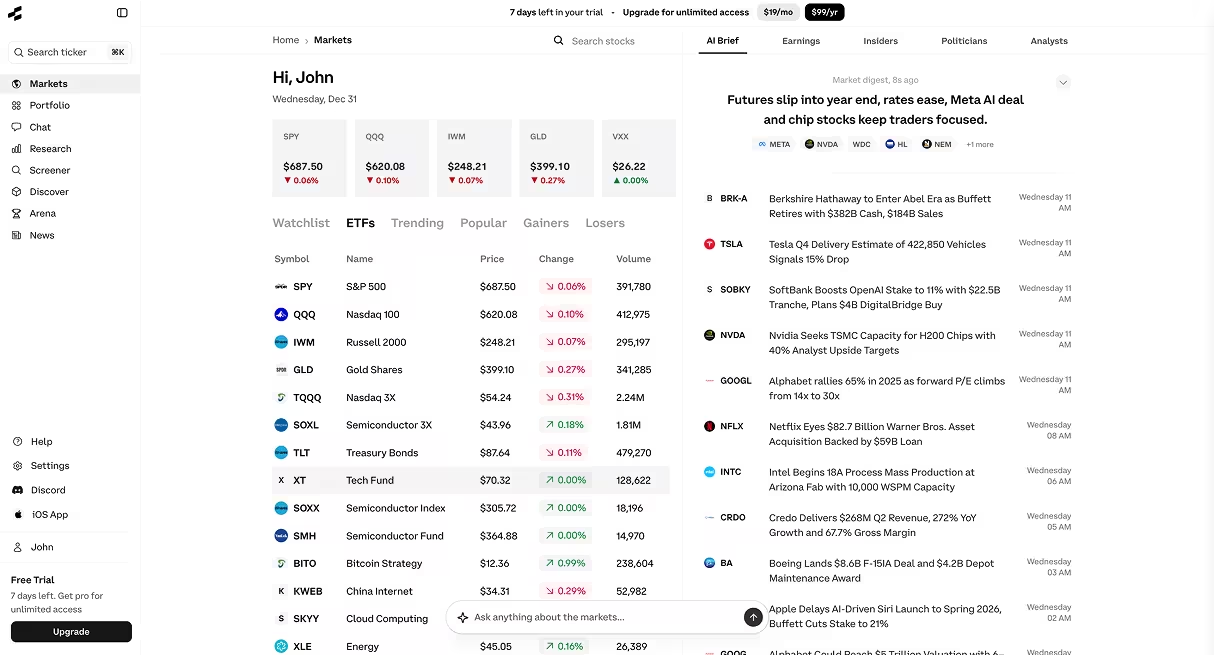
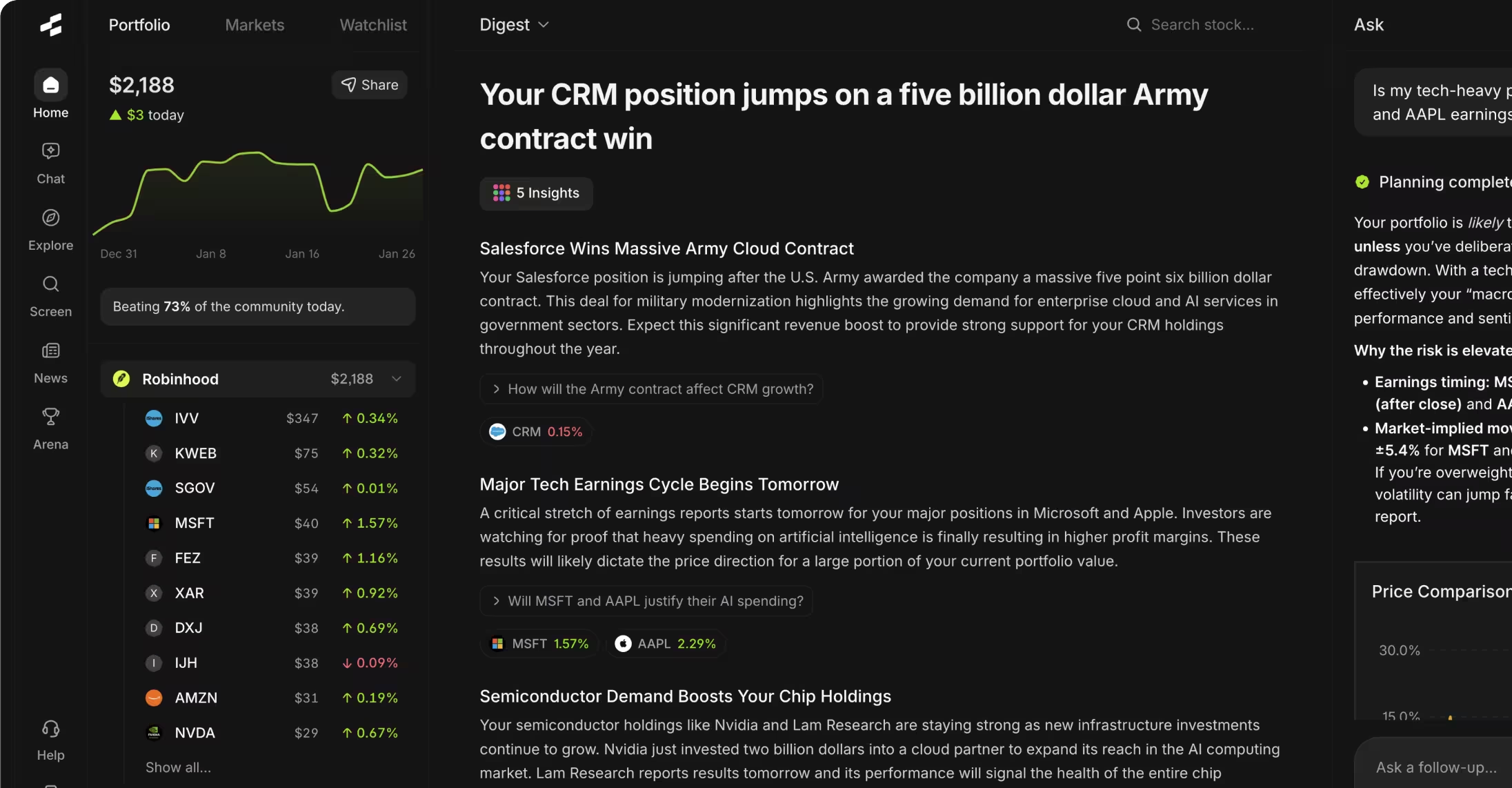
You can launch Deep Research mode from any stock page on Rallies.ai or by using the command in the AI Research Assistant. The feature is available to all registered users at no additional cost.
From a Stock Page
Navigate to any stock page (for example, https://rallies.ai/research/AAPL for Apple). Look for the "Deep Research" button in the top section, typically next to "Add to Watchlist" and "Set Alert." Click it, and the report begins generating immediately.
From the AI Research Assistant
Open the AI Research Assistant and type a command like "Run deep research on Tesla" or "Give me a deep research report for MSFT." The system recognizes the request and initiates the report generation.
From the Mobile App
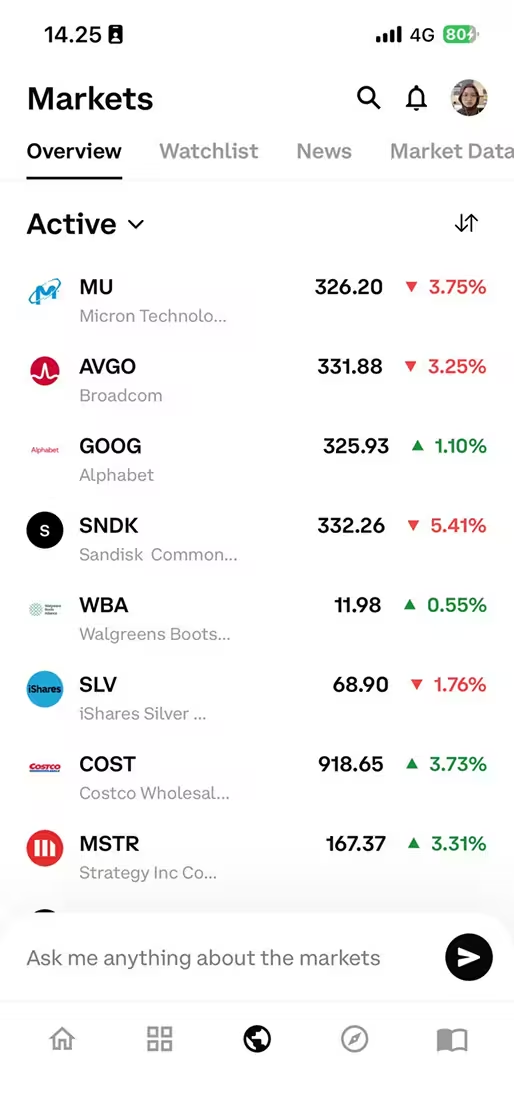
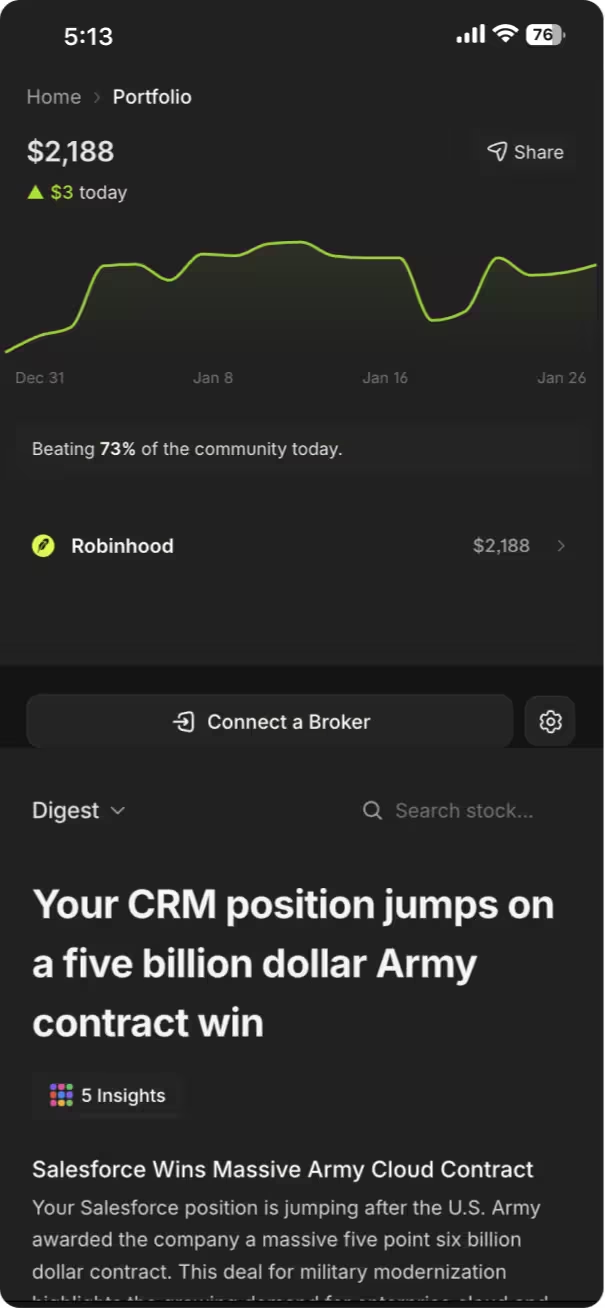
On the iOS app, tap any stock to open its detail page, then tap the "Deep Research" icon in the action bar. The report displays in a mobile-optimized format with collapsible sections.
Once generated, reports remain accessible in your research history. You can revisit previous Deep Research reports from your dashboard without regenerating them, though data won't update until you run a fresh report.
What's Included in a Deep Research Report
A standard Deep Research report contains 8-12 sections, each focusing on a specific aspect of the company's investment profile. The exact structure adapts based on data availability—for example, dividend analysis only appears for dividend-paying stocks.
Company Overview
This section summarizes what the company does, its business model, revenue sources, and market position. You'll see the company's stated mission, primary products or services, geographic breakdown of revenue, and key subsidiaries or brands.
Financial Performance
Here you get 5-year trends for revenue, net income, operating margin, and earnings per share. The report calculates year-over-year and compound annual growth rates, identifies inflection points (quarters where growth accelerated or decelerated), and compares current performance to historical averages.
Operating Margin: The percentage of revenue left after paying for variable costs of production and fixed operating expenses, but before interest and taxes. A company with $1 billion in revenue and $200 million in operating income has a 20% operating margin.
Balance Sheet Health
This section examines the company's financial stability through metrics like current ratio, debt-to-equity ratio, interest coverage ratio, and cash reserves. You'll see how much debt matures in the next 12 months versus available cash, which indicates short-term financial stress risk.
Valuation Metrics
The report calculates current P/E ratio, forward P/E based on analyst estimates, price-to-sales ratio, price-to-book ratio, and enterprise value to EBITDA. Each metric includes a comparison to the company's 5-year average, industry median, and sector median.
Profitability Analysis
Beyond basic profit margins, this section covers return on equity (ROE), return on assets (ROA), and return on invested capital (ROIC). These metrics reveal how efficiently the company converts shareholder equity, total assets, and invested capital into profits.
Cash Flow Assessment
You'll see operating cash flow, free cash flow, and capital expenditure trends. The report calculates free cash flow margin (free cash flow as a percentage of revenue) and shows whether the company generates enough cash to fund operations, pay dividends, and buy back shares without increasing debt.
Growth Drivers and Catalysts
This section identifies potential positive developments: new product launches mentioned in recent earnings calls, market expansion plans, analyst upgrades, margin improvement initiatives, or industry tailwinds. The AI pulls these from earnings transcripts, press releases, and analyst reports from the past 90 days.
Risk Factors
Deep Research summarizes material risks from the company's most recent 10-K filing, supplemented by recent news. You'll see regulatory risks, competitive threats, customer concentration issues, supply chain dependencies, and macroeconomic sensitivities the company has disclosed.
Competitive Positioning
The report compares the company to 3-5 direct competitors across key metrics: market share, revenue growth, profit margins, and valuation multiples. This helps you assess whether the company leads, lags, or sits in the middle of its competitive set.
Analyst Sentiment
You'll see consensus price targets, the distribution of buy/hold/sell ratings, and recent changes in analyst recommendations. The report notes when consensus estimates have moved up or down over the past quarter, which can signal improving or deteriorating expectations.
Deep Research vs. Basic AI Research Assistant
Rallies.ai offers two main research tools: the AI Research Assistant and Deep Research mode. They serve different purposes and work best for different types of questions.
FactorAI Research AssistantDeep Research ModePurposeAnswer specific questionsComprehensive stock evaluationScopeSingle data point or concept100+ metrics across multiple categoriesResponse Time2-5 seconds45-60 secondsFormatConversational answerStructured report with sectionsInteractionBack-and-forth dialogueSingle comprehensive outputBest ForQuick lookups, learning concepts, exploring ideasDue diligence, comparing investment candidates, deep dives
Use the AI Research Assistant when you have a specific question: "What's Microsoft's dividend yield?" or "How does Tesla's gross margin compare to Ford's?" It gives you a direct answer with context in seconds.
Use Deep Research mode when you're evaluating whether to add a stock to your portfolio, comparing multiple investment candidates, or conducting comprehensive due diligence. The structured format helps you work through a checklist of considerations systematically.
Many investors use both: they start with the AI Research Assistant to explore ideas and identify candidates, then run Deep Research on the 2-3 stocks that seem most promising after initial screening.
When to Use Deep Research Mode
Deep Research mode works best for fundamental analysis of established companies with public financial data. Specific scenarios where the tool adds the most value include pre-purchase due diligence, quarterly earnings review, portfolio rebalancing decisions, and comparing similar stocks.
Evaluating New Investment Ideas
When you've identified a stock through a stock screener, news article, or recommendation, Deep Research helps you verify whether the investment thesis holds up. The comprehensive report reveals financial trends, competitive positioning, and risks you might miss by looking at price charts alone.
Post-Earnings Analysis
After a company reports quarterly earnings, run an updated Deep Research report to see how the new data affects the overall picture. The report incorporates the latest quarter's results into trend calculations and updates year-over-year growth rates.
Portfolio Review
Every quarter or twice a year, generate fresh Deep Research reports for your holdings. This helps you spot deteriorating fundamentals early—declining margins, rising debt levels, weakening competitive position—before they significantly impact the stock price.
Comparing Multiple Stocks
When you're deciding between 2-3 similar stocks, run Deep Research on each and compare the reports side by side. The standardized format makes it easy to see which company has stronger revenue growth, better profitability, or more reasonable valuation.
Pre-Investment Deep Research Checklist
- ☐ Review 5-year revenue and earnings trends for consistency
- ☐ Check debt-to-equity ratio and interest coverage to assess financial stability
- ☐ Compare valuation metrics to 5-year average and industry peers
- ☐ Examine free cash flow trends to verify profit quality
- ☐ Read the risk factors section for material threats
- ☐ Verify that growth catalysts have specific timelines or milestones
- ☐ Check if insider ownership or recent buying/selling appears unusual
How to Interpret Deep Research Results
A Deep Research report presents data and analysis, but you need to interpret the findings based on your investment criteria, risk tolerance, and time horizon. The same report might look attractive to a value investor and unappealing to a growth investor.
Look for Trend Direction, Not Just Current Numbers
A company with a P/E ratio of 25 isn't inherently expensive or cheap without context. What matters more: Is the P/E rising or falling? Are earnings growing faster than the stock price (causing P/E to decline)? Has the company historically traded at P/E of 20-30 or 15-20?
Compare Metrics to Industry Norms
A 5% operating margin might be excellent for a grocery chain (where 2-3% is typical) but poor for a software company (where 20-30% is common). Deep Research provides industry comparisons for this reason—use them.
Cross-Check Financial Health and Valuation
A low P/E ratio sometimes signals a bargain, but it can also indicate financial distress or declining business prospects. If you see an unusually low valuation, check the balance sheet health and risk factors sections. High debt, declining revenue, or significant disclosed risks might explain the discount.
Assess Whether Growth Justifies Valuation
High-growth companies often trade at premium valuations. A software company growing revenue 30% annually might reasonably trade at a P/E of 40-50, while a utility growing 3% annually should trade closer to P/E of 15-18. Compare the growth rate to the valuation multiple.
Pay Attention to Cash Flow vs. Earnings
Net income can be manipulated through accounting choices, but cash flow is harder to distort. If a company reports growing earnings but declining or negative free cash flow, investigate further. The opposite—growing cash flow with flat earnings—often indicates conservative accounting and might be a positive sign.
Free Cash Flow: The cash a company generates after paying for capital expenditures needed to maintain or expand its asset base. Calculated as operating cash flow minus capital expenditures. Positive free cash flow means the company can pay dividends, reduce debt, or make acquisitions without raising external capital.
Don't Ignore the Risks Section
Every company discloses material risks in SEC filings, and Deep Research summarizes these. Take them seriously. If a company derives 40% of revenue from a single customer, or faces pending regulatory action, or depends on a patent expiring in two years, factor that into your decision.
Limitations and What Deep Research Can't Do
Deep Research mode has constraints you should understand before relying on its output for investment decisions. The tool excels at synthesizing public data but can't predict future events, assess qualitative factors like management quality, or make personalized recommendations.
What Deep Research Does Well
- Compiles financial data from SEC filings faster than manual research
- Calculates metrics consistently across different stocks for comparison
- Identifies disclosed risks from official company documents
- Presents data in standardized format regardless of company or industry
- Updates with latest quarterly data automatically
What Deep Research Can't Do
- Predict future stock price movements or returns
- Assess management quality, corporate culture, or execution capability
- Identify undisclosed risks or fraud
- Account for your specific financial situation, goals, or tax considerations
- Make buy/sell/hold recommendations tailored to your portfolio
Data Availability Constraints
Deep Research works best for publicly traded U.S. companies that file with the SEC. Coverage for international stocks, over-the-counter securities, and private companies is limited or unavailable. The tool requires at least 2-3 years of financial history to calculate meaningful trends, so it's less useful for recent IPOs or SPACs.
Backward-Looking Analysis
Financial statements and SEC filings report what already happened. A Deep Research report can tell you that revenue grew 15% last year, but it can't tell you whether that growth will continue, accelerate, or reverse. You need to combine the historical analysis with your own assessment of future prospects.
Can't Replace Professional Advice
Deep Research is an educational tool, not a substitute for personalized financial advice. The report doesn't know your risk tolerance, time horizon, tax situation, or overall financial plan. Before making investment decisions based on any research—AI-generated or otherwise—consult with a qualified financial advisor.
No Guarantee of Data Accuracy
While Rallies.ai sources data from official channels like SEC EDGAR, errors can occur during data extraction, calculation, or reporting. Always verify critical numbers against the original SEC filings before making significant investment decisions.
Frequently Asked Questions
1. How often does Deep Research mode update its data?
Deep Research pulls the latest available data each time you generate a report. For SEC filings, this means data updates within hours of a company filing its 10-Q or 10-K. Price data and analyst estimates update in real-time during market hours. If you generate a report today and again next week, you'll see any new filings or estimate changes reflected in the second report.
2. Can I export or save Deep Research reports?
Yes. Reports remain accessible in your research history on Rallies.ai, and you can revisit them anytime from your dashboard. You can also print reports to PDF using your browser's print function, which preserves the formatting and structure. The mobile app allows you to bookmark reports for quick access.
3. Does Deep Research work for stocks outside the United States?
Coverage currently focuses on U.S. publicly traded companies that file with the SEC. Some large international companies that trade on U.S. exchanges as ADRs (American Depositary Receipts) are supported if they file SEC reports. Native coverage for stocks trading exclusively on foreign exchanges is limited but expanding.
4. How does Deep Research mode differ from reading a 10-K myself?
A 10-K filing typically runs 100-200 pages and requires financial literacy to interpret. Deep Research extracts the key data points, calculates metrics like year-over-year growth and margin trends, compares results to industry benchmarks, and presents everything in a structured format. It's faster than manual analysis but lacks the complete detail you'd get from reading the full filing. Think of it as a starting point that tells you where to look deeper.
5. Can Deep Research identify stocks that are good buys?
No. Deep Research presents financial data and analysis but doesn't make buy/sell/hold recommendations. What constitutes a "good buy" depends on your investment strategy, risk tolerance, time horizon, and portfolio composition—factors the tool doesn't know. The report gives you information to make your own informed decision.
6. What should I do if Deep Research data conflicts with information I found elsewhere?
Verify against the original source—the company's SEC filings at sec.gov. Differences sometimes arise from timing (you might be comparing data from different quarters), calculation methods (some sources adjust for non-recurring items differently), or errors. When in doubt, the official SEC filing is the authoritative source.
7. Does Deep Research mode analyze technical indicators or chart patterns?
No. Deep Research focuses on fundamental analysis—financial statements, valuation metrics, business performance, and competitive positioning. It doesn't evaluate moving averages, RSI, support and resistance levels, or other technical analysis tools. For that type of analysis, you'd use different features on the platform or technical charting tools.
8. How many Deep Research reports can I generate?
All registered Rallies.ai users can generate Deep Research reports without a per-report limit. The feature is included in the standard platform access at no additional cost. You can run reports on as many stocks as you want to evaluate.
Conclusion
Deep Research mode on Rallies.ai automates the data gathering and initial analysis phases of stock research, condensing hours of manual work into a 60-second comprehensive report. The feature works best for fundamental analysis of established public companies, providing structured evaluation across financials, valuation, competitive position, and risks.
Use Deep Research as one input in your investment process, not the sole basis for decisions. Combine the quantitative analysis from the report with your own assessment of qualitative factors like management capability, industry dynamics, and future catalysts. Remember that all investments carry risk, and historical data doesn't guarantee future results. For personalized advice, consult with a qualified financial advisor who understands your complete financial situation.
Ready to try Deep Research? Pick a stock you're curious about and generate your first report on Rallies.ai.
Start researching smarter. Get Started with Rallies.ai →
References
- U.S. Securities and Exchange Commission. "Form 10-K." https://www.sec.gov/files/form10-k.pdf
- U.S. Securities and Exchange Commission. "Form 10-Q." https://www.sec.gov/files/form10-q.pdf
- Financial Industry Regulatory Authority. "Getting Started in Stocks." https://www.finra.org/investors/investing/investment-products/stocks
- CFA Institute. "Equity Valuation: A Survey of Professional Practice." https://www.cfainstitute.org/
- U.S. Securities and Exchange Commission. "Beginners' Guide to Financial Statements." https://www.sec.gov/reportspubs/investor-publications/investorpubsbegfinstmtguidehtm.html
Disclaimer: This article is for educational and informational purposes only. It does not constitute investment advice, financial advice, trading advice, or any other type of advice. Rallies.ai does not recommend that any security, portfolio of securities, transaction, or investment strategy is suitable for any specific person.
Risk Warning: All investments involve risk, including the possible loss of principal. Past performance does not guarantee future results. Before making any investment decision, you should consult with a qualified financial advisor and conduct your own research.
Written by: Gav Blaxberg
CEO of WOLF Financial | Co-Founder of Rallies.ai