


```html
Portfolio risk management is the systematic process of identifying, measuring, and controlling the potential for losses in your investment holdings through diversification, position sizing, and strategic asset allocation. Effective risk management balances the pursuit of returns with protection against significant drawdowns, using tools like stop-losses, portfolio rebalancing, and correlation analysis to maintain your desired risk-reward profile.
Key Takeaways
- Portfolio risk management combines diversification across 15-25 positions, position sizing limits of 5-10% per holding, and quarterly rebalancing to control downside exposure
- The three primary risk types—market risk, concentration risk, and liquidity risk—require different management approaches and monitoring frequencies
- A maximum portfolio drawdown target of 20-25% helps determine appropriate asset allocation between stocks, bonds, and cash based on your risk tolerance
- Correlation analysis prevents false diversification by ensuring holdings don't move in lockstep during market stress, aiming for correlation coefficients below 0.7
- Regular risk audits every 90 days help identify portfolio drift, sector overconcentration, and changes in individual position risk profiles
Table of Contents
- What Is Portfolio Risk Management?
- Types of Portfolio Risk You Need to Monitor
- How Do You Measure Portfolio Risk?
- Building Diversification That Actually Works
- Position Sizing Rules for Risk Control
- Asset Allocation as Risk Foundation
- When and How to Rebalance for Risk Management
- Using Stop-Losses and Exit Rules
- Understanding Correlation in Portfolio Construction
- Conducting Regular Risk Audits
- Common Portfolio Risk Management Mistakes
- Frequently Asked Questions
- Conclusion
What Is Portfolio Risk Management?
Portfolio risk management is the ongoing process of structuring and monitoring your investments to limit the probability and magnitude of losses while pursuing your return objectives. This involves quantifying how much you could lose in various scenarios, then applying specific techniques—diversification, position limits, hedging, and rebalancing—to keep potential losses within acceptable boundaries.
The goal isn't to eliminate risk entirely. That's impossible if you want meaningful returns. Instead, you're managing the trade-off between risk and return to match your financial situation, time horizon, and tolerance for volatility.
Risk-Adjusted Return: A measure of investment performance that accounts for the amount of risk taken to achieve those returns, typically expressed as ratios like Sharpe ratio or Sortino ratio. Higher risk-adjusted returns indicate more efficient use of risk.
Risk management operates at multiple levels. At the portfolio level, you're concerned with total volatility and maximum drawdown—how much your entire account could drop from peak to trough. At the position level, you're managing individual stock risk through sizing and diversification. At the strategy level, you're balancing growth investments against defensive holdings.
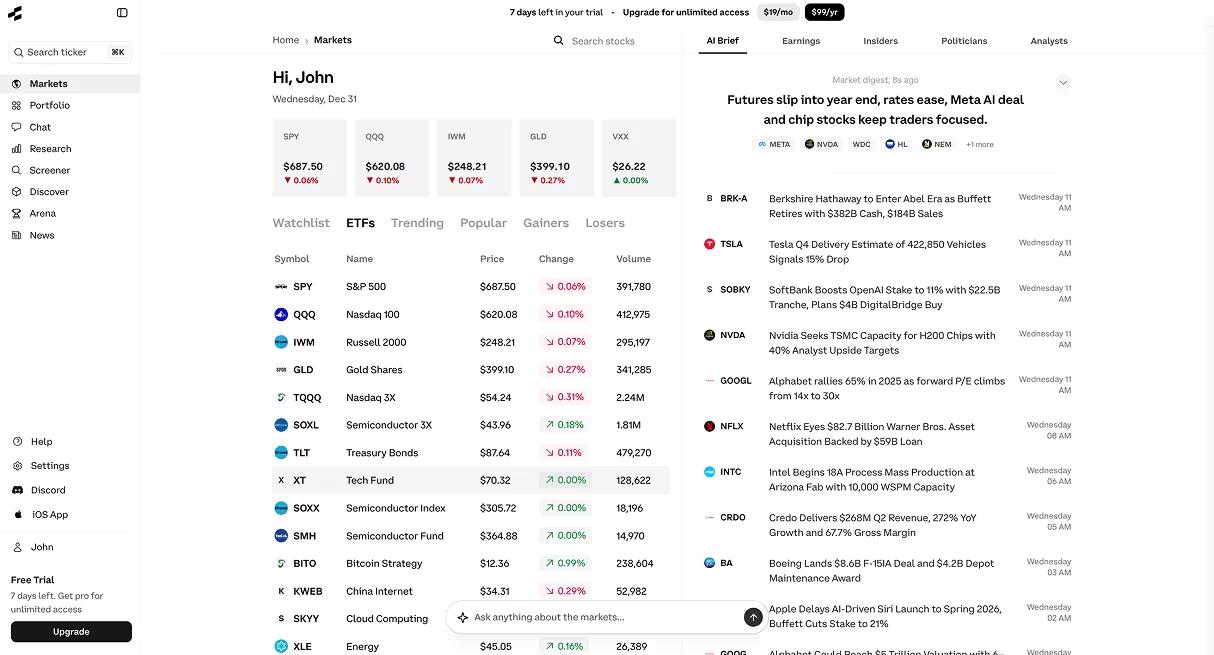
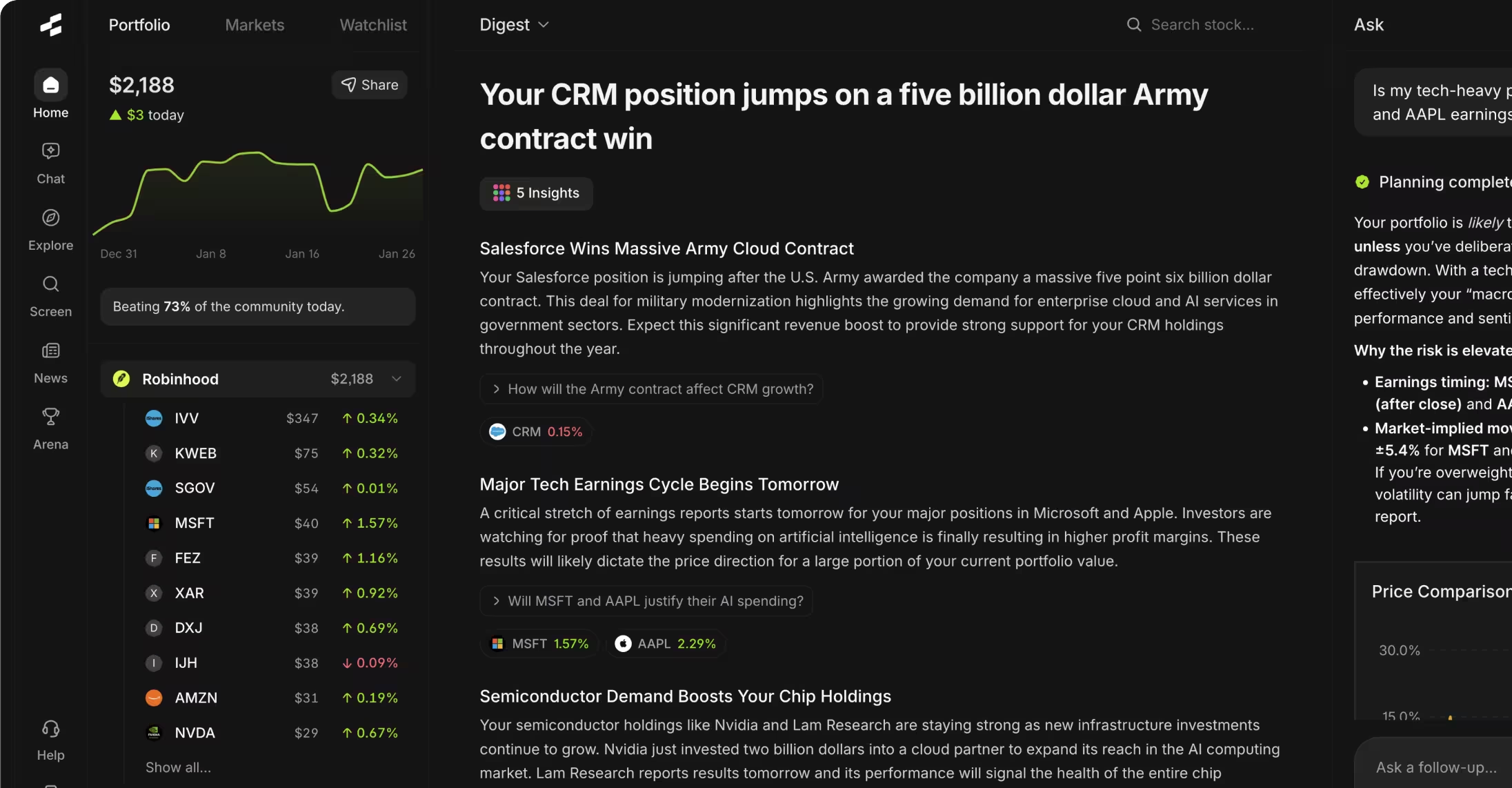
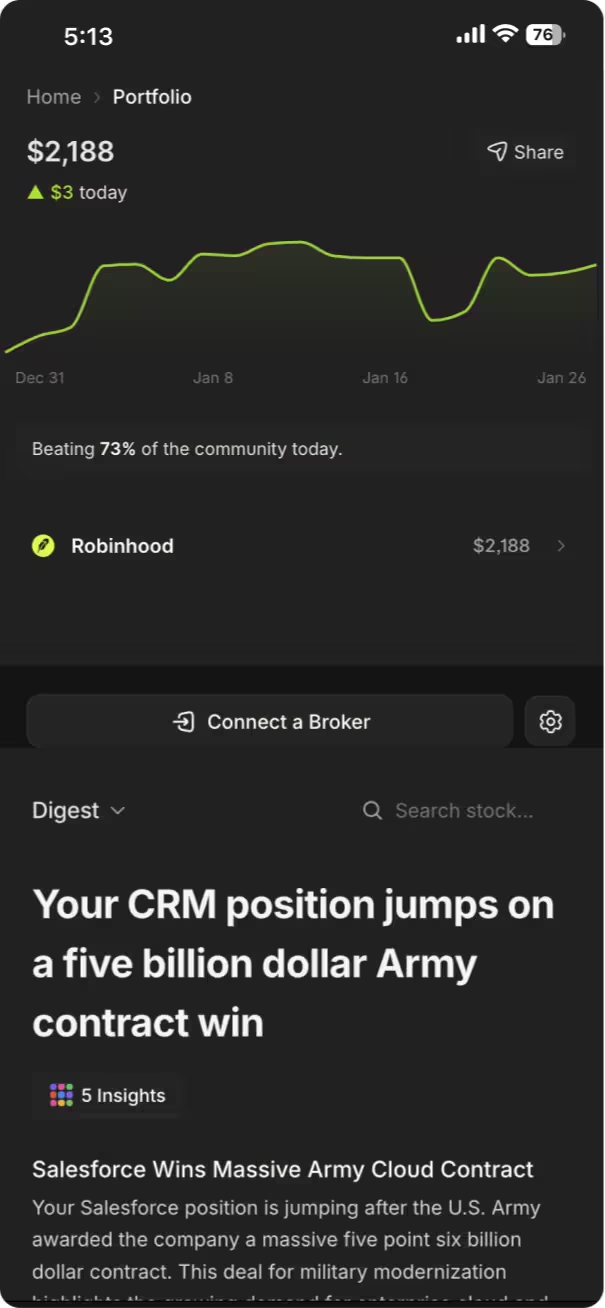
Tools like portfolio tracking software help visualize these risk dimensions by showing sector concentration, position weights, and correlation patterns across your holdings.
Types of Portfolio Risk You Need to Monitor
Portfolio risk comes in several distinct forms, each requiring different management approaches. Understanding these categories helps you identify where your exposures actually lie.
Market Risk (Systematic Risk)
Market risk is the possibility of losses due to broad market movements that affect nearly all stocks simultaneously. A market-wide decline of 20% will drag down most portfolios regardless of diversification. This risk can't be eliminated through stock selection—it's inherent to equity investing. Historical data shows the S&P 500 experiences corrections (10%+ declines) roughly every 18 months on average, with bear markets (20%+ declines) occurring about once every 4-5 years.
Concentration Risk (Unsystematic Risk)
Concentration risk arises when too much capital sits in a single position, sector, or asset class. If one stock represents 25% of your portfolio and drops 40%, your total account declines 10% from that position alone. This risk is manageable through diversification. Most advisors recommend limiting individual positions to 5-10% of portfolio value and capping sector exposure at 20-25%.
Liquidity Risk
Liquidity risk is the difficulty of converting a position to cash without significant price impact. Small-cap stocks, certain ETFs, and options on thinly traded securities present liquidity challenges. During market stress, bid-ask spreads widen and finding buyers becomes harder. A stock averaging 50,000 shares daily volume might be fine for a 100-share position but problematic for 5,000 shares.
Currency Risk
For portfolios holding international stocks or ADRs, currency fluctuations add another risk layer. A European stock might gain 10% in euros but deliver only 5% in dollars if the euro weakens. Some investors hedge this exposure; others accept it as part of international diversification.
Risk Type Can Be Diversified Away? Primary Management Tool Market Risk No Asset allocation, hedging Concentration Risk Yes Position sizing, diversification Liquidity Risk Partially Volume screening, position limits Currency Risk Partially Currency hedging, domestic focus
How Do You Measure Portfolio Risk?
Quantifying risk turns abstract concerns into concrete numbers you can monitor and manage. Several statistical measures help assess different dimensions of portfolio risk.
Standard Deviation and Volatility
Standard deviation measures how much returns fluctuate around the average. A portfolio with 15% annualized standard deviation typically sees returns vary within 15 percentage points of the mean about 68% of the time. Higher standard deviation means wider swings—more volatility. The S&P 500 historically shows roughly 18-20% annual standard deviation, though this varies by period.
Beta: A measure of a stock or portfolio's volatility relative to the broader market, where the market has a beta of 1.0. A beta of 1.3 means the investment is 30% more volatile than the market, while 0.7 indicates 30% less volatile.
Maximum Drawdown
Maximum drawdown tracks the largest peak-to-trough decline in portfolio value during a specific period. If your portfolio reached $100,000, then dropped to $75,000 before recovering, the maximum drawdown was 25%. This metric matters more than volatility for many investors because it represents real experienced losses. Conservative portfolios might target maximum drawdowns of 10-15%, while aggressive portfolios might tolerate 30-40%.
Value at Risk (VaR)
Value at Risk estimates the maximum expected loss over a given time frame at a specific confidence level. A one-day VaR of $5,000 at 95% confidence means there's a 5% chance of losing more than $5,000 in a single day. VaR helps quantify tail risk—those extreme scenarios that devastate portfolios. It has limitations (it doesn't specify how bad things get in that worst 5%), but provides a useful probabilistic framework.
Sharpe Ratio
The Sharpe ratio divides excess return (above the risk-free rate) by standard deviation, giving you return per unit of risk. A Sharpe ratio of 1.0 means you earned 1% of excess return for each 1% of volatility. Ratios above 1.0 are generally considered good; above 2.0 is excellent. This helps compare strategies with different risk profiles on an apples-to-apples basis.
The AI Research Assistant can calculate these metrics for specific stocks or help you understand the risk characteristics of companies you're researching.
Building Diversification That Actually Works
Diversification is the only free lunch in investing—it reduces risk without necessarily sacrificing returns. But diversification requires more thought than just buying lots of different stocks.
Research suggests most of the diversification benefit comes from the first 15-20 holdings. Beyond 30 positions, additional risk reduction becomes minimal while portfolio complexity increases. The key is ensuring those positions are actually different from each other in meaningful ways.
Sector Diversification
Owning 10 technology stocks isn't diversified—it's concentrated sector exposure with company-specific risk layered on top. Effective sector diversification spreads holdings across industries that behave differently during various economic conditions. A basic framework might allocate 10-20% to each of these sectors: technology, healthcare, financials, consumer discretionary, consumer staples, industrials, and energy/materials.
Market Cap Diversification
Large-cap stocks (above $10 billion market cap) behave differently than small-caps (below $2 billion). Large-caps offer stability and liquidity; small-caps provide growth potential and diversification from mega-cap performance. A balanced approach might be 60-70% large-cap, 20-30% mid-cap, and 10-20% small-cap, adjusted based on risk tolerance.
Geographic Diversification
U.S. stocks represent about 60% of global market capitalization, yet many investors hold 90%+ domestic positions. International diversification provides exposure to different economic cycles, currencies, and growth opportunities. A 20-30% international allocation is common, though some advisors suggest matching global market cap weights more closely.
Asset Class Diversification
Stocks, bonds, real estate, and cash each serve different roles. Bonds provide stability and income, typically moving inversely to stocks during risk-off periods. A traditional 60/40 stock-bond allocation historically provided 8-9% annual returns with 20-25% drawdowns during major bear markets. More aggressive portfolios might go 80/20 or 90/10; conservative portfolios 40/60 or lower.
Tools like the Vibe Screener help identify stocks across different sectors and market caps to build properly diversified positions.
Position Sizing Rules for Risk Control
Position sizing determines how much capital you allocate to each investment. This is where theory meets execution—get sizing wrong and even great stock picks won't save your portfolio.
A common framework is the 5% rule: no single position should exceed 5% of portfolio value at purchase. This means if you have $100,000, you'd buy no more than $5,000 of any one stock. Some investors use 10% for high-conviction positions, but this increases concentration risk substantially.
Equal Weighting vs. Conviction Weighting
Equal weighting means every position gets the same allocation—if you hold 20 stocks, each starts at 5% of the portfolio. This approach is simple and prevents overconfidence from concentrating capital poorly. Conviction weighting allocates more to your highest-confidence ideas—maybe 8-10% to top picks and 2-4% to speculative positions. Research shows equal weighting often outperforms conviction weighting because investors tend to be overconfident about their best ideas.
Risk-Based Position Sizing
This approach sizes positions based on the individual stock's volatility. A stable utility stock might warrant a 7% position while a volatile biotech gets 3%, keeping the dollar risk roughly equal. This requires calculating or estimating each stock's standard deviation and adjusting share counts accordingly.
The Kelly Criterion
The Kelly Criterion is a mathematical formula that calculates optimal bet size based on win probability and payoff ratios. It's aggressive—following it strictly often recommends uncomfortably large positions. Most practitioners use "half Kelly" or "quarter Kelly" as a more conservative approach. The formula is: f = (bp - q) / b, where f is the fraction to bet, b is the odds received, p is probability of winning, and q is probability of losing.
Position Sizing Checklist
- ☐ No position exceeds 10% at purchase
- ☐ Core holdings are 5-8% each
- ☐ Speculative positions are 2-3% maximum
- ☐ Total sector exposure under 25%
- ☐ Top 5 positions represent less than 40% combined
- ☐ Position sizes adjusted for individual stock volatility
Asset Allocation as Risk Foundation
Asset allocation—the split between stocks, bonds, and other assets—determines roughly 90% of portfolio volatility according to landmark research. Get this wrong and clever stock picking won't save you.
The traditional formula is to subtract your age from 110 or 120 to get your stock allocation percentage. A 40-year-old might hold 70-80% stocks (110-120 minus 40), with the remainder in bonds. This rule has merit but ignores individual circumstances like risk tolerance, income stability, and investment experience.
Risk Tolerance Assessment
Your risk tolerance has two components: risk capacity (how much loss you can afford financially) and risk appetite (how much volatility you can stomach emotionally). Someone with a stable job, minimal debt, and 20+ years until retirement has high risk capacity. But if a 20% portfolio decline would cause panic selling, their risk appetite is lower. Asset allocation should respect both constraints.
Aggressive Allocation (80-100% Stocks)
Appropriate for investors with 15+ year time horizons, high risk tolerance, and stable income. Historical data shows this approach delivered 9-10% annualized returns over long periods, but with maximum drawdowns of 50%+ during major bear markets like 2008. You need emotional fortitude to hold through multi-year declines.
Moderate Allocation (60-80% Stocks)
The most common allocation for investors 10-20 years from retirement. A 70/30 stock-bond split historically returned 8-9% annually with maximum drawdowns around 30-35%. This provides growth potential while buffering against extreme volatility.
Conservative Allocation (40-60% Stocks)
Suited for investors within 5-10 years of needing their capital or with low risk tolerance. A 50/50 split typically delivers 6-7% annual returns with drawdowns limited to 20-25%. The trade-off is lower long-term wealth accumulation in exchange for stability.
Allocation Historical Return Max Drawdown Best For 90/10 Stock/Bond 9-10% 45-50% 20+ year horizon, high risk tolerance 70/30 Stock/Bond 8-9% 30-35% 10-20 year horizon, moderate tolerance 50/50 Stock/Bond 6-7% 20-25% 5-10 year horizon, lower tolerance 30/70 Stock/Bond 5-6% 12-15% Near retirement, capital preservation
For more context on building an overall portfolio management approach, consider how asset allocation fits within your broader investment strategy.
When and How to Rebalance for Risk Management
Rebalancing is the process of selling outperformers and buying underperformers to return your portfolio to target allocations. This forces you to sell high and buy low, though it feels counterintuitive in the moment.
Without rebalancing, a portfolio that starts 70/30 stocks/bonds can drift to 85/15 after a strong bull market, taking on far more risk than intended. If the market then crashes, you experience larger losses than your plan anticipated.
Calendar Rebalancing
This approach rebalances on a fixed schedule—quarterly, semi-annually, or annually. Annual rebalancing is most common because it balances risk control with tax efficiency and trading costs. More frequent rebalancing might generate better risk control but incurs higher transaction costs and potential tax bills. Research suggests annual rebalancing captures most of the benefit without excessive trading.
Threshold Rebalancing
Threshold rebalancing triggers when allocations drift beyond specified limits. A common threshold is 5 percentage points—if your target is 70% stocks and actual allocation hits 75% or 65%, you rebalance. This method responds to market volatility rather than arbitrary calendar dates, though it requires ongoing monitoring.
Hybrid Approach
Many investors combine methods: check allocations quarterly, but only rebalance if drift exceeds 5 percentage points. This prevents excessive trading while ensuring timely risk control.
Tax Considerations in Taxable Accounts
Rebalancing in taxable accounts can trigger capital gains taxes. Strategies to minimize this include: using new contributions to buy underweighted assets rather than selling overweighted ones; harvesting losses to offset gains; and rebalancing more aggressively in tax-advantaged accounts (IRAs, 401(k)s) where transactions don't create tax events.
Portfolio Drift: The gradual shift in asset allocation percentages caused by different returns across holdings. A position bought at 5% might grow to 12% through appreciation, creating unintended concentration risk.
Using Stop-Losses and Exit Rules
Stop-losses are predetermined exit points that force you to sell when a position declines to a specific price. They prevent small losses from becoming catastrophic ones by removing emotion from the exit decision.
A common approach is the 20% stop-loss: if a stock drops 20% from your purchase price, you sell automatically. The logic is that 20% losses are recoverable with 25% gains, but 50% losses require 100% gains to break even. This rule isn't magic—it's a risk management tool that caps individual position damage.
Fixed Percentage Stops
Fixed percentage stops exit at a predetermined loss level—15%, 20%, or 25% are common. The tighter the stop (15%), the more often you'll get stopped out, potentially missing recoveries. Wider stops (25%) give positions more room but allow larger losses. Your choice depends on typical stock volatility—tech stocks might need wider stops than utilities.
Trailing Stops
Trailing stops move up with price but never down. If you buy at $50 with a 20% trailing stop, your initial stop is $40. If the stock rises to $60, your stop moves to $48 (20% below $60). This locks in gains while giving upside room. The drawback is that volatile stocks might trigger trailing stops during normal fluctuations.
Volatility-Adjusted Stops
This approach sets stops based on the stock's Average True Range (ATR) or standard deviation rather than fixed percentages. A stock with 3% daily ATR might get a stop 2x ATR away (6%), while a stable stock with 1% ATR gets a 2% stop. This customizes stop distance to the stock's actual behavior patterns.
Fundamental vs. Technical Stops
Technical stops trigger based on price action. Fundamental stops trigger when the investment thesis breaks—the company loses a major contract, earnings miss significantly, or debt levels spike. Many investors use both: technical stops for risk control and fundamental stops for thesis invalidation.
Advantages of Stop-Losses
- Cap maximum loss on individual positions
- Remove emotion from exit decisions
- Force discipline in risk management
- Protect capital during portfolio-wide stress
Limitations of Stop-Losses
- Can trigger during temporary volatility
- Don't protect in gap-down scenarios
- Generate tax events in taxable accounts
- Might sell before recovery in quality companies
Understanding Correlation in Portfolio Construction
Correlation measures how two investments move relative to each other, ranging from +1.0 (perfect lockstep) to -1.0 (perfect opposite movement). A correlation of 0 means no relationship. This metric reveals whether your diversification is real or illusory.
During the 2008 financial crisis, many "diversified" portfolios crashed together because holdings were more correlated than investors realized. Stocks that seemed different during calm markets moved in tandem during stress. Correlation analysis helps prevent this false diversification.
Correlation Targets
For effective diversification, seek holdings with correlations below 0.7. Lower is better—correlations of 0.3-0.5 provide meaningful diversification. Negative correlations are rare among stocks but exist between certain asset classes (stocks and bonds historically showed near-zero or slightly negative correlation, though this relationship has shifted recently).
Within-Portfolio Correlations
Check correlations between your holdings, not just against a benchmark. If your top five positions all have 0.85+ correlations with each other, you have concentration risk despite holding five different stocks. Technology stocks often show high correlations; adding more tech names doesn't diversify much.
Rolling Correlations
Correlations aren't static—they change over time and spike during market stress. Rolling correlation analysis calculates correlations over moving time windows (like 90 days) to reveal how relationships evolve. Two stocks might show 0.4 correlation during normal markets but 0.9 during crashes, limiting diversification benefit precisely when you need it.
Practical Application
When adding a new position, check its correlation to existing holdings. If it's highly correlated to multiple current positions, you're adding little diversification benefit. Look for additions that provide exposure to different factors—growth vs. value, cyclical vs. defensive, domestic vs. international.
Research tools like the AI Research Assistant can help analyze correlation patterns and identify stocks that provide genuine diversification to your existing holdings.
Conducting Regular Risk Audits
Risk audits are systematic reviews of your portfolio's risk exposure, conducted quarterly or after significant market moves. These audits identify problems before they become disasters.
Position-Level Review
Check each holding for: position size as percentage of portfolio, performance since purchase, changes to investment thesis, and current volatility. Flag any position exceeding 10% for potential trimming. Review positions down more than 25% to determine if the thesis is intact or you're holding a losing position out of hope.
Sector Concentration Analysis
Calculate your exposure to each sector. Technology might seem diversified across five stocks until you realize it represents 40% of your portfolio. Compare your sector weights to benchmark indices (like S&P 500 sector weights) to understand your tilts. Overweights aren't necessarily wrong, but they should be intentional.
Correlation Matrix
Generate a correlation matrix showing relationships between all holdings. Look for clusters of high correlation—these represent hidden concentration risks. If six holdings all correlate above 0.75, they're essentially one large position from a risk perspective.
Stress Testing
Model your portfolio's response to various scenarios: a 20% market drop, a sector-specific crash, or interest rate spikes. How much would each scenario cost you? If potential losses exceed your tolerance, adjust allocations or add hedges. Historical scenarios (2008 financial crisis, 2020 COVID crash, 2022 bear market) provide realistic test cases.
Metrics to Track
Calculate and record these metrics quarterly: portfolio beta, standard deviation, Sharpe ratio, maximum drawdown year-to-date, largest position size, top 5 concentration percentage, and sector allocations. Tracking over time reveals trends—if beta creeps from 1.0 to 1.3, you're taking more market risk than you might realize.
Quarterly Risk Audit Checklist
- ☐ Review position sizes—flag any over 10%
- ☐ Calculate sector allocations—cap at 25% per sector
- ☐ Check portfolio beta and standard deviation
- ☐ Analyze top 5 concentration—should be under 40%
- ☐ Review correlation matrix for hidden concentration
- ☐ Assess year-to-date drawdown vs. target
- ☐ Stress test against 20% market decline scenario
- ☐ Document any thesis changes in holdings
Common Portfolio Risk Management Mistakes
Even experienced investors fall into predictable risk management traps. Recognizing these patterns helps you avoid them.
Overdiversification
Holding 50+ positions doesn't improve risk-adjusted returns and creates a tracking problem. You can't monitor that many companies effectively. Research shows marginal diversification benefit drops sharply beyond 20-25 holdings. Overdiversification often results from inability to sell—you keep adding without trimming losers or low-conviction positions.
False Diversification
Owning 15 technology stocks across different subsectors (software, semiconductors, hardware) feels diversified but isn't. These stocks correlate heavily and all suffer during tech selloffs. True diversification requires exposure to genuinely different factors and economic drivers.
Ignoring Correlation Changes
Correlations spike during market stress. Stocks that moved independently during bull markets often crash together. A portfolio with 0.4 average correlations in normal times might see correlations jump to 0.8+ during a crisis, eliminating diversification precisely when needed. Account for this in stress testing.
Setting and Forgetting
Risk management requires ongoing attention. A well-constructed portfolio today becomes risky tomorrow as positions grow, sectors shift, and correlations change. Investors who rebalance annually show better risk-adjusted returns than those who never rebalance.
Emotional Stop-Loss Overrides
You set a 20% stop-loss, but when the stock hits it, you convince yourself to hold "just a little longer" for the recovery. This defeats the purpose. Either honor your stops or don't use them. Inconsistent execution creates worse outcomes than having no stops at all.
Excessive Trading in Response to Volatility
Market volatility spikes, you panic, and you overhaul your portfolio—tightening stops, selling positions, moving to cash. This often locks in losses right before recoveries. Risk management is proactive (building robust portfolios before stress) not reactive (panicking during stress).
Confusing Volatility with Risk
High volatility isn't necessarily high risk if you have a long time horizon. A stock fluctuating 30% annually but trending up over decades might be less risky than a stable-looking stock slowly eroding value. Permanent loss of capital is risk; temporary fluctuation is volatility.
Frequently Asked Questions
1. What percentage of my portfolio should be in cash for risk management?
Cash allocations typically range from 0-20% depending on your situation and market outlook. Aggressive investors might hold minimal cash (0-5%) to stay fully invested for long-term growth. Moderate investors often maintain 5-10% cash for rebalancing opportunities and psychological comfort. Conservative or near-retirement investors might hold 15-20% cash for stability and income needs. Some investors raise cash when valuations seem stretched, though timing markets consistently is difficult. A 5-10% cash position provides flexibility without significantly dragging on long-term returns.
2. How do I calculate the right position size for a specific stock?
Start with a maximum position size rule—commonly 5% for most holdings and 10% for high-conviction positions. Calculate dollar amount by multiplying your portfolio value by this percentage (5% of $100,000 = $5,000 maximum). For risk-based sizing, adjust for the stock's volatility—reduce position size for higher-beta or more volatile stocks. A stock with beta of 1.5 might warrant a 3-4% position while a 0.8 beta stock could be 6-7%. Always consider sector concentration too—even if a single stock position is 5%, adding another in the same sector compounds risk.
3. Should I use stop-losses in retirement accounts versus taxable accounts?
Stop-losses make more sense in retirement accounts because they don't trigger tax consequences when executed. In taxable accounts, stop-losses create capital gains or losses that affect your tax bill. For taxable accounts, consider wider stops or fundamental stops based on thesis changes rather than tight technical stops. Some investors use mental stops in taxable accounts—they monitor prices and make manual selling decisions when thresholds are hit, giving flexibility to harvest losses strategically or delay gains. In retirement accounts, you can implement mechanical stop-losses without tax considerations complicating the decision.
4. How often should correlation analysis be performed?
Review correlations quarterly during your regular portfolio audit, and again after significant market events or when adding new positions. Before buying a new stock, check its correlation to existing holdings to ensure you're adding real diversification. After major market moves (20%+ swings), correlations often shift, so an additional check helps identify if your diversification is holding up under stress. Use 90-day rolling correlations to capture recent relationships rather than long-term historical data that might not reflect current dynamics. Annual correlation reviews are minimum; quarterly is better for active portfolios.
5. What's the difference between rebalancing and tax-loss harvesting?
Rebalancing means returning your portfolio to target allocations by selling outperformers and buying underperformers, regardless of tax implications. The goal is risk management and maintaining your desired asset mix. Tax-loss harvesting involves selling positions at a loss to offset capital gains or reduce taxable income (up to $3,000 annually against ordinary income). You typically reinvest proceeds in similar but not identical securities to maintain exposure while capturing the tax benefit. These strategies can work together—you might harvest losses opportunistically throughout the year and then rebalance systematically at year-end, using any additional harvesting opportunities that arise during rebalancing.
6. How much portfolio drawdown should I expect in a typical bear market?
Expected drawdowns depend heavily on your stock-bond allocation. An 80-100% stock portfolio historically experiences 30-50% drawdowns during major bear markets like 2008 (peak losses of 55% in the S&P 500) or 2000-2002 (49% decline). A balanced 60/40 stock-bond portfolio typically sees 20-30% maximum drawdowns. Conservative 40/60 portfolios might decline 15-20%. These are worst-case scenarios during severe bear markets; typical corrections of 10-15% occur much more frequently, roughly every 1-2 years. Your asset allocation should align with the maximum drawdown you can tolerate emotionally and financially.
7. Is a 20% stop-loss rule too tight for volatile growth stocks?
Yes, 20% stops often trigger prematurely on high-volatility growth stocks that routinely fluctuate 25-40% during normal market conditions. For growth stocks with high beta or wide trading ranges, consider 25-30% stops or volatility-adjusted stops based on Average True Range. Alternatively, use fundamental stops rather than technical ones—exit when the growth story breaks (missed earnings, competitive threats, management changes) rather than on price action alone. Another approach is position sizing—if you're worried about volatility, take a smaller position (3% instead of 5%) rather than using tight stops that might cut off winners before they develop.
8. Should sector allocation match market benchmarks or can I overweight certain sectors?
You can deliberately overweight sectors based on your research and outlook, but understand you're making an active bet that increases concentration risk. If you overweight technology at 35% versus the S&P 500's 28%, you'll outperform if tech does well and underperform if it struggles. Many investors maintain core positions roughly matching benchmark weights (within 5 percentage points) and use a smaller "satellite" portion for sector tilts. A reasonable framework is keeping sector allocations within 10 percentage points of the benchmark unless you have high conviction and risk tolerance. Always cap any single sector at 30-35% maximum to prevent excessive concentration.
Conclusion
Portfolio risk management combines multiple techniques—diversification across 15-25 positions, position sizing limits of 5-10%, quarterly rebalancing, and systematic risk monitoring—to control downside exposure while pursuing returns. The goal isn't eliminating risk, which would eliminate returns, but matching risk to your financial situation and emotional tolerance.
Effective risk management is proactive, built into your portfolio from the start through proper asset allocation and position sizing. Conduct quarterly risk audits to check sector concentration, correlation patterns, and position drift. Use stress testing to model portfolio responses to various scenarios, ensuring potential losses stay within acceptable bounds.
Start by defining your maximum acceptable drawdown, then work backward to determine appropriate asset allocation and position sizing rules. Track your key risk metrics over time and adjust as your situation changes. For deeper context on integrating these risk management techniques into your overall approach, review our complete portfolio management guide.
Want to analyze the risk characteristics of specific stocks? Ask the AI Research Assistant about beta, volatility, and correlation patterns, or use the portfolio tracker to monitor your risk metrics in real-time.
References
- Brinson, Gary P., L. Randolph Hood, and Gilbert L. Beebower. "Determinants of Portfolio Performance." Financial Analysts Journal, 1986. CFA Institute
- Markowitz, Harry. "Portfolio Selection." The Journal of Finance, 1952. JSTOR
- U.S. Securities and Exchange Commission. "Beginners' Guide to Asset Allocation, Diversification, and Rebalancing." sec.gov
- Dimensional Fund Advisors. "The Diversification Return." 2023. dimensional.com
- Vanguard. "Best practices for portfolio rebalancing." Vanguard Research, 2022. institutional.vanguard.com
- Financial Industry Regulatory Authority (FINRA). "Risk Management and Portfolio Construction." finra.org
Disclaimer: This article is for educational and informational purposes only. It does not constitute investment advice, financial advice, trading advice, or any other type of advice. Rallies.ai does not recommend that any security, portfolio of securities, transaction, or investment strategy is suitable for any specific person.
Risk Warning: All investments involve risk, including the possible loss of principal. Past performance does not guarantee future results. Before making any investment decision, you should consult with a qualified financial advisor and conduct your own research.
Written by: Gav Blaxberg
CEO of WOLF Financial | Co-Founder of Rallies.ai
```