


Portfolio management is the systematic process of selecting, monitoring, and adjusting a collection of investments to meet specific financial goals while managing risk. Effective portfolio management involves determining appropriate asset allocation, diversifying holdings across securities and sectors, regularly rebalancing to maintain target weightings, and continuously evaluating performance against relevant benchmarks. This disciplined approach helps investors balance their desired returns with acceptable risk levels over time.
Key Takeaways
- Portfolio management combines asset allocation, diversification, and rebalancing to align investments with your financial goals and risk tolerance
- Asset allocation—how you divide investments across stocks, bonds, and other assets—typically accounts for 90% of portfolio performance variability according to research
- Diversification reduces unsystematic risk by spreading investments across 20-30 different securities, multiple sectors, and various asset classes
- Rebalancing your portfolio annually or when allocations drift 5% or more from targets helps maintain your intended risk level
- Performance tracking should compare your returns to appropriate benchmarks like the S&P 500 for U.S. stocks or a 60/40 stock-bond blend for balanced portfolios
- Regular portfolio reviews every 3-6 months help you adjust strategy as your financial situation, goals, or market conditions change
Table of Contents
- What Is Portfolio Management?
- Building Your First Portfolio
- Diversification Strategies
- Asset Allocation Approaches
- Rebalancing Your Portfolio
- Risk Management Techniques
- Tracking Portfolio Performance
- When to Adjust Your Strategy
- Frequently Asked Questions
- Conclusion
What Is Portfolio Management?
Portfolio management is the ongoing process of constructing, monitoring, and adjusting a collection of investments to achieve specific financial objectives. Rather than picking individual stocks in isolation, portfolio management takes a holistic view of how different investments work together to generate returns while controlling risk.
The practice involves several interconnected activities: determining appropriate asset allocation across different investment types, selecting specific securities within each asset class, monitoring performance against benchmarks, and adjusting holdings as market conditions or personal circumstances change. Professional portfolio managers and individual investors both apply these principles, though with varying levels of complexity and resources.
Portfolio: A collection of financial investments like stocks, bonds, mutual funds, ETFs, and other securities held by an investor or institution. The portfolio represents your complete investment holdings rather than individual positions.
Portfolio management differs from simply buying stocks or funds in its systematic approach. You establish target allocations—perhaps 70% stocks and 30% bonds—based on your risk tolerance and time horizon. You diversify within each category to reduce concentration risk. You monitor whether your actual allocations drift from targets and make adjustments accordingly.
This disciplined framework helps investors avoid common behavioral mistakes like chasing recent winners or panic-selling during downturns. By following a predetermined strategy, you make decisions based on your long-term goals rather than short-term market movements.
Active vs. Passive Management Approaches
Portfolio management splits into two broad philosophies. Active management involves frequent trading and security selection in an attempt to beat market benchmarks. Active managers research companies, analyze economic trends, and make timing decisions about when to buy or sell.
Passive management aims to match market returns by holding broad index funds with minimal trading. Instead of trying to outperform, passive investors accept market returns while minimizing costs and taxes. Research by S&P Dow Jones Indices shows that over 15-year periods, more than 85% of actively managed U.S. equity funds underperform their benchmark indexes after fees.
Most individual investors benefit from a primarily passive approach using low-cost index funds for core holdings, with active decisions limited to asset allocation and rebalancing timing. This hybrid approach captures market returns while maintaining control over risk levels and tax efficiency.
Building Your First Portfolio
Starting your first investment portfolio requires answering three questions: how much can you invest, what timeline you're working with, and how much volatility you can tolerate. These factors determine the appropriate mix of stocks, bonds, and other assets for your situation.
Begin by establishing an emergency fund with 3-6 months of expenses in a savings account before investing. Investment accounts should hold money you won't need for at least 3-5 years, since short-term market fluctuations can temporarily reduce your balance. Money needed within 2-3 years belongs in cash or short-term bonds, not stocks.
Determining Your Risk Tolerance
Risk tolerance combines your emotional capacity to handle losses with your financial ability to recover from them. A common rule suggests subtracting your age from 110 to estimate your stock allocation percentage—a 30-year-old might hold 80% stocks and 20% bonds, while a 60-year-old might prefer 50% stocks and 50% bonds.
Test your actual risk tolerance by considering how you'd react if your portfolio dropped 30% in a year. Could you avoid selling and wait for recovery? If that scenario causes significant stress, you need a more conservative allocation with higher bond percentages, regardless of what formulas suggest.
Choosing Account Types
Your first decision is between taxable brokerage accounts and tax-advantaged retirement accounts. For retirement savings, prioritize accounts in this order: 401(k) up to employer match, Roth IRA up to the annual limit ($6,500 for 2024, or $7,500 if 50+), then additional 401(k) contributions up to the $23,000 limit.
Roth IRAs offer tax-free growth and withdrawals in retirement, making them ideal for younger investors in lower tax brackets. Traditional 401(k) and IRA contributions reduce current taxable income but create tax bills on withdrawals. Taxable brokerage accounts offer complete flexibility without contribution limits or early withdrawal penalties.
Selecting Initial Investments
New investors should start with broad market index funds or ETFs rather than individual stocks. A simple three-fund portfolio covers your needs: a U.S. total stock market fund (like VTI or FSKAX), an international stock fund (like VXUS or FTIHX), and a total bond market fund (like BND or FXNAX).
A conservative allocation might split 42% U.S. stocks, 18% international stocks, and 40% bonds. A moderate portfolio could use 54% U.S. stocks, 26% international stocks, and 20% bonds. Aggressive young investors might go 63% U.S. stocks, 27% international stocks, and 10% bonds. These percentages should add to 100% and reflect your personal risk tolerance.
Target-date funds offer an even simpler option by automatically adjusting from stocks to bonds as you approach retirement. A 2060 target-date fund starts with roughly 90% stocks and gradually shifts to 50% stocks by 2060. You pick the fund closest to your expected retirement year and own just that single fund.
Diversification Strategies
Diversification means spreading investments across different securities, sectors, and asset classes to reduce the impact of any single investment's poor performance on your overall portfolio. Research shows that holding 20-30 different stocks eliminates most unsystematic risk—the risk specific to individual companies—while maintaining exposure to systematic market risk.
The goal isn't to maximize returns but to achieve your target returns with less volatility. A portfolio of 50 technology stocks isn't diversified, even though it holds many positions. True diversification requires exposure to different types of investments that don't all move in the same direction at the same time.
Correlation: A statistical measure of how two investments move in relation to each other, ranging from -1 (perfect opposite movement) to +1 (perfect identical movement). Effective diversification combines assets with low or negative correlations.
Diversifying Across Asset Classes
The most important diversification happens at the asset class level. Stocks, bonds, real estate, and commodities behave differently across economic cycles. When stocks fall during recessions, high-quality bonds often rise as investors seek safety. Real estate investment trusts (REITs) correlate with stocks but also generate income from property rent.
A classic 60/40 portfolio—60% stocks and 40% bonds—demonstrates asset class diversification. From 1926 to 2022, this allocation returned 9.1% annually with a worst single-year loss of 22.5%, compared to 10.3% returns and 43.1% worst loss for 100% stocks. You gave up 1.2% annual return to cut your worst-case loss nearly in half.
Sector and Industry Allocation
Within stocks, sector allocation spreads risk across different parts of the economy. The S&P 500 divides into 11 sectors: technology, healthcare, financials, consumer discretionary, industrials, communication services, consumer staples, energy, utilities, real estate, and materials.
Technology currently represents about 28% of the S&P 500, making it the largest sector. If you hold only a total market fund, you're already diversified across all sectors in proportion to their market weights. Some investors adjust these weightings based on economic outlook, but overweighting sectors increases both potential returns and risk.
Geographic Diversification
International stocks provide exposure to economic growth outside the United States and reduce dependence on U.S. market performance. While U.S. stocks outperformed international markets during the 2010s, international stocks led during the 2000s. Most experts recommend 20-40% international allocation within your stock holdings.
Developed markets (Europe, Japan, Canada, Australia) offer stability and mature companies, while emerging markets (China, India, Brazil) provide higher growth potential with increased volatility. A typical international allocation might split 70-80% developed and 20-30% emerging markets.
Investment Style Diversification
Stocks divide into growth and value categories. Growth stocks have high valuations relative to current earnings, betting on future expansion. Value stocks trade at lower multiples of earnings or book value, often paying higher dividends. Historical data shows value stocks outperformed growth stocks from 1926 to 2006, though growth dominated from 2007 to 2020.
Market capitalization diversification spreads holdings across large-cap (over $10 billion), mid-cap ($2-10 billion), and small-cap (under $2 billion) companies. Small-cap stocks historically returned about 2% more annually than large-caps but with higher volatility. A total market index fund automatically provides this diversification.
Asset Allocation Approaches
Asset allocation is the process of dividing your portfolio among different asset categories—primarily stocks, bonds, and cash. Research by Brinson, Hood, and Beebower found that asset allocation explains about 90% of a portfolio's return variability over time, making it more important than security selection or market timing.
Your allocation should reflect three factors: your time horizon until you need the money, your capacity to take risk based on financial situation, and your willingness to accept volatility. A 25-year-old saving for retirement can recover from market downturns over decades, supporting a 90% stock allocation. A 65-year-old entering retirement might prefer 40% stocks to preserve capital.
Strategic Asset Allocation
Strategic allocation establishes long-term target percentages for each asset class based on your goals and maintains them through regular rebalancing. You might decide on 70% stocks and 30% bonds, then stick with those targets regardless of market conditions.
This approach follows modern portfolio theory, which suggests the optimal portfolio balances expected returns against volatility for your risk tolerance. Strategic allocation works for most investors because it prevents emotional decision-making and keeps risk levels consistent with your objectives.
Age-Based Allocation Rules
Traditional guidance suggests your bond percentage should equal your age—a 40-year-old holds 40% bonds and 60% stocks. With longer life expectancies and lower bond yields, many advisors now use 110 or 120 minus your age for stock allocation. A 40-year-old using the 120 rule would hold 80% stocks and 20% bonds.
These formulas provide starting points, not absolute rules. Someone with a pension covering basic expenses can take more risk with investment portfolios. A person with unstable income or high debt should use more conservative allocations. Health issues or family longevity patterns also matter.
Risk Parity Approaches
Risk parity allocation aims to balance risk contribution rather than dollar amounts across asset classes. Traditional 60/40 portfolios derive 90% of their risk from the stock portion because stocks are more volatile than bonds. Risk parity would increase bond allocation and potentially add other assets to equalize risk sources.
This approach typically results in higher bond allocations (50-70%) and may include commodities, real estate, or other alternatives. Risk parity portfolios showed more stable returns during the 2008 financial crisis but underperformed during the 2010s stock rally. The strategy requires more complex implementation and isn't necessary for most individual investors.
Tactical Asset Allocation
Tactical allocation makes short-term adjustments to strategic targets based on market conditions or valuations. You might reduce stocks from 70% to 60% when valuations look extreme, then return to 70% when conditions normalize. These adjustments typically stay within 5-10% of strategic targets.
Tactical approaches require market timing ability that most investors lack. Research shows that individual investors who trade frequently underperform buy-and-hold investors by 3-4% annually on average. Unless you have specific expertise and time for analysis, stick with strategic allocation and scheduled rebalancing.
Rebalancing Your Portfolio
Rebalancing is the process of buying and selling assets to return your portfolio to target allocations after market movements cause drift. If your 60% stock, 40% bond portfolio grows to 70% stocks after a market rally, rebalancing means selling stocks and buying bonds to restore the 60/40 split.
This disciplined process forces you to sell high and buy low, maintaining your intended risk level. Without rebalancing, a portfolio drifts toward whatever assets performed best recently, often increasing risk beyond your comfort level right before market corrections.
When to Rebalance
You can rebalance on a schedule (calendar-based) or when allocations drift beyond certain thresholds (percentage-based). Calendar rebalancing happens annually or semi-annually regardless of how far allocations have drifted. This approach is simple and prevents over-trading but might miss significant drifts between rebalancing dates.
Threshold rebalancing triggers when any asset class moves more than 5% from its target—if your 60% stock target reaches 65% or 55%, you rebalance. Research by Vanguard found that most rebalancing strategies produced similar long-term returns, with annual rebalancing offering a good balance of risk control and simplicity.
Tax-Efficient Rebalancing
In taxable accounts, selling appreciated assets creates capital gains taxes. You can rebalance without tax hits by directing new contributions to underweight assets, using dividends and interest to buy underweight positions, or harvesting losses to offset necessary gains.
Tax-advantaged accounts like 401(k)s and IRAs avoid these concerns—sell and buy freely to rebalance without tax consequences. Many investors maintain aggressive allocations in IRAs where they can rebalance easily, while holding tax-efficient assets like total market index funds in taxable accounts.
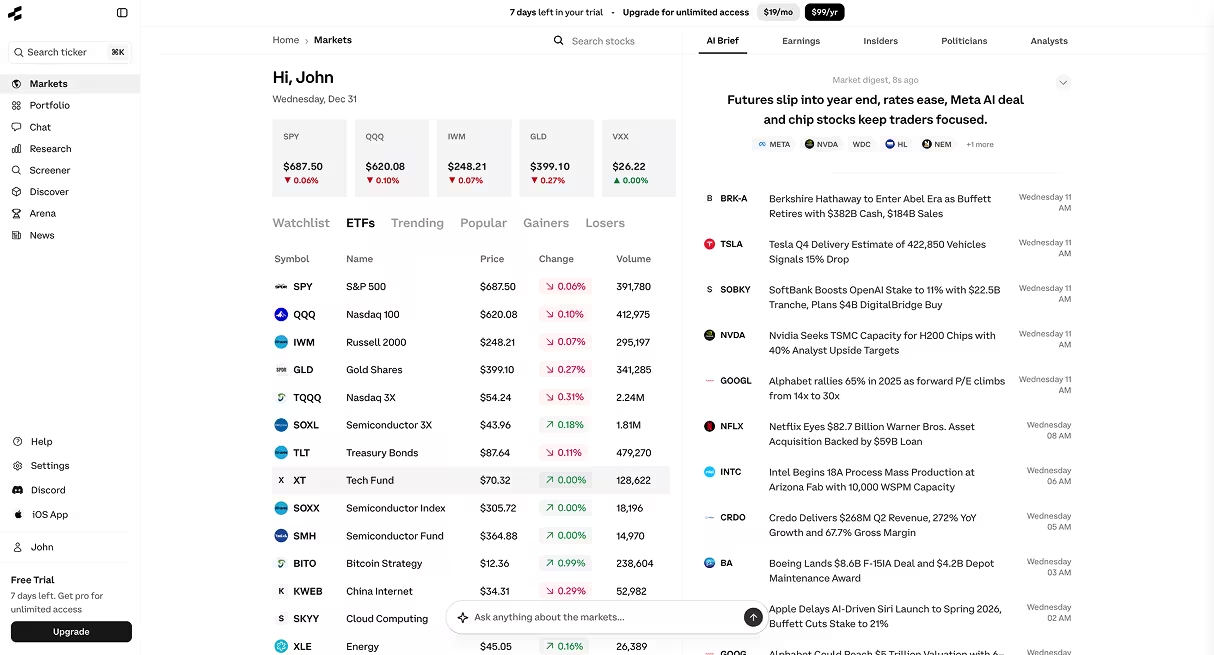
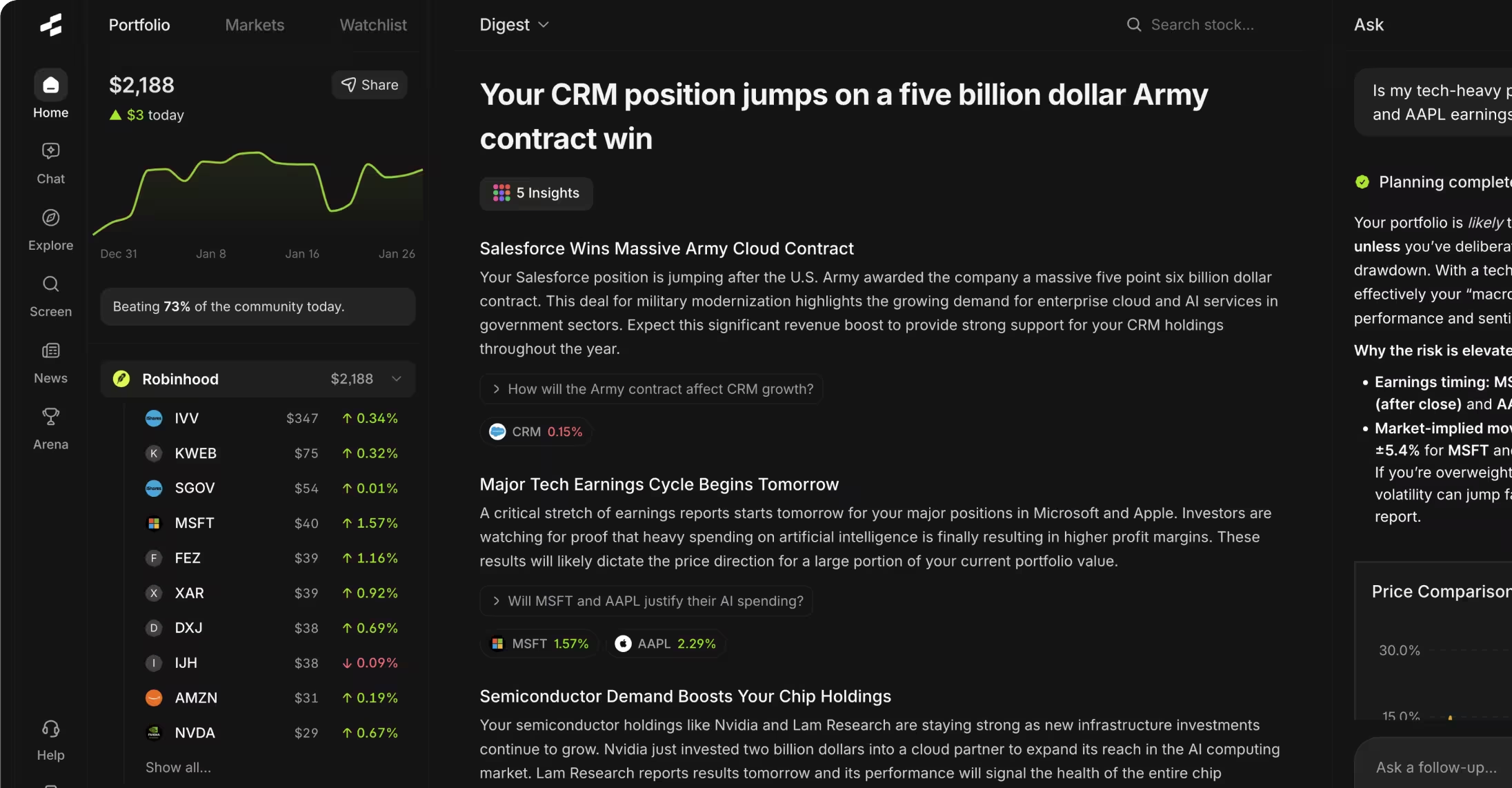
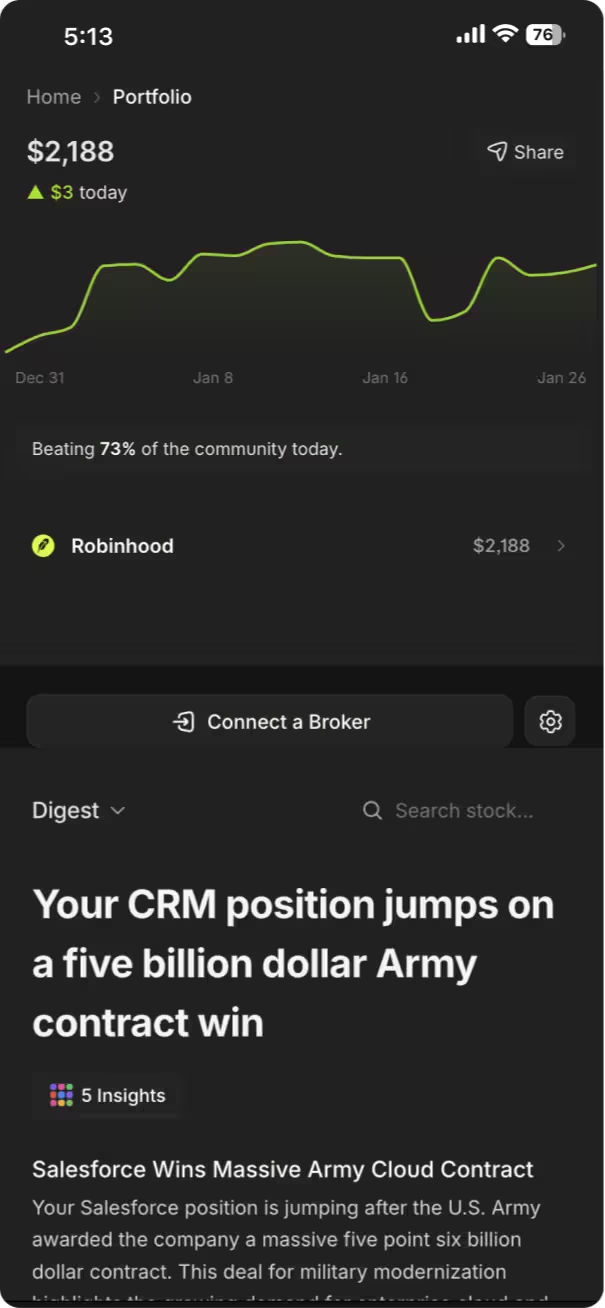
Tools like Rallies.ai's portfolio tracking can visualize your current allocation compared to targets, making it easier to identify when rebalancing is needed across multiple accounts.
Rebalancing with Cash Flows
If you regularly add money to your portfolio, direct new investments to underweight assets instead of selling overweight ones. This approach avoids transaction costs and taxes while achieving the same risk control. Someone adding $500 monthly could put the entire amount into bonds if stocks have drifted above target.
Required minimum distributions (RMDs) from retirement accounts after age 73 create forced cash flows you can use strategically. Take distributions from overweight positions to rebalance while meeting IRS requirements.
Risk Management Techniques
Risk management in portfolio construction involves identifying, measuring, and controlling the various risks that could prevent you from achieving your financial goals. While higher returns typically require accepting higher risk, effective risk management helps you take appropriate risks while avoiding unnecessary ones.
Investment risk comes in multiple forms. Market risk affects all investments in an asset class. Credit risk is the chance a bond issuer defaults. Liquidity risk means you can't sell an investment quickly without significant price concessions. Inflation risk erodes purchasing power. Currency risk impacts international investments when exchange rates move.
Standard Deviation: A statistical measure of how much an investment's returns vary from its average return, used as a proxy for volatility and risk. An asset with 15% standard deviation typically sees annual returns within 15% of its average about 68% of the time.
Position Sizing
Position sizing determines how much of your portfolio to allocate to any single investment. For individual stocks, most advisors recommend limiting positions to 3-5% of your portfolio to prevent any single company's problems from seriously damaging your wealth. If you hold 20-30 stocks, each represents roughly 3-5% of your holdings.
Index funds and ETFs already contain hundreds or thousands of positions, so concentration risk is minimal. You might hold 40-50% of your portfolio in a single total market index fund because that fund itself is diversified across the entire market. The position sizing rule applies to individual securities, not diversified funds.
Stop-Loss Strategies
Stop-loss orders automatically sell a security when it falls to a specified price, limiting potential losses. A stop-loss set 20% below your purchase price ensures you exit before losses become severe. Some investors use trailing stops that move up with the price, locking in profits while providing downside protection.
The downside is that stops can trigger during temporary volatility, selling positions right before they recover. Stop-losses work better for short-term trading than long-term investing. For retirement portfolios, maintaining proper asset allocation provides better risk management than trying to time individual position exits.
Hedging with Bonds and Alternatives
Bonds hedge stock market risk because they often rise when stocks fall. During the 2008 financial crisis, the S&P 500 dropped 37% while long-term Treasury bonds gained 20%. This negative correlation provides portfolio ballast during turbulent periods.
Some investors add gold (5-10% of portfolio) as an inflation hedge and crisis insurance. Gold historically maintains purchasing power over decades, though it can be volatile short-term. Real estate through REITs provides income and some inflation protection. Alternatives like commodities or managed futures might add diversification but also complexity and costs.
Managing Behavioral Risks
The biggest risk most investors face is their own behavior. Selling during market panics or chasing hot stocks causes more wealth destruction than market crashes. A study by Dalbar found that from 1992 to 2021, the average equity fund investor earned 7.1% annually while the S&P 500 returned 10.7%—the 3.6% gap came almost entirely from poor timing decisions.
Automatic investing through dollar-cost averaging removes timing decisions. Rebalancing on a fixed schedule prevents emotional reactions. Writing down your investment plan and goals makes it harder to abandon them during stress. Some investors work with advisors primarily for behavioral coaching rather than investment expertise.
Tracking Portfolio Performance
Performance tracking measures whether your portfolio is meeting your goals and how your returns compare to relevant benchmarks. Simply watching your account balance isn't enough—you need to calculate actual returns, compare them to appropriate indexes, and analyze what drove performance.
Total return includes both price appreciation and income from dividends or interest. If your portfolio started the year at $100,000, received $2,000 in dividends, and ended at $108,000, your total return was 10%: ($108,000 + $2,000 - $100,000) / $100,000. Many investors forget to include reinvested dividends, which represent 30-40% of stock market returns over time.
Choosing Appropriate Benchmarks
Compare your returns to benchmarks that match your allocation. A 100% U.S. stock portfolio should benchmark against the S&P 500 or total U.S. stock market. A 60/40 portfolio needs a blended benchmark—perhaps 60% S&P 500 and 40% Bloomberg U.S. Aggregate Bond Index.
International exposure requires adding international benchmarks like MSCI EAFE for developed markets or MSCI Emerging Markets. If you hold 60% U.S. stocks, 20% international stocks, and 20% bonds, your benchmark would blend those three indexes in the same proportions.
Your goal isn't necessarily to beat the benchmark, especially if you invest in index funds designed to match market returns. Instead, tracking benchmark comparisons reveals whether you're getting the returns you should for your risk level and helps identify problems like excessive fees or poor fund selection.
Risk-Adjusted Return Metrics
The Sharpe ratio measures return per unit of risk by dividing your excess return above the risk-free rate by your portfolio's standard deviation. A Sharpe ratio above 1.0 is good, above 2.0 is very good, and above 3.0 is excellent. This metric helps you compare whether higher returns justified the extra volatility you accepted.
Maximum drawdown shows the largest peak-to-trough decline in your portfolio value. If your portfolio peaked at $150,000 and bottomed at $105,000 before recovering, your maximum drawdown was 30%. This metric reveals your worst-case experience and helps calibrate whether your risk tolerance matches your allocation.
Attribution Analysis
Performance attribution breaks down your returns into components: how much came from asset allocation decisions versus security selection, which sectors contributed most, and how timing affected results. This analysis helps you understand what's working and what isn't.
If your portfolio underperformed its benchmark, attribution might reveal you held too much cash during a rally (asset allocation problem), picked weak stocks within sectors (security selection problem), or rebalanced at unfortunate times (timing problem). Each issue requires different solutions.
Portfolio Tracking Tools
Spreadsheets work for simple portfolios but become cumbersome with multiple accounts and frequent transactions. Dedicated portfolio tracking software automatically imports transactions, calculates returns, and generates performance reports.
Most brokerages provide basic performance tracking, though they only see assets held at their firm. Aggregation tools pull data from multiple accounts to show your complete financial picture. Some platforms offer AI-powered analysis that can answer specific questions about your holdings and performance patterns.
When to Adjust Your Strategy
Portfolio management isn't a set-and-forget activity, but you also shouldn't constantly tinker with your allocations. Knowing when to make strategic changes versus when to stay the course separates successful long-term investors from those who underperform through overtrading.
Major life changes typically trigger strategy reviews: marriage or divorce, buying a home, having children, receiving an inheritance, changing jobs, or approaching retirement. Your investment time horizon, income needs, and risk capacity all shift during these transitions, potentially requiring allocation adjustments.
Life Stage Transitions
As you approach retirement, gradually reduce stock exposure to protect accumulated wealth from severe market downturns. Most advisors suggest shifting to your retirement allocation 5-10 years before retiring, not all at once when you stop working. Someone retiring at 65 might start reducing stocks from 80% to 50% between ages 55 and 65.
Early retirement or financial independence changes the equation because your portfolio must last 40-50 years instead of 20-30. Sequence-of-returns risk—suffering poor returns early in retirement—can derail your plan. Many early retirees maintain 60-70% stock allocations to ensure growth outpaces inflation over multiple decades.
Market Valuation Considerations
Extremely high or low market valuations sometimes justify tactical adjustments within your strategic ranges. The cyclically adjusted price-to-earnings ratio (CAPE or Shiller P/E) for the S&P 500 averaged 17 from 1880 to 2024, with peaks above 30 preceding major crashes in 2000 and 2007.
When CAPE exceeds 30, you might reduce your 70% stock allocation to 60% and increase bonds to 40%. This adjustment acknowledges elevated risk without abandoning stocks entirely. When CAPE drops below 15 during market panics, shift back to 70% stocks or higher. These moves should be gradual and rare—perhaps once per decade at most.
When Not to Adjust
Resist the urge to adjust strategy based on short-term market movements, economic headlines, or financial media predictions. The market dropping 10% in a month isn't a reason to sell—it's expected volatility for stock investors. Political elections, inflation reports, and Federal Reserve meetings rarely justify strategy changes.
Your portfolio allocation should withstand normal market conditions without adjustment. If you can't tolerate typical 10-20% declines without selling, you need a more conservative permanent allocation, not reactive trading. Most investors improve returns by doing less, not more.
Annual Strategy Review Process
Schedule an annual review each January or on your birthday to assess whether your strategy still fits your situation. Ask yourself: Has my time horizon changed? Has my income or net worth changed significantly? Have my goals changed? Am I comfortable with last year's volatility?
Review your actual asset allocation and rebalance if needed. Check investment expenses to ensure you're not paying high fees for underperforming funds. Verify beneficiaries on retirement accounts remain current. Update your financial plan if major life changes occurred. This structured annual process prevents both neglect and overtrading.
Frequently Asked Questions
1. How much money do I need to start portfolio management?
You can start portfolio management with any amount, though most brokerages now have no minimum requirements for opening accounts. With fractional shares available at most platforms, you can build a diversified portfolio with as little as $100 by buying portions of index funds or ETFs. The principles of asset allocation and diversification apply whether you're investing $500 or $500,000. Start with what you can afford while maintaining an emergency fund, and add to your portfolio regularly as your income allows.
2. What's the difference between portfolio management and wealth management?
Portfolio management focuses specifically on selecting and managing investments within your accounts. Wealth management is broader, encompassing portfolio management plus financial planning, tax planning, estate planning, insurance analysis, and retirement planning. Wealth managers typically work with high-net-worth clients who need comprehensive financial advice, while portfolio management can be done independently or with a robo-advisor. If you only need help with investments, portfolio management services or tools are sufficient.
3. How often should I check my portfolio?
For long-term investors, checking quarterly or monthly is sufficient. Checking daily or weekly increases the temptation to make emotional decisions based on short-term volatility. Set a regular schedule for portfolio reviews—perhaps the first of each quarter—and stick to it. Outside your scheduled reviews, only check your portfolio if you need to rebalance, add new contributions, or address a specific question. Research shows that investors who check their portfolios frequently tend to underperform those who check less often because they're more likely to panic-sell during downturns.
4. Should I manage my portfolio myself or hire a professional?
Most investors with straightforward situations can successfully manage portfolios using index funds and simple allocations. You might need professional help if you have complex tax situations, significant wealth requiring estate planning, lack time for financial management, or find yourself making emotional decisions. Robo-advisors charge 0.25-0.50% annually for automated portfolio management, while human advisors typically charge 0.5-1.5%. If you're comfortable with basic investing concepts and can follow a disciplined rebalancing schedule, self-management saves these fees.
5. What's the optimal number of stocks to hold in a portfolio?
Research shows that 20-30 individual stocks provide adequate diversification to eliminate most company-specific risk. Adding more stocks beyond 30 provides minimal additional risk reduction. However, most individual investors should hold far fewer individual stocks or none at all, instead using index funds or ETFs that provide instant diversification across hundreds or thousands of companies. If you do buy individual stocks, limit them to 10-20% of your portfolio, with the remainder in diversified funds.
6. How do I calculate my portfolio's rate of return?
Calculate simple return by adding your ending balance to any withdrawals, subtracting your beginning balance and any deposits, then dividing by your beginning balance. If you started with $100,000, added $10,000 in contributions, and ended with $115,000, your return was ($115,000 - $10,000 - $100,000) / $100,000 = 5%. For portfolios with multiple deposits and withdrawals throughout the year, use the time-weighted return method or money-weighted return (internal rate of return) for more accuracy. Most brokerage platforms calculate these automatically.
7. What's the best asset allocation for retirement?
Asset allocation for retirement depends on your age, other income sources, and risk tolerance, not a single "best" formula. A common approach is the 110-minus-age rule for stock allocation—a 65-year-old would hold 45% stocks and 55% bonds. If you have significant pension income or Social Security covering basic expenses, you can afford more stock exposure. If your portfolio is your only retirement income source, shift more conservative. Many retirees use a 40-60% stock allocation, adjusting based on market conditions and spending needs.
8. How do I protect my portfolio during a recession?
The best recession protection is maintaining an appropriate asset allocation before the recession starts. Bonds, especially Treasury bonds, typically rise when stocks fall during economic downturns, cushioning portfolio losses. Keep 1-2 years of spending needs in cash or short-term bonds so you don't have to sell stocks at depressed prices. Avoid the temptation to sell everything when recession fears emerge—by the time recession is obvious, markets have usually already fallen. Portfolios that stayed invested through the 2008-2009 recession recovered within 3-4 years and went on to new highs.
9. What are the biggest portfolio management mistakes to avoid?
The most costly mistakes include: trying to time the market by moving in and out of investments, chasing recent winners and selling recent losers, holding too much cash out of fear, paying high fees for actively managed funds that underperform, failing to diversify across asset classes and sectors, letting your portfolio drift far from target allocations without rebalancing, and making decisions based on financial media headlines rather than your written plan. Avoiding these behavioral errors matters more than sophisticated investment strategies.
10. How does portfolio management differ for taxable vs. retirement accounts?
In retirement accounts like 401(k)s and IRAs, you can trade freely without tax consequences, making rebalancing simple. Hold your highest-growth assets and least tax-efficient investments here. Taxable accounts require tax-aware management—hold tax-efficient index funds, harvest losses to offset gains, avoid frequent trading that generates short-term capital gains taxed at higher rates, and use specific identification when selling shares to minimize taxes. Many investors keep simple total market index funds in taxable accounts and do all active rebalancing in retirement accounts.
11. What role should alternatives like gold or cryptocurrency play in my portfolio?
Most financial advisors recommend limiting alternatives to 5-10% of your portfolio maximum, if you include them at all. Gold has served as an inflation hedge and crisis insurance over long periods, though it produces no income and can be volatile short-term. Cryptocurrency remains highly speculative with limited historical data and extreme volatility—Bitcoin has experienced multiple 50%+ drawdowns. If you invest in alternatives, treat them as small satellite positions that won't determine your financial success or failure. Your core portfolio of stocks and bonds should represent 90-95% of your holdings.
12. How do I know if my portfolio is properly diversified?
Check these diversification indicators: you hold at least three different asset classes (stocks, bonds, cash/alternatives), your stock holdings span at least 8-10 different sectors, no single stock represents more than 5% of your portfolio, you have exposure to both U.S. and international markets (typically 20-40% international), and your largest position is no more than 10-15% of your total portfolio. If your portfolio is concentrated in just a few stocks, one sector, or one country, you're taking unnecessary risk that won't be rewarded with higher expected returns.
Conclusion
Effective portfolio management combines strategic asset allocation, broad diversification, and disciplined rebalancing to help you achieve financial goals while managing risk. The principles work at any wealth level: determine appropriate stock-bond allocation based on your timeline and risk tolerance, diversify across asset classes and sectors, rebalance annually or when allocations drift 5% from targets, and make strategic adjustments only when your life situation changes significantly.
Most investors benefit from a simple, low-cost approach using broad index funds rather than complex strategies or active trading. Focus on controlling what you can—costs, taxes, and your own behavior—rather than trying to predict market movements. Regular portfolio reviews every 3-6 months keep you on track without encouraging overtrading.
Whether you manage your portfolio independently or work with an advisor, understanding these fundamentals helps you make informed decisions aligned with your financial objectives. Start with appropriate asset allocation, build diversification through index funds, and maintain discipline through market cycles.
Ready to implement these strategies? Explore our complete portfolio management guide for detailed implementation steps, or ask the AI Research Assistant specific questions about building your portfolio.
References
- U.S. Securities and Exchange Commission. "Beginners' Guide to Asset Allocation, Diversification, and Rebalancing." https://www.sec.gov/investor/pubs/assetallocation.htm
- Brinson, Gary P., L. Randolph Hood, and Gilbert L. Beebower. "Determinants of Portfolio Performance." Financial Analysts Journal, 1986. https://www.cfapubs.org/
- Vanguard Research. "Best practices for portfolio rebalancing." https://www.vanguard.com/pdf/ISGPORE.pdf
- S&P Dow Jones Indices. "SPIVA U.S. Scorecard." https://www.spglobal.com/spdji/en/research-insights/spiva/
- Dalbar, Inc. "Quantitative Analysis of Investor Behavior." https://www.dalbar.com/QAIB/Index
- Federal Reserve Bank of St. Louis. "Historical Stock Market Data." https://fred.stlouisfed.org/
- Dimensional Fund Advisors. "Returns of Asset Classes 1928-2022." https://www.dimensional.com/us-en/insights
- Internal Revenue Service. "Retirement Topics - Required Minimum Distributions (RMDs)." https://www.irs.gov/retirement-plans/plan-participant-employee/retirement-topics-required-minimum-distributions-rmds
Disclaimer: This article is for educational and informational purposes only. It does not constitute investment advice, financial advice, trading advice, or any other type of advice. Rallies.ai does not recommend that any security, portfolio of securities, transaction, or investment strategy is suitable for any specific person.
Risk Warning: All investments involve risk, including the possible loss of principal. Past performance does not guarantee future results. Before making any investment decision, you should consult with a qualified financial advisor and conduct your own research.
Written by: Gav Blaxberg
CEO of WOLF Financial | Co-Founder of Rallies.ai