


Portfolio diversification is the practice of spreading investments across different asset classes, sectors, and securities to reduce risk. By holding a mix of stocks, bonds, and other investments that respond differently to market conditions, investors can lower their portfolio's volatility without necessarily sacrificing returns. Proper diversification helps protect against the risk that any single investment's poor performance will significantly damage your overall portfolio.
Key Takeaways
- Diversification reduces unsystematic risk by spreading investments across 20-30 different holdings in various sectors and asset classes
- A diversified investment portfolio typically includes 60-70% stocks, 20-30% bonds, and 5-10% alternative assets, adjusted based on age and risk tolerance
- Correlation matters more than quantity—holding 50 tech stocks provides less diversification than 15 stocks across different sectors
- Over-diversification (holding more than 30-40 individual stocks) can dilute returns without meaningful additional risk reduction
- Rebalancing your portfolio allocation every 6-12 months maintains your intended diversification strategy as market values shift
Table of Contents
- What Is Portfolio Diversification?
- Why Does Diversification Matter for Investors?
- Types of Diversification
- Asset Allocation Approaches
- Building Your First Diversified Portfolio
- Diversification Strategies by Investment Goal
- Common Diversification Mistakes
- Rebalancing Your Portfolio
- How to Measure Portfolio Diversification
- Frequently Asked Questions
- Conclusion
What Is Portfolio Diversification?
Portfolio diversification means spreading your money across different investments to reduce the risk that any single holding will significantly harm your returns. The concept rests on a simple observation: different investments perform well at different times. When stocks fall, bonds often hold steady or rise. When domestic markets struggle, international markets may thrive. When one sector crashes, others may remain stable.
Diversification: An investment strategy that mixes different types of assets, sectors, and securities within a portfolio to reduce exposure to any single risk. It's the financial equivalent of not putting all your eggs in one basket.
The mathematical foundation comes from modern portfolio theory, developed by economist Harry Markowitz in 1952. His research showed that a portfolio's risk depends not just on the individual securities' volatility, but on how those securities move relative to each other. Two volatile stocks that move in opposite directions can actually create a more stable portfolio than two stable stocks that always move together.
Diversification addresses what's called unsystematic risk—the risk specific to individual companies or sectors. It can't eliminate systematic risk, which affects the entire market. No amount of diversification would have protected you from losses during the 2008 financial crisis or the March 2020 pandemic crash. But proper diversification can protect you when a company you own goes bankrupt, a sector falls out of favor, or a country's market underperforms.
Why Does Diversification Matter for Investors?
Diversification reduces portfolio volatility without necessarily lowering long-term returns. Research by Vanguard found that a portfolio of 30 stocks carries about 25% less risk than a single stock, while still capturing most of the market's returns. Beyond that point, additional diversification produces diminishing benefits.
The historical data is compelling. From 1926 to 2023, the S&P 500 delivered an average annual return of about 10.2%, but individual stocks within the index showed far more variation. Roughly 40% of all stocks have experienced a permanent 70% decline from their peak value. Another 20% of stocks have lost essentially all their value. Yet the index itself, which automatically diversifies across 500 companies, has consistently trended upward over long periods.
Consider the real-world example of Enron employees. Many had concentrated their retirement savings in Enron stock, believing their inside knowledge made it a safe bet. When Enron collapsed in 2001, these employees lost not just their jobs but their entire retirement savings. Employees with diversified portfolios in similar situations maintained most of their wealth despite losing their jobs.
Diversification also provides psychological benefits. Watching a concentrated portfolio swing 30-40% in value creates emotional stress that leads to poor decisions—typically selling at the worst possible time. A diversified portfolio still experiences volatility, but the swings are smaller and easier to tolerate, helping you stick to your long-term strategy.
Types of Diversification
Effective portfolio construction requires diversification across multiple dimensions. Each type addresses different sources of risk in your investment mix.
Asset Class Diversification
This means holding different types of investments: stocks (equities), bonds (fixed income), real estate, commodities, and cash. Each asset class responds differently to economic conditions. Stocks typically perform well during economic expansion. Bonds often hold value during recessions. Real estate provides inflation protection. Commodities can hedge against supply shocks.
According to research from Fidelity, a portfolio split 60% stocks and 40% bonds experienced 30% lower volatility than a 100% stock portfolio from 1926-2023, while only sacrificing about 1.5 percentage points of annual return.
Sector Diversification
Within stocks, spreading investments across different industries protects against sector-specific downturns. The S&P 500 divides into 11 sectors: Information Technology, Healthcare, Financials, Consumer Discretionary, Communication Services, Industrials, Consumer Staples, Energy, Utilities, Real Estate, and Materials.
Sector Allocation: The percentage of your portfolio invested in each industry group. Most diversified portfolios avoid having more than 25-30% in any single sector to prevent concentration risk.
Tech stocks dominated returns from 2010-2021, but energy stocks outperformed in 2022 as oil prices surged. An investor holding only tech stocks would have experienced severe losses that year, while a diversified investor saw gains in their energy holdings offset tech losses.
Geographic Diversification
Investing across different countries and regions reduces exposure to any single economy's performance. U.S. stocks outperformed international stocks from 2010-2023, but international stocks led during the 2000s. Japan's market has spent decades recovering from its 1989 peak, demonstrating the risk of home-country bias.
Most financial advisors recommend 20-40% international exposure for U.S. investors, split between developed markets (Europe, Japan, Australia) and emerging markets (China, India, Brazil).
Market Cap Diversification
This involves holding companies of different sizes: large-cap (over $10 billion market value), mid-cap ($2-10 billion), and small-cap (under $2 billion). Small-cap stocks historically deliver higher returns but with greater volatility. Large-cap stocks provide stability. A mix captures growth opportunities while maintaining a foundation of established companies.
Investment Style Diversification
Growth stocks (companies expected to expand rapidly) and value stocks (companies trading below their intrinsic worth) perform well in different market environments. Growth stocks dominated the 2010s. Value stocks outperformed in 2022. Position sizing across both styles smooths returns across different market cycles.
Asset Allocation Approaches
Asset allocation—how you divide your portfolio among stocks, bonds, and other investments—drives 90% of your portfolio's long-term return variability, according to a famous study by Brinson, Hood, and Beebower. The right investment mix depends on your time horizon, risk tolerance, and financial goals.
Age-Based Allocation
A common rule of thumb: subtract your age from 110 to get your stock allocation percentage. A 30-year-old would hold 80% stocks, 20% bonds. A 60-year-old would hold 50% stocks, 50% bonds. This approach gradually shifts from growth to preservation as you near retirement.
Target-date funds automate this strategy, automatically adjusting your portfolio allocation as you age. A 2050 target-date fund might start with 90% stocks and gradually shift to 40% stocks by 2050.
Risk-Based Allocation
This method focuses on your personal risk tolerance rather than age. Conservative investors might hold 40% stocks, 50% bonds, 10% cash regardless of age. Aggressive investors might maintain 80-90% stocks even in their 60s if they have sufficient other income sources and can tolerate volatility.
Risk Profile Stock Allocation Bond Allocation Other Assets Expected Annual Return Expected Volatility Conservative 30-40% 50-60% 5-10% 5-6% Low (±8%) Moderate 50-70% 25-40% 5-10% 7-8% Medium (±12%) Aggressive 80-90% 5-15% 5-10% 9-10% High (±18%)
Goal-Based Allocation
This approach creates separate mental buckets for different goals, each with its own portfolio allocation. Money needed in 3 years for a house down payment might be 100% bonds and cash. Retirement money needed in 30 years might be 90% stocks. College savings needed in 10 years might be 60% stocks, 40% bonds.
The bucket strategy divides retirement portfolios into three segments: immediate needs (1-3 years, held in cash/bonds), medium-term needs (3-10 years, balanced mix), and long-term growth (10+ years, mostly stocks). This prevents forced selling of stocks during downturns.
Building Your First Diversified Portfolio
Creating a diversified investment portfolio doesn't require complexity. A simple three-fund portfolio can provide excellent diversification at low cost.
The Three-Fund Portfolio
This approach, popularized by Bogleheads (followers of Vanguard founder John Bogle), uses just three index funds:
- Total U.S. Stock Market Index (60% of portfolio): Provides exposure to all U.S. stocks across all sectors and market caps
- Total International Stock Market Index (20% of portfolio): Covers developed and emerging markets outside the U.S.
- Total Bond Market Index (20% of portfolio): Holds diversified U.S. government and corporate bonds
This simple mix provides exposure to roughly 10,000 different securities across dozens of countries and all major sectors. Annual expenses typically run under 0.10%, compared to 1.0% or more for actively managed funds.
Step-by-Step Portfolio Construction
For investors who want more control, follow this framework:
- Determine your target asset allocation based on age and risk tolerance (see previous section)
- Within your stock allocation, divide between U.S. and international (typically 70% U.S., 30% international)
- Within U.S. stocks, ensure sector diversification by using a total market fund or selecting stocks across at least 6-8 different sectors
- Select 15-25 individual stocks if building your own portfolio, or use index funds for instant diversification
- Include bonds appropriate to your allocation, mixing government and corporate bonds with varying maturities
- Add 5-10% alternative investments if desired (real estate, commodities, or other assets)
- Keep 3-6 months of expenses in cash as an emergency fund outside your investment portfolio
Position Sizing: The percentage of your total portfolio allocated to a single investment. Most diversified portfolios limit individual stock positions to 3-5% to prevent concentration risk.
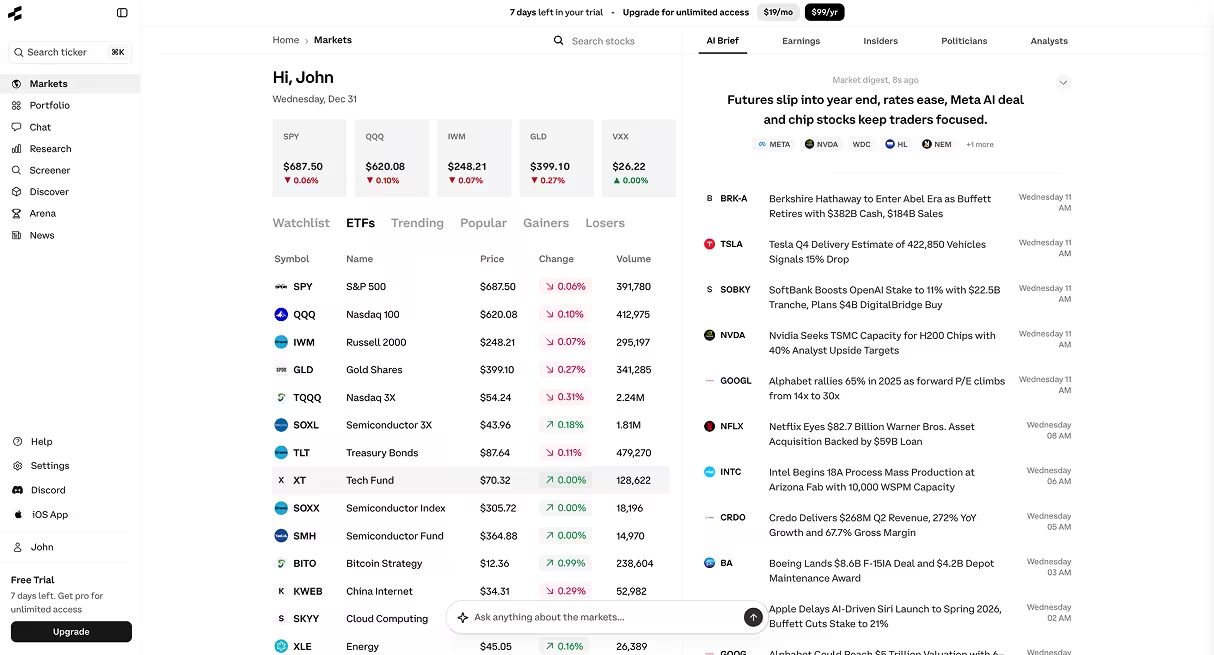
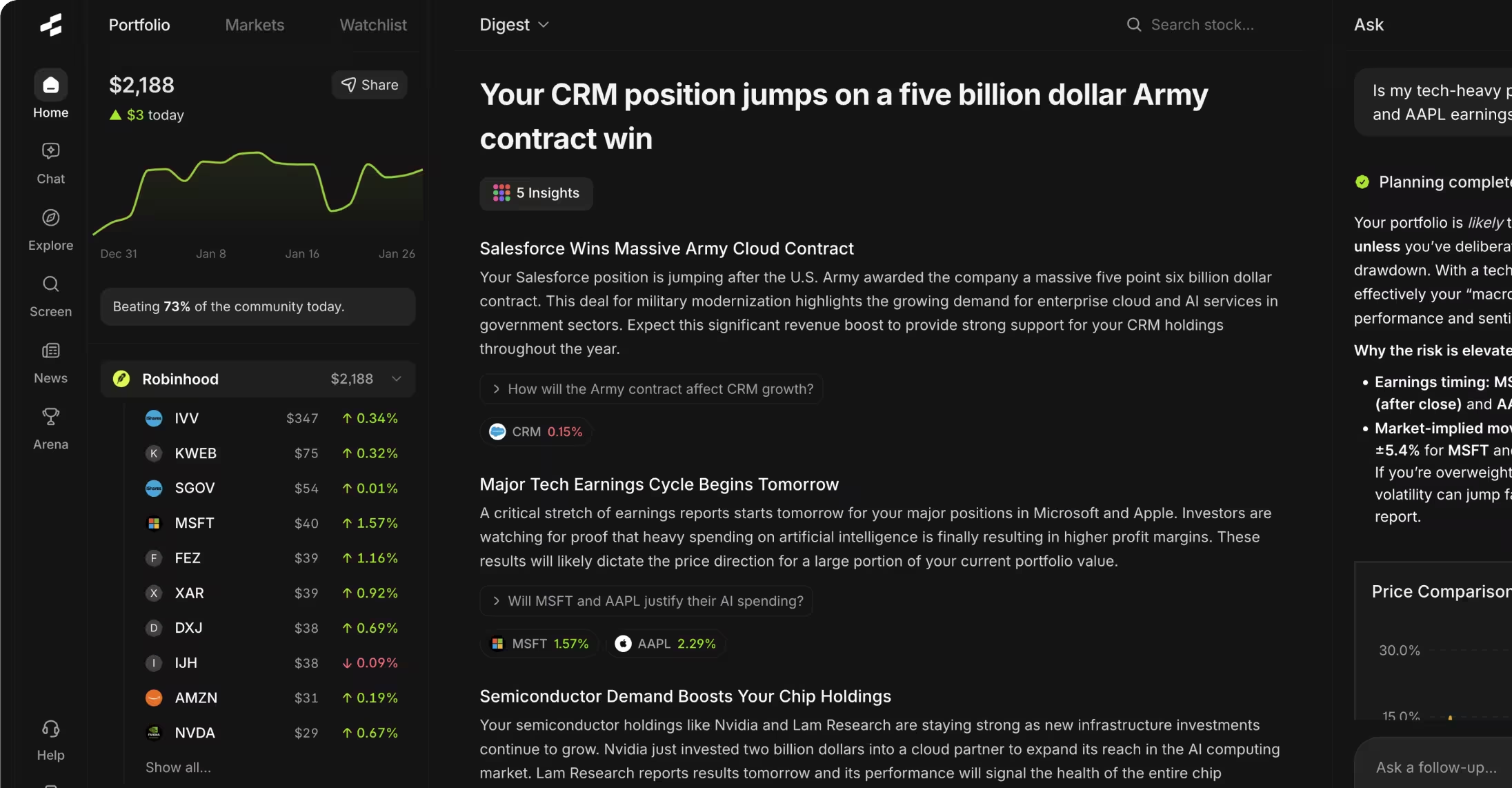
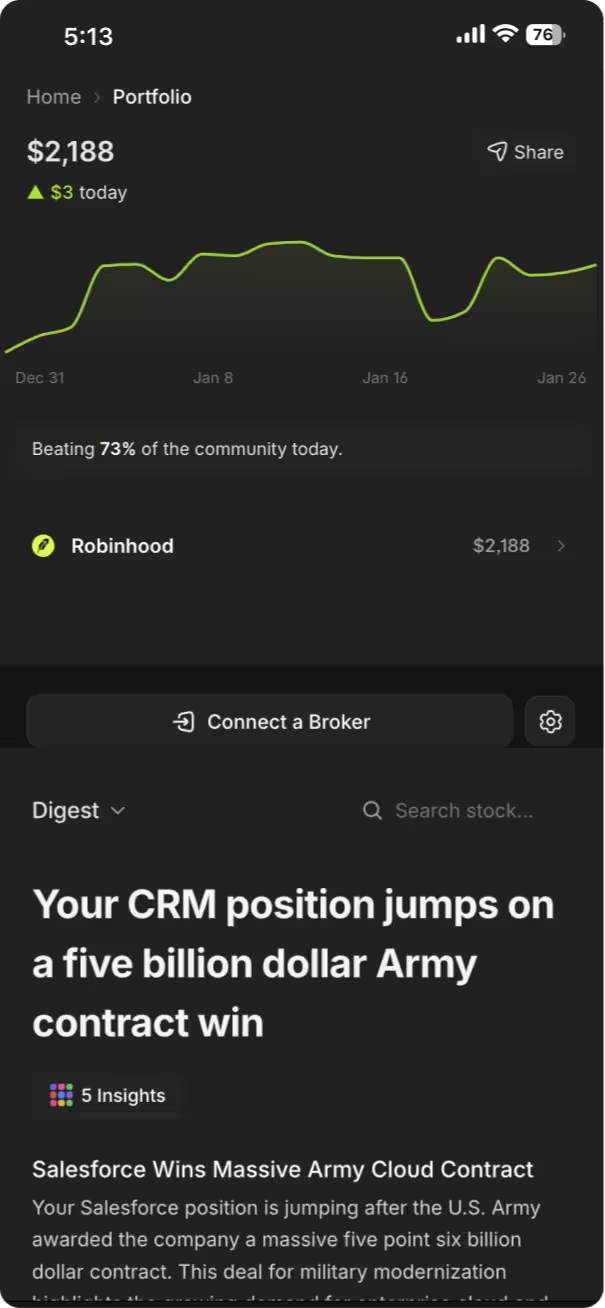
You can research and track these investments using portfolio tracking tools that visualize your current allocation and help identify concentration risks.
Diversification Strategies by Investment Goal
Your portfolio strategy should align with your specific financial objectives and timeline. Different goals require different approaches to portfolio construction.
Long-Term Wealth Building (20+ Years)
For retirement or other distant goals, prioritize growth through higher stock allocation. A portfolio of 80-90% stocks and 10-20% bonds maximizes long-term returns while accepting higher short-term volatility. Time allows you to ride out market downturns and benefit from compounding.
Consider including small-cap and international stocks for additional growth potential. Historical data shows small-cap value stocks returned 13.4% annually from 1928-2022, compared to 10.2% for the broad market, according to Dimensional Fund Advisors research.
Medium-Term Goals (5-10 Years)
For goals like funding education or a major purchase, balance growth with stability. A 60% stock, 40% bond allocation provides meaningful growth potential while reducing the risk that a market downturn shortly before your target date will derail your plans.
Focus on high-quality bonds with moderate duration (5-7 years) to provide stability. Include both U.S. and international stocks for sector allocation across global opportunities.
Income Generation
Retirees and others seeking regular income should emphasize dividend-paying stocks, bonds, and real estate investment trusts (REITs). A typical income portfolio might hold 40% dividend stocks, 50% bonds, 10% REITs.
Diversify across different income sources to reduce dependence on any single sector. Utility stocks pay steady dividends but grow slowly. Technology companies increasingly pay dividends while offering growth potential. Bond ladders (bonds maturing at regular intervals) provide predictable income streams.
Capital Preservation
For money needed within 1-3 years or emergency funds, prioritize safety over growth. Hold 80-100% in cash, money market funds, or short-term bonds. Accept lower returns in exchange for protection against losses.
This isn't technically a diversified investment strategy—it's about avoiding risk entirely for money you can't afford to lose. Keep only these near-term funds in safe assets while maintaining properly diversified portfolios for longer-term money.
Common Diversification Mistakes
Investors frequently make errors that undermine their diversification efforts. Avoiding these pitfalls improves your portfolio's risk-adjusted returns.
Confusing Diversification with Number of Holdings
Owning 50 stocks doesn't guarantee diversification if they're all in the same sector or style. An investor holding 50 different technology stocks has far more risk than someone holding 15 stocks spread across different sectors. Correlation matters more than quantity.
Similarly, owning 10 different mutual funds can create false diversification if those funds hold overlapping positions. Check your portfolio's actual underlying holdings, not just the number of funds you own.
Home-Country Bias
U.S. investors often hold 80-90% U.S. stocks, despite the U.S. representing only about 60% of global market capitalization. This overexposure to a single country's economy creates unnecessary concentration risk. International markets have outperformed U.S. markets in many historical periods, including 2002-2007 and much of the 1980s.
Over-Diversification
Research shows that beyond about 20-30 stocks, additional diversification provides minimal risk reduction while diluting your potential for outperformance. Peter Lynch, the legendary Fidelity fund manager, argued that "diworsification" occurs when investors spread money across too many ideas they haven't properly researched.
If you can't explain why you own each investment in your portfolio, you probably own too many things.
Recency Bias
Investors chase recent winners, loading up on assets that just performed well. After technology stocks surged in 2020-2021, many investors concentrated portfolios in tech just before the sector declined sharply in 2022. Proper rebalancing would have reduced tech exposure after gains, not increased it.
Ignoring Correlation Changes
Assets that normally move independently can suddenly move together during crises. In March 2020, stocks, bonds, real estate, and commodities all fell simultaneously as investors rushed to cash. Diversification still helped—a 60/40 portfolio fell about 20% while stocks alone dropped 34%—but the benefit was smaller than normal.
This reminds us that diversification reduces but doesn't eliminate risk. Some systematic risk affects all investments.
Forgetting About Fees
Achieving diversification through expensive actively managed funds can cost 1-2% annually in fees, potentially erasing any benefit. Index funds charging 0.03-0.10% provide broader diversification at a fraction of the cost.
Rebalancing Your Portfolio
Portfolio rebalancing means adjusting your holdings back to your target allocation after market movements push them off course. This rebalancing strategy is essential for maintaining your intended diversification and risk level.
Here's why it matters: If your target allocation is 70% stocks and 30% bonds, a strong stock market might push you to 80% stocks and 20% bonds. You now have more risk exposure than intended. Rebalancing sells some stocks and buys bonds, returning to 70/30.
When to Rebalance
Most advisors recommend one of two approaches:
- Time-based rebalancing: Review and adjust your portfolio allocation at fixed intervals (quarterly, semi-annually, or annually). Annual rebalancing works well for most investors, providing enough time for meaningful drift while limiting transaction costs.
- Threshold-based rebalancing: Adjust when any asset class drifts more than 5 percentage points from its target. If your 70% stock allocation reaches 75% or 65%, you rebalance. This approach responds to actual market movements rather than arbitrary dates.
Research by Vanguard found that both methods produce similar long-term results. Annual rebalancing provides simplicity and adequate performance for most investors.
Tax-Efficient Rebalancing
In taxable accounts, selling winners to rebalance triggers capital gains taxes. Minimize tax impact through these strategies:
- Direct new contributions to underweighted assets instead of selling overweighted ones
- Harvest tax losses by selling positions with losses, then use proceeds to buy underweighted assets
- Do most rebalancing in tax-advantaged accounts (401k, IRA) where sales don't trigger taxes
- Wait until positions qualify for long-term capital gains treatment (held over one year) before selling
Tools like the Rallies.ai portfolio tracker can help visualize your current allocation and identify when rebalancing is needed.
Rebalancing Strategy: A systematic approach to returning your portfolio to its target asset allocation by selling assets that have grown beyond their intended percentage and buying those that have fallen below. This forces you to "sell high and buy low" in a disciplined way.
How to Measure Portfolio Diversification
Quantifying diversification helps you understand whether your portfolio construction actually reduces risk as intended. Several metrics provide insight into your portfolio's true diversification level.
Correlation Analysis
Correlation measures how closely two investments move together, ranging from -1 (perfect opposite movement) to +1 (perfect synchronization). A well-diversified portfolio includes assets with low or negative correlations.
U.S. stocks and U.S. bonds historically show a correlation of about 0.0 to -0.2, meaning they often move independently or in opposite directions. U.S. large-cap and U.S. small-cap stocks correlate at about 0.8, providing less diversification benefit. You can calculate correlation using free tools or spreadsheet functions with historical price data.
Standard Deviation
Standard deviation measures volatility—how much returns vary from the average. A diversified portfolio should have lower standard deviation than its individual holdings. If your portfolio's standard deviation equals or exceeds that of a total market index, your diversification isn't working effectively.
The S&P 500 has a historical standard deviation of about 18-20%. A well-diversified portfolio with bonds might have a standard deviation of 10-12%, indicating meaningful risk management through portfolio optimization.
Concentration Metrics
Measure concentration through simple rules:
- No single stock should exceed 5% of your portfolio
- Your top 10 holdings shouldn't exceed 40% of your portfolio
- No single sector should exceed 25-30% of your stock allocation
- No single country (except your home country) should exceed 15% of your total portfolio
If you exceed these thresholds, you're taking concentrated bets that increase risk beyond what's necessary for good returns.
Effective N
This metric estimates how many truly independent bets your portfolio contains. A portfolio of 100 highly correlated stocks might have an Effective N of only 5-10, meaning it behaves like a concentrated portfolio despite holding many positions. The formula is complex, but the concept is simple: you want your Effective N to be reasonably close to your actual number of holdings.
Frequently Asked Questions
1. How many stocks do I need for proper diversification?
Research suggests 15-20 stocks across different sectors provides adequate diversification for individual investors. Studies show that about 90% of diversification benefits are achieved with 20 stocks, while holding more than 30-40 stocks produces diminishing returns. Focus on quality over quantity and ensure your holdings span different sectors and industries rather than simply accumulating more positions.
2. Is it better to use index funds or pick individual stocks for diversification?
Index funds provide instant diversification at low cost and work well for most investors. A single total market index fund holds thousands of stocks across all sectors. Individual stock selection gives you more control and potential for outperformance but requires significant research time and carries higher risk if you make poor choices. Many investors use a core-satellite approach: index funds for 70-80% of the portfolio (the core) and individual stocks for 20-30% (satellites).
3. How does portfolio diversification affect returns?
Diversification typically reduces returns slightly compared to your best-performing asset, but it also prevents catastrophic losses from your worst performers. Historical data shows diversified portfolios deliver 85-95% of the returns of pure stock portfolios while experiencing 30-40% less volatility. Over time, this smoother return pattern often leads to better wealth accumulation because you avoid panic selling during downturns and benefit from compound growth on a more stable base.
4. Should I diversify into cryptocurrency or other alternative investments?
Alternative investments like cryptocurrency, commodities, or private equity can enhance diversification if they have low correlation to stocks and bonds. However, these assets often carry higher fees, less liquidity, and greater complexity. If you choose to include them, most advisors recommend limiting alternatives to 5-10% of your portfolio until you thoroughly understand their risks and behavior. Bitcoin, for example, has shown high correlation with growth stocks during market stress, reducing its diversification benefit.
5. How often should I review my portfolio's diversification?
Review your portfolio allocation quarterly but only rebalance annually or when allocations drift 5+ percentage points from targets. More frequent rebalancing generates unnecessary transaction costs and taxes without improving returns. However, you should immediately reassess if your personal circumstances change significantly—job loss, inheritance, approaching retirement, or major financial goals shifting your risk tolerance or time horizon.
6. Does diversification work during market crashes?
Diversification reduces losses during crashes but doesn't eliminate them. During the 2008 financial crisis, a 60% stock/40% bond portfolio fell about 22%, while a 100% stock portfolio fell 37%. In March 2020, the diversified portfolio dropped about 20% versus 34% for pure stocks. Diversification helps you weather storms better and recover faster, though all risk-bearing assets can decline simultaneously during severe crises. The key benefit is that diversified portfolios historically recover faster and reach new highs sooner than concentrated portfolios.
7. What's the difference between diversification and asset allocation?
Asset allocation refers to your high-level mix of stocks, bonds, and other major asset classes—it's your strategic decision about risk and return. Diversification is the tactical implementation within each asset class—how you spread investments across individual securities, sectors, and geographies. You might have an asset allocation of 70% stocks and 30% bonds, then achieve diversification by holding 25 stocks across 8 sectors for the equity portion and bonds with varying maturities for the fixed income portion.
8. Can I be diversified with just ETFs?
Yes, exchange-traded funds (ETFs) offer an efficient path to diversification. A simple portfolio of 3-4 ETFs covering U.S. stocks, international stocks, bonds, and perhaps real estate can provide exposure to thousands of securities at annual costs under 0.10%. Many investors achieve excellent diversification with just VTI (total U.S. market), VXUS (total international), and BND (total bond market). However, verify that your ETFs don't overlap significantly—owning five different S&P 500 ETFs doesn't provide more diversification than owning one.
Conclusion
Portfolio diversification remains one of the few "free lunches" in investing—reducing risk without sacrificing long-term returns. By spreading investments across different asset classes, sectors, geographies, and securities, you protect your wealth against individual failures while capturing market returns. The key is finding the right balance: enough diversification to manage risk effectively, but not so much that you dilute returns or lose track of what you own.
Start with a clear asset allocation based on your goals and risk tolerance, implement it through low-cost index funds or carefully selected individual stocks, and maintain discipline through regular rebalancing. Remember that risk management through diversification is a continuous process, not a one-time decision. As your life circumstances and market conditions change, your portfolio strategy should evolve while maintaining its core diversification principles.
For additional guidance, explore our complete portfolio management guide covering portfolio tracking, return analysis, and benchmark comparison strategies.
Want to dig deeper? Read our complete guide to portfolio management or ask the AI Research Assistant your specific questions about building a diversified portfolio.
References
- U.S. Securities and Exchange Commission. "Beginners' Guide to Asset Allocation, Diversification, and Rebalancing." sec.gov
- Vanguard Group. "Vanguard's approach to target-date funds." investor.vanguard.com
- Dimensional Fund Advisors. "The Small-Cap Value Premium: A Historical Perspective." dimensional.com
- Brinson, Gary P., L. Randolph Hood, and Gilbert L. Beebower. "Determinants of Portfolio Performance." Financial Analysts Journal, 1986.
- Fidelity Investments. "Asset Allocation Research." fidelity.com
- Federal Reserve Bank of St. Louis. "Economic Research: Asset Correlation Studies." fred.stlouisfed.org
Disclaimer: This article is for educational and informational purposes only. It does not constitute investment advice, financial advice, trading advice, or any other type of advice. Rallies.ai does not recommend that any security, portfolio of securities, transaction, or investment strategy is suitable for any specific person.
Risk Warning: All investments involve risk, including the possible loss of principal. Past performance does not guarantee future results. Before making any investment decision, you should consult with a qualified financial advisor and conduct your own research.
Written by: Gav Blaxberg
CEO of WOLF Financial | Co-Founder of Rallies.ai