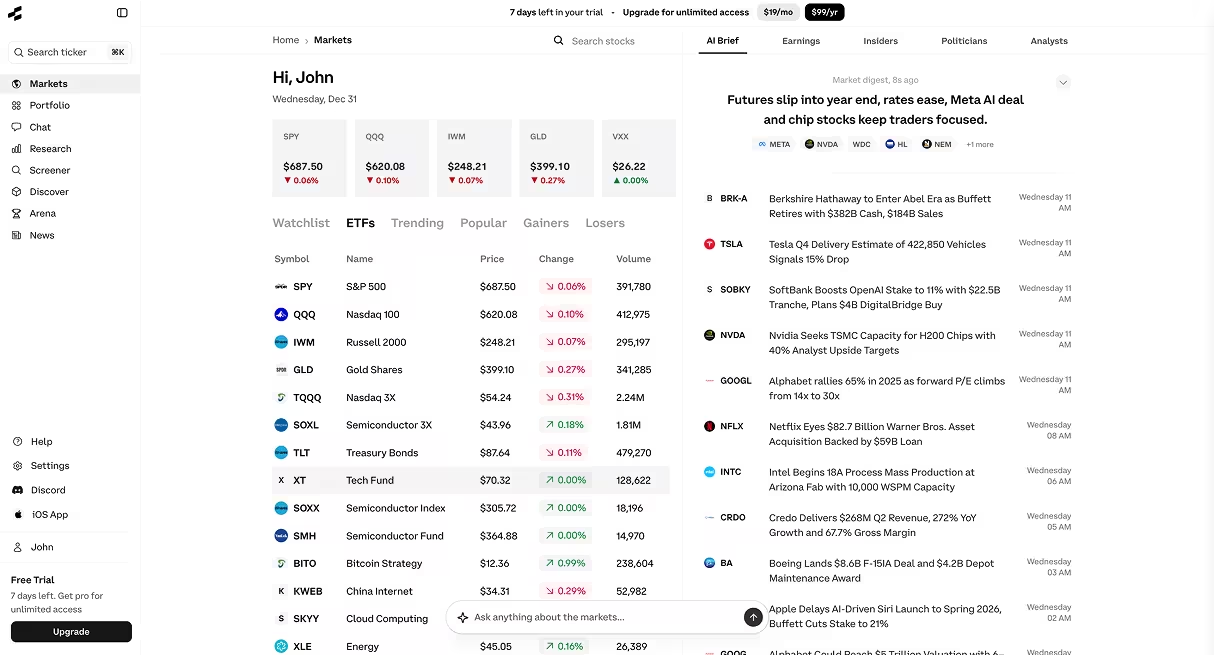



The P/E ratio (price-to-earnings ratio) measures how much investors pay for each dollar of a company's annual earnings by dividing the stock price by earnings per share. A P/E of 20 means you're paying $20 for every $1 of profit the company generates. This valuation metric helps investors compare stock prices across companies and industries, though it works best when comparing similar businesses and should be combined with other financial ratios for complete analysis.
Key Takeaways
- The P/E ratio divides stock price by earnings per share (EPS)—a P/E of 25 means investors pay $25 for $1 of annual earnings
- Technology stocks historically average P/E ratios of 25-30, while utilities typically trade at 12-18, making cross-industry comparisons misleading
- The forward P/E uses projected future earnings instead of historical data, offering a view of expected valuation
- P/E ratios become unreliable or meaningless for unprofitable companies, cyclical businesses at earnings peaks/troughs, and during periods of unusual earnings
- Most analysts compare a company's current P/E to its own 5-year average and industry peers rather than using absolute thresholds
Table of Contents
- What Is the P/E Ratio?
- How Do You Calculate the P/E Ratio?
- Types of P/E Ratios: Trailing vs Forward
- How Do You Interpret P/E Ratios?
- Why Do P/E Ratios Vary by Industry?
- What Are the Limitations of P/E Ratios?
- How to Use P/E Ratios in Stock Analysis
- Related Valuation Metrics
- Frequently Asked Questions
- Conclusion
What Is the P/E Ratio?
The price-to-earnings ratio is a valuation metric that compares a company's stock price to its earnings per share. It tells you how many dollars investors are willing to pay for one dollar of the company's annual profit. This ratio appears in virtually every stock analysis because it provides a quick snapshot of whether a stock might be expensive or cheap relative to its earnings power.
Price-to-Earnings Ratio (P/E): A valuation multiple that divides a company's current share price by its earnings per share. It quantifies the market's willingness to pay for current profitability.
The P/E ratio belongs to a broader category of price multiples that investors use to evaluate company financials. Unlike absolute stock prices, which tell you little without context, the P/E ratio creates a standardized comparison point. A $500 stock isn't necessarily more expensive than a $50 stock—the P/E ratio reveals which offers more earnings per dollar invested.
This metric gained widespread use because it distills complex financial information into a single, comparable number. When you screen stocks or read analyst reports, you'll see P/E ratios prominently featured alongside other stock metrics. The ratio works for both individual stock evaluation and market-level analysis, with the S&P 500's average P/E serving as a benchmark for overall market valuation.
How Do You Calculate the P/E Ratio?
You calculate the P/E ratio by dividing the current stock price by earnings per share. The formula is: P/E Ratio = Stock Price ÷ Earnings Per Share (EPS).
Here's a concrete example: If a stock trades at $150 per share and the company earned $6 per share over the past 12 months, the P/E ratio is 25 ($150 ÷ $6 = 25). This means investors are paying $25 for each dollar of annual earnings.
Earnings Per Share (EPS): A company's net income divided by the number of outstanding shares. EPS represents the portion of profit allocated to each share of stock.
Most financial websites calculate this automatically, but understanding the components matters. The stock price is straightforward—it's the current market price. The earnings figure typically comes from the company's most recent annual report or the sum of the past four quarters. Some analysts use diluted EPS, which accounts for potential shares from stock options and convertible securities, providing a more conservative measure.
You can also work backwards from the P/E ratio. If you know a stock has a P/E of 18 and trades at $90, you can calculate that its EPS is $5 ($90 ÷ 18 = $5). This reverse calculation helps when comparing investment ratios across companies where you might have incomplete data.
Types of P/E Ratios: Trailing vs Forward
The trailing P/E uses historical earnings from the past 12 months, while the forward P/E uses projected earnings for the next 12 months. Each serves different analytical purposes and comes with distinct advantages.
Type Calculation Best Used For Main Limitation Trailing P/E (TTM) Stock Price ÷ Past 12 Months EPS Historical valuation, stable companies Backward-looking, ignores future changes Forward P/E Stock Price ÷ Next 12 Months Projected EPS Growth companies, future expectations Relies on estimates that may be wrong
Trailing P/E ratios use actual reported earnings, making them objective and verifiable. When a financial site shows a company's P/E ratio without specification, it's usually the trailing twelve months (TTM) version. This measure provides a factual baseline—you're looking at real profits the company already generated. For mature, stable businesses with predictable earnings, trailing P/E ratios offer reliable valuation context.
Forward P/E ratios incorporate analyst projections about future earnings. If analysts expect earnings to grow 30% next year, the forward P/E will be lower than the trailing P/E (assuming the stock price stays constant). A stock with a trailing P/E of 30 might have a forward P/E of 23 if earnings are expected to jump. This explains why high-growth stocks often show elevated trailing P/E ratios—investors are paying for future earnings growth, not just current profitability.
The gap between trailing and forward P/E ratios signals market expectations. A wide gap suggests investors anticipate significant earnings changes. You'll see this pattern frequently in technology stocks or companies undergoing major transitions. Tools like Rallies.ai's AI Research Assistant can pull both trailing and forward P/E data to help you understand how market expectations compare to historical performance.
How Do You Interpret P/E Ratios?
A higher P/E ratio typically indicates investors expect stronger future growth, while a lower P/E suggests slower growth expectations or potential undervaluation. However, interpretation always requires context—a P/E of 40 might be high for a utility but normal for a software company.
The broad market provides reference points. The S&P 500's historical average P/E sits around 15-16, though it has ranged from under 10 during recessions to over 30 during bull markets. As of late 2024, the S&P 500 trades near a P/E of 20-22, slightly above the long-term average. Individual stocks typically get compared against these benchmarks, their own historical ranges, and their industry peers.
What Higher P/E Ratios Often Indicate
- Market expects strong future earnings growth
- Company operates in a high-growth industry
- Business has competitive advantages or strong brand value
- Investors anticipate earnings expansion or margin improvement
What Lower P/E Ratios Often Indicate
- Market expects modest or declining earnings
- Company faces industry headwinds or competitive pressure
- Stock may be undervalued relative to fundamentals
- Business operates in a mature, slow-growth sector
Context matters more than absolute numbers. A P/E of 12 isn't automatically "cheap" and a P/E of 35 isn't automatically "expensive." You need to ask: What's normal for this industry? What's this company's historical range? Are earnings temporarily depressed or inflated? A cyclical company at peak earnings might show a low P/E that's actually misleading—earnings could drop significantly in the next downturn, making the valuation less attractive than it appears.
Value investors often seek stocks with low P/E ratios relative to peers, betting that the market has mispriced the company's earning power. Growth investors may accept higher P/E ratios if they believe earnings will expand rapidly enough to justify the premium. Neither approach is inherently superior—both can work depending on market conditions and individual company circumstances.
Why Do P/E Ratios Vary by Industry?
Different industries have different growth rates, capital requirements, and risk profiles, which lead to structurally different P/E ratio ranges. Technology companies average P/E ratios of 25-30, while utilities typically trade at 12-18, and banks often fall in the 10-15 range.
Growth expectations drive much of this variation. Software companies with 20-30% annual revenue growth potential command premium valuations because investors project years of earnings expansion. Utilities with 2-3% growth face regulatory constraints and mature markets, so investors pay less per dollar of current earnings. These aren't temporary anomalies—they reflect fundamental differences in business economics and financial analysis metrics appropriate to each sector.
Industry Typical P/E Range Key Drivers Technology/Software 25-35 High growth rates, scalability, low marginal costs Consumer Staples 18-24 Stable demand, predictable cash flows, moderate growth Financial Services 10-15 Regulatory constraints, economic sensitivity, leverage Utilities 12-18 Regulated returns, stable but slow growth, high capital needs Energy 8-15 Commodity price volatility, cyclical earnings, capital intensity
Capital intensity also affects appropriate P/E levels. Companies requiring constant heavy reinvestment to maintain operations often trade at lower multiples because earnings don't fully translate to free cash flow. A manufacturer needing to replace equipment every few years generates less value per dollar of earnings than a software company with minimal capital requirements. This is why complementary metrics like price-to-free-cash-flow often accompany P/E analysis.
Risk profiles matter too. Industries with unpredictable earnings—like energy companies exposed to commodity price swings—typically trade at lower P/E ratios. Investors demand a discount to compensate for earnings volatility. Conversely, businesses with recession-resistant revenues and steady profitability ratios can sustain higher valuations because their earnings are more reliable.
What Are the Limitations of P/E Ratios?
P/E ratios don't work for unprofitable companies, can be distorted by one-time events, and ignore capital structure, debt levels, and cash flow quality. These limitations mean P/E ratios should never be used in isolation for investment decisions.
The most obvious limitation: companies losing money have negative earnings, producing meaningless negative P/E ratios. This eliminates the metric's usefulness for early-stage growth companies, turnaround situations, and cyclical businesses at the bottom of their cycle. Many high-potential investments simply can't be evaluated using P/E ratios at certain stages of their development.
When P/E Ratios Become Unreliable
- ☐ Company is unprofitable (negative earnings create meaningless ratios)
- ☐ Earnings include large one-time gains or losses
- ☐ Company uses aggressive or unusual accounting methods
- ☐ Business is highly cyclical at peak or trough earnings
- ☐ Capital structure changed significantly (major debt issuance or paydown)
- ☐ Comparing companies across different countries with different accounting standards
Earnings quality matters. Two companies with identical P/E ratios might have very different underlying fundamentals. One might generate strong cash flow metrics while the other shows paper profits from aggressive revenue recognition. P/E ratios use net income, which can be manipulated through accounting choices, depreciation methods, and one-time adjustments. Savvy investors always examine balance sheet ratios and cash flow statements alongside earnings-based metrics.
Debt creates another blind spot. A company with no debt and a P/E of 20 occupies a fundamentally different risk position than a highly leveraged company with the same P/E. The earnings multiple doesn't capture this distinction. Enterprise value-based metrics like EV/EBITDA address this limitation by accounting for debt, but that means P/E ratios tell an incomplete story for companies with significant leverage.
Cyclical companies pose special challenges. A manufacturer at peak profitability during an economic boom might show a P/E of 8, appearing cheap. But if earnings are about to drop 50% in a recession, that "low" P/E is deceptive. Conversely, the same company might show a P/E of 40 at the bottom of a cycle when earnings are temporarily depressed—looking expensive right when it's actually most attractively valued. Understanding business cycles and normalizing earnings helps, but it adds complexity beyond the simple ratio.
How to Use P/E Ratios in Stock Analysis
Use P/E ratios as a starting point for valuation assessment, always comparing against industry peers, the company's historical range, and overall market levels. Combine P/E analysis with other valuation ratios, growth metrics, and qualitative factors for complete evaluation.
Start with relative comparisons, not absolute judgments. Pull up three to five direct competitors and compare their P/E ratios. If most peers trade at 22-25 times earnings but one trades at 16, that's a signal to investigate further. Maybe the market identified a problem you haven't noticed, or maybe it's a genuine opportunity. The Vibe Screener can help you find companies with similar characteristics to make these peer comparisons more efficient.
Look at the trend, not just the current number. Has the company's P/E expanded from 15 to 28 over two years? That suggests either earnings haven't kept pace with the stock price, or investors have become more optimistic about growth prospects. Has it compressed from 30 to 18? Maybe growth is slowing, or the sector has fallen out of favor. Historical context reveals whether current valuation represents a premium or discount relative to the company's own past.
Pair P/E analysis with growth rates. The PEG ratio (P/E divided by earnings growth rate) attempts to normalize for growth expectations. A P/E of 30 looks expensive in isolation, but if earnings are growing 40% annually, the PEG ratio of 0.75 suggests undervaluation. Conversely, a P/E of 15 with 3% earnings growth (PEG of 5) might be expensive. This combination helps distinguish between justified premiums and overvaluations.
Cross-check with other financial ratios explained in comprehensive analysis. Does the price-to-book ratio confirm what the P/E suggests? What about price-to-sales? Do profitability ratios like ROE and operating margin support the valuation multiple? When multiple metrics point in the same direction, you can have more confidence. When they conflict, dig deeper to understand why.
Consider the qualitative context. A company with strong competitive advantages, high switching costs, and network effects might deserve a premium P/E. A commodity producer in a fragmented industry typically warrants a discount. Management quality, market position, and business model durability all factor into appropriate valuation levels beyond what any single number captures.
Related Valuation Metrics
Several other price multiples and valuation ratios complement P/E analysis, each addressing different aspects of company financials or correcting for P/E ratio limitations.
Price-to-Book Ratio (P/B): Compares stock price to book value per share (assets minus liabilities). Useful for asset-heavy businesses like banks and real estate companies.
The price-to-sales (P/S) ratio works where P/E ratios fail—for unprofitable companies. By comparing market cap to revenue, P/S ratios let you value early-stage companies or turnarounds before they reach profitability. The trade-off: revenue tells you nothing about profit margins or efficiency ratios. Two companies with identical P/S ratios might have vastly different economics if one operates at 5% margins and the other at 30%.
Enterprise value to EBITDA (EV/EBITDA) accounts for debt and cash, providing a capital-structure-neutral valuation. It's particularly useful for comparing companies with different leverage ratios or when evaluating potential acquisitions. EBITDA (earnings before interest, taxes, depreciation, and amortization) strips out capital structure and accounting decisions, though critics argue it ignores real costs like capital expenditures.
PEG Ratio: P/E ratio divided by earnings growth rate. A PEG below 1.0 may indicate undervaluation relative to growth, while above 2.0 might suggest overvaluation.
Free cash flow yield (free cash flow per share divided by stock price) addresses earnings quality concerns. Cash is harder to manipulate than accounting earnings, so this metric reveals what the business actually generates for shareholders. Companies with strong free cash flow relative to earnings typically trade at premium valuations because that cash can fund dividends, buybacks, or growth investments.
Dividend yield intersects with P/E ratios in interesting ways. High-dividend stocks often show moderate P/E ratios because investors value the income stream. Growth stocks with minimal dividends command higher P/E ratios because earnings get reinvested for expansion rather than distributed. Understanding this relationship helps explain why comparing a utility's P/E to a tech company's P/E rarely produces useful insights—they serve different investor objectives.
For complete stock evaluation, you'll want to examine market ratios, liquidity ratios, and efficiency ratios alongside valuation multiples. The financial metrics guide covers how these different ratio categories work together to create a comprehensive picture of company health and investment potential.
Frequently Asked Questions
1. What is considered a good P/E ratio?
There's no universal "good" P/E ratio—it depends entirely on industry, growth rate, and market conditions. As a rough benchmark, the S&P 500 historically averages 15-16, though it ranged from 20-22 in late 2024. Technology stocks frequently trade at 25-35, while banks and utilities often fall in the 10-15 range. Compare any P/E to industry peers and the company's own historical range rather than using absolute thresholds.
2. How does P/E ratio differ from PEG ratio?
The P/E ratio measures price relative to current earnings, while the PEG ratio divides the P/E by the earnings growth rate to account for growth expectations. A stock with a P/E of 30 and 30% earnings growth has a PEG of 1.0, while a stock with a P/E of 15 and 5% growth also has a PEG of 3.0. PEG ratios below 1.0 may indicate undervaluation relative to growth prospects, though this isn't a mechanical rule.
3. Can you use P/E ratios to compare stocks in different countries?
Cross-border P/E comparisons require caution because accounting standards differ between countries. U.S. GAAP and international IFRS standards treat items like depreciation, goodwill, and revenue recognition differently, which affects reported earnings. Additionally, interest rate environments, tax rates, and market maturity levels vary by country, making direct comparisons misleading. Focus on comparing companies within the same accounting regime or adjust for known differences.
4. Why do profitable companies sometimes have no P/E ratio listed?
Financial sites may not display a P/E ratio if earnings are extremely small (creating an unrealistically high ratio), if recent results included large one-time items that distort the calculation, or if the company just returned to profitability after losses. Some sites also suppress P/E ratios during the period immediately after earnings announcements before updating their databases with new figures.
5. How often should you check a stock's P/E ratio?
P/E ratios change continuously as stock prices move throughout the trading day, but the earnings component only updates quarterly. For long-term investors, checking quarterly after earnings releases makes sense—you'll see how the market revalued the stock based on new financial results. Short-term traders might monitor P/E ratios more frequently to spot valuation anomalies, though the ratio itself doesn't provide actionable day-to-day signals.
6. What's the difference between trailing and forward P/E ratios?
Trailing P/E uses actual reported earnings from the past 12 months, providing an objective historical measure. Forward P/E uses analyst estimates of earnings for the next 12 months, incorporating growth expectations but introducing uncertainty since projections may be wrong. Growth companies often show much lower forward P/E ratios than trailing P/E ratios if analysts expect strong earnings growth, while mature companies show smaller gaps between the two.
Conclusion
The P/E ratio provides a standardized way to evaluate how much investors pay for company earnings, making it one of the most widely used valuation ratios in stock analysis. By comparing stock price to earnings per share, this metric helps identify potentially overvalued or undervalued stocks relative to peers, historical ranges, and market averages. Technology stocks typically trade at P/E ratios of 25-35, while utilities and financials often fall in the 10-18 range, reflecting different growth profiles and risk characteristics.
Understanding both trailing and forward P/E ratios, recognizing industry-specific norms, and acknowledging the metric's limitations—particularly for unprofitable or cyclical companies—helps you use this tool effectively. The P/E ratio works best when combined with other stock metrics like price-to-book, free cash flow yield, and growth metrics to create a comprehensive valuation picture.
For deeper analysis of company financials and valuation ratios, explore the complete financial metrics encyclopedia covering profitability ratios, liquidity ratios, and leverage ratios alongside price multiples.
Want to analyze P/E ratios and other valuation metrics instantly? Ask the AI Research Assistant questions like "What's Tesla's P/E compared to other automakers?" or use the Vibe Screener to find stocks matching your valuation criteria.
References
- U.S. Securities and Exchange Commission. "Beginners' Guide to Financial Statements." https://www.sec.gov/reportspubs/investor-publications/investorpubsbegfinstmtguidehtm.html
- CFA Institute. "Equity Valuation: Concepts and Basic Tools." https://www.cfainstitute.org/
- Federal Reserve Bank of St. Louis. "S&P 500 PE Ratio." FRED Economic Data. https://fred.stlouisfed.org/
- Damodaran, Aswath. "Price Earnings Ratios: Measurement, Cross Sectional Determinants and Implications." Stern School of Business, NYU. https://pages.stern.nyu.edu/~adamodar/
- Financial Accounting Standards Board. "Generally Accepted Accounting Principles." https://www.fasb.org/
Disclaimer: This article is for educational and informational purposes only. It does not constitute investment advice, financial advice, trading advice, or any other type of advice. Rallies.ai does not recommend that any security, portfolio of securities, transaction, or investment strategy is suitable for any specific person.
Risk Warning: All investments involve risk, including the possible loss of principal. Past performance does not guarantee future results. Before making any investment decision, you should consult with a qualified financial advisor and conduct your own research.
Written by: Gav Blaxberg
CEO of WOLF Financial | Co-Founder of Rallies.ai