


Market capitalization (market cap) is the total dollar value of a company's outstanding shares of stock, calculated by multiplying the current share price by the total number of shares outstanding. Market cap determines a company's size classification—large-cap ($10 billion+), mid-cap ($2-10 billion), or small-cap (under $2 billion)—and influences investment risk, liquidity, and growth potential.
Key Takeaways
- Market cap equals share price multiplied by total shares outstanding, providing a real-time measure of company value
- Companies are classified as large-cap ($10B+), mid-cap ($2-10B), small-cap ($300M-$2B), or micro-cap (under $300M)
- Market cap differs from enterprise value, which includes debt and cash in the valuation calculation
- Larger market caps typically mean lower volatility and higher liquidity, while smaller caps often offer higher growth potential with increased risk
- Stock splits and share buybacks change the number of outstanding shares but don't inherently alter total market cap
Table of Contents
- What Is Market Capitalization?
- How to Calculate Market Cap
- Market Cap Size Classifications
- Why Market Cap Matters for Investors
- What Market Cap Doesn't Tell You
- Market Cap vs. Enterprise Value
- How to Research Market Cap Data
- Frequently Asked Questions
- Conclusion
What Is Market Capitalization?
Market capitalization represents the total dollar value the market assigns to a company's equity. It's calculated by taking the current stock price and multiplying it by all outstanding shares. This gives investors a snapshot of company size that's updated every time the stock price changes.
Market Capitalization: The aggregate value of a company's outstanding shares, calculated as share price times shares outstanding. It reflects what investors collectively believe the entire company is worth at any given moment.
Unlike metrics that appear on financial statements, market cap fluctuates constantly during trading hours. When Apple's stock price rises $5, its market cap increases by roughly $78 billion because it has approximately 15.6 billion shares outstanding. This real-time adjustment makes market cap one of the most dynamic company financials used in stock analysis.
Market cap serves as the foundation for many investment decisions. Index providers like S&P use market cap to weight holdings—larger companies get bigger allocations in market-cap-weighted index funds. Fund managers categorize their strategies by market cap focus. Individual investors use it to assess whether a stock fits their risk tolerance.
How to Calculate Market Cap
The market cap formula is straightforward: multiply the current share price by the total number of shares outstanding. Both numbers are publicly available for all traded companies.
Market Cap = Share Price × Total Shares Outstanding
Here's a concrete example using Microsoft data from early 2024:
- Share price: $420
- Shares outstanding: 7.43 billion
- Market cap: $420 × 7.43 billion = $3.12 trillion
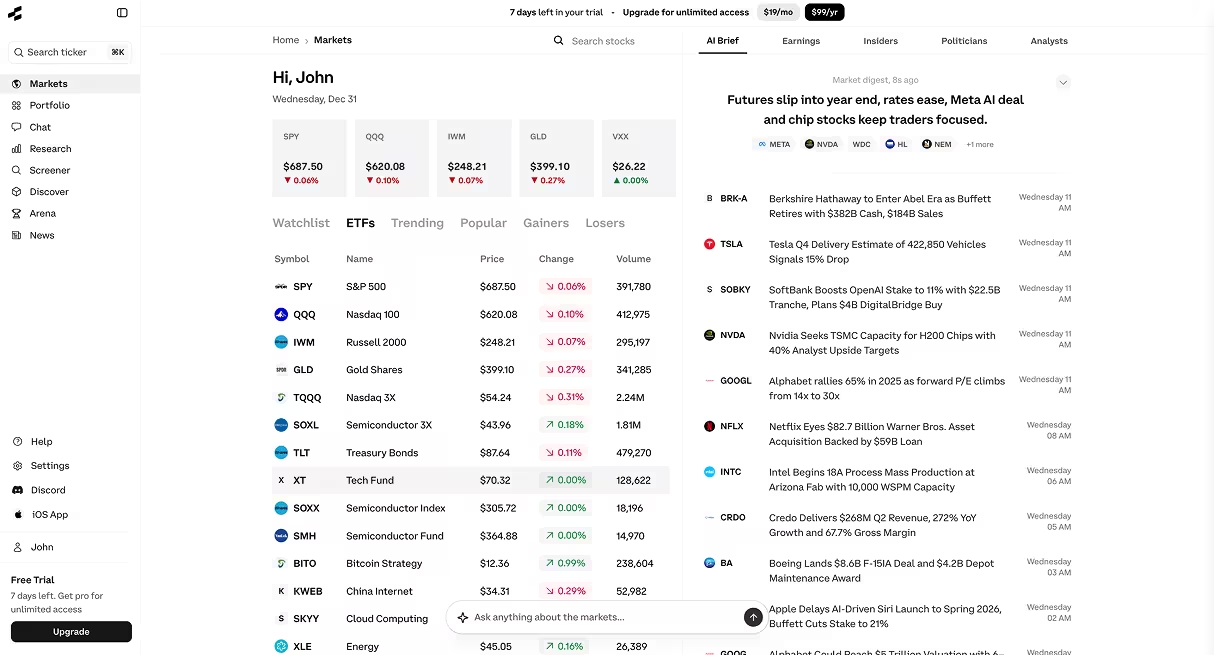
You can find shares outstanding in a company's most recent quarterly report (10-Q) or annual report (10-K) filed with the SEC. Most financial websites display both the current share count and market cap, saving you the calculation. The stock research page for any company shows this data updated in real-time.
One complication: companies report several share counts. Use "shares outstanding" or "basic shares outstanding," not diluted shares. Diluted shares include potential shares from stock options and convertible securities that don't yet exist. Market cap reflects actual shares currently trading.
Shares Outstanding: The total number of a company's shares currently held by all shareholders, including restricted shares owned by insiders. This excludes treasury shares the company has repurchased.
Market Cap Size Classifications
Investment professionals group companies into categories based on market cap ranges. These categories help investors set expectations for risk, growth potential, and volatility.
ClassificationMarket Cap RangeExample CompaniesTypical CharacteristicsMega-Cap$200B+Apple, Microsoft, AmazonHighest liquidity, lowest volatility, global operationsLarge-Cap$10B - $200BNetflix, Adobe, StarbucksEstablished businesses, steady growth, widely analyzedMid-Cap$2B - $10BEtsy, Crocs, Five BelowGrowth potential with moderate risk, less analyst coverageSmall-Cap$300M - $2BRegional banks, niche retailersHigher volatility, potential for rapid growth, less liquidMicro-CapUnder $300MEarly-stage public companiesHighest risk, lowest liquidity, limited information
These ranges aren't standardized across the industry. Some analysts place the large-cap threshold at $8 billion instead of $10 billion. Index providers use their own cutoffs. The key is understanding relative size, not memorizing exact boundaries.
Historical returns show patterns by size category. According to data from the Center for Research in Security Prices covering 1926-2023, small-cap stocks returned 11.9% annually versus 10.3% for large-caps. But small-caps experienced roughly 50% higher volatility, meaning bigger gains came with bigger drawdowns.
Portfolio diversification often involves mixing market cap categories. A balanced portfolio might hold 70% large-cap stocks for stability and 30% mid- and small-cap stocks for growth potential. The Vibe Screener lets you filter stocks by market cap range when building a diversified watchlist.
Why Market Cap Matters for Investors
Market cap influences four key aspects of stock investing: risk level, liquidity, growth potential, and index inclusion. Understanding these relationships helps investors build portfolios aligned with their goals.
Risk and Volatility Patterns
Larger market caps generally correlate with lower price volatility. Microsoft's stock might move 2-3% on an earnings report, while a $500 million small-cap could swing 15-20% on similar news. This happens because large-caps have more diverse revenue streams, deeper management teams, and broader analyst coverage that reduces information asymmetry.
Beta coefficients support this pattern. The average large-cap stock has a beta near 1.0 (moving in line with the market), while small-caps average betas of 1.2-1.4 (amplifying market movements by 20-40%).
Liquidity and Trading Considerations
Market cap directly impacts how easily you can buy or sell shares. Apple trades 50-70 million shares daily with minimal bid-ask spread. A micro-cap might trade 50,000 shares per day with a 2-3% spread between buy and sell prices. If you need to sell a large position quickly, that spread represents real cost.
For investors with portfolios under $100,000, liquidity differences rarely matter. For those managing $1 million+, small-cap positions become harder to enter and exit without moving the price.
Growth Potential Differences
A $10 billion company can realistically double to $20 billion by capturing more market share or expanding into adjacent markets. A $3 trillion company doubling to $6 trillion would require unprecedented value creation—adding the equivalent of five Amazons.
This math explains why small-caps and mid-caps often appear in growth-focused portfolios. They have more room to expand before hitting market saturation. The tradeoff is higher failure risk—small companies are more vulnerable to competitive threats, economic downturns, and operational mistakes.
Index Inclusion and Passive Flows
Market cap determines which indexes include a stock. The S&P 500 requires minimum market cap around $14 billion (along with profitability and other criteria). Russell 2000 captures small-caps. These classifications matter because index funds must buy stocks when they're added and sell when removed, creating price pressure independent of business fundamentals.
Approximately 40% of U.S. stock market value is held in index funds as of 2024. When a stock crosses into large-cap territory and enters the S&P 500, billions of dollars in passive capital automatically flow in. The thematic portfolios approach focuses on business fundamentals rather than market cap tiers.
What Market Cap Doesn't Tell You
Market cap measures market perception, not business reality. It reflects what investors will pay today, which can diverge significantly from intrinsic value, debt levels, or operational health.
Market Cap Limitations
- Ignores debt burden—two companies with identical market caps may have vastly different debt loads
- Doesn't account for cash reserves that could fund acquisitions or weather downturns
- Reflects market sentiment that can detach from fundamentals during bubbles or crashes
- Doesn't indicate profitability—unprofitable companies can have large market caps during growth phases
- Vulnerable to manipulation through low-float stocks where small share counts exaggerate valuation
Consider two hypothetical $50 billion companies. Company A has $30 billion in debt and $2 billion cash. Company B has $5 billion in debt and $15 billion cash. Market cap treats them identically, but Company B's balance sheet is far stronger. An acquirer would need to pay $78 billion for Company A ($50B equity + $30B debt - $2B cash) versus $40 billion for Company B.
Market cap also fluctuates with sentiment cycles that don't reflect business changes. Tesla's market cap exceeded $1 trillion in late 2021, dropped to $350 billion in 2022, then recovered to $800 billion by early 2024—despite delivering similar vehicle volumes across all three periods. Price movements reflected shifting investor expectations about future growth, not current operations.
For comprehensive analysis, combine market cap with other valuation ratios. The price-to-earnings ratio contextualizes market cap against profits. The price-to-sales ratio helps when evaluating unprofitable growth companies. Enterprise value provides a fuller picture of total valuation. You can explore these metrics in the complete guide to financial ratios.
Market Cap vs. Enterprise Value
Enterprise value (EV) expands on market cap by including debt and subtracting cash, providing a more complete picture of what it would cost to acquire an entire company. Investors comparing two companies should often use EV instead of market cap alone.
Enterprise Value: A company's total value calculated as market cap plus debt minus cash and cash equivalents. It represents the theoretical takeover price for the entire business.
Enterprise Value = Market Cap + Total Debt - Cash and Cash Equivalents
Here's why this matters with a real example. In 2023, Ford had a market cap around $48 billion but carried $130 billion in automotive debt (typical for car manufacturers that finance vehicle loans). After subtracting $25 billion in cash, Ford's enterprise value was approximately $153 billion—more than triple its market cap.
MetricWhat It IncludesBest Used ForMarket CapEquity value onlyComparing similar companies, tracking size changes, index classificationEnterprise ValueEquity + debt - cashValuation multiples (EV/EBITDA), acquisition analysis, capital-intensive industries
When comparing companies across industries, EV-based ratios often work better than market cap ratios. The EV/EBITDA multiple (enterprise value divided by earnings before interest, taxes, depreciation, and amortization) lets you compare companies with different capital structures. A company might look cheap on a P/E basis but expensive on EV/EBITDA once you account for debt.
Software companies with minimal debt and large cash hoards often have enterprise values below their market caps. Enterprise software firm Atlassian, for example, has historically traded with an enterprise value 10-15% below its market cap due to substantial cash reserves and zero debt. For these companies, market cap and EV tell different stories.
How to Research Market Cap Data
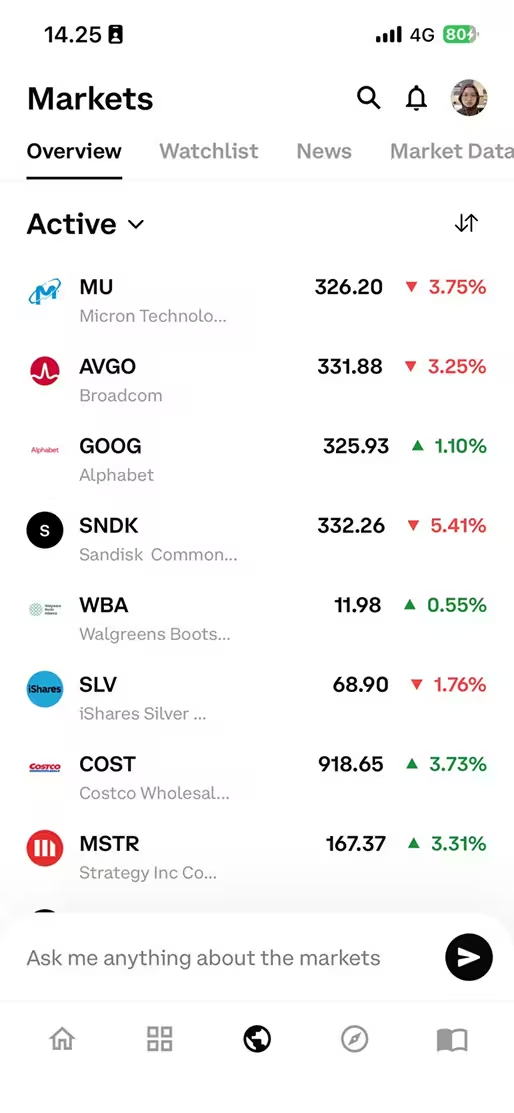
Finding market cap data takes seconds with modern tools. Every financial website and platform displays current market cap prominently on stock quote pages. The challenge isn't finding the number—it's understanding what it means in context.
When researching a stock's market cap, ask these questions:
- How does this market cap compare to competitors in the same industry?
- Has market cap grown in line with revenue and earnings growth?
- What's the enterprise value, and how much does debt impact total valuation?
- Where does this fall in the market cap spectrum for my portfolio strategy?
The AI Research Assistant can answer contextual questions like "How does Shopify's market cap compare to other e-commerce platforms?" or "What's the average market cap for biotechnology companies?" This helps you move beyond the raw number to understand relative positioning.
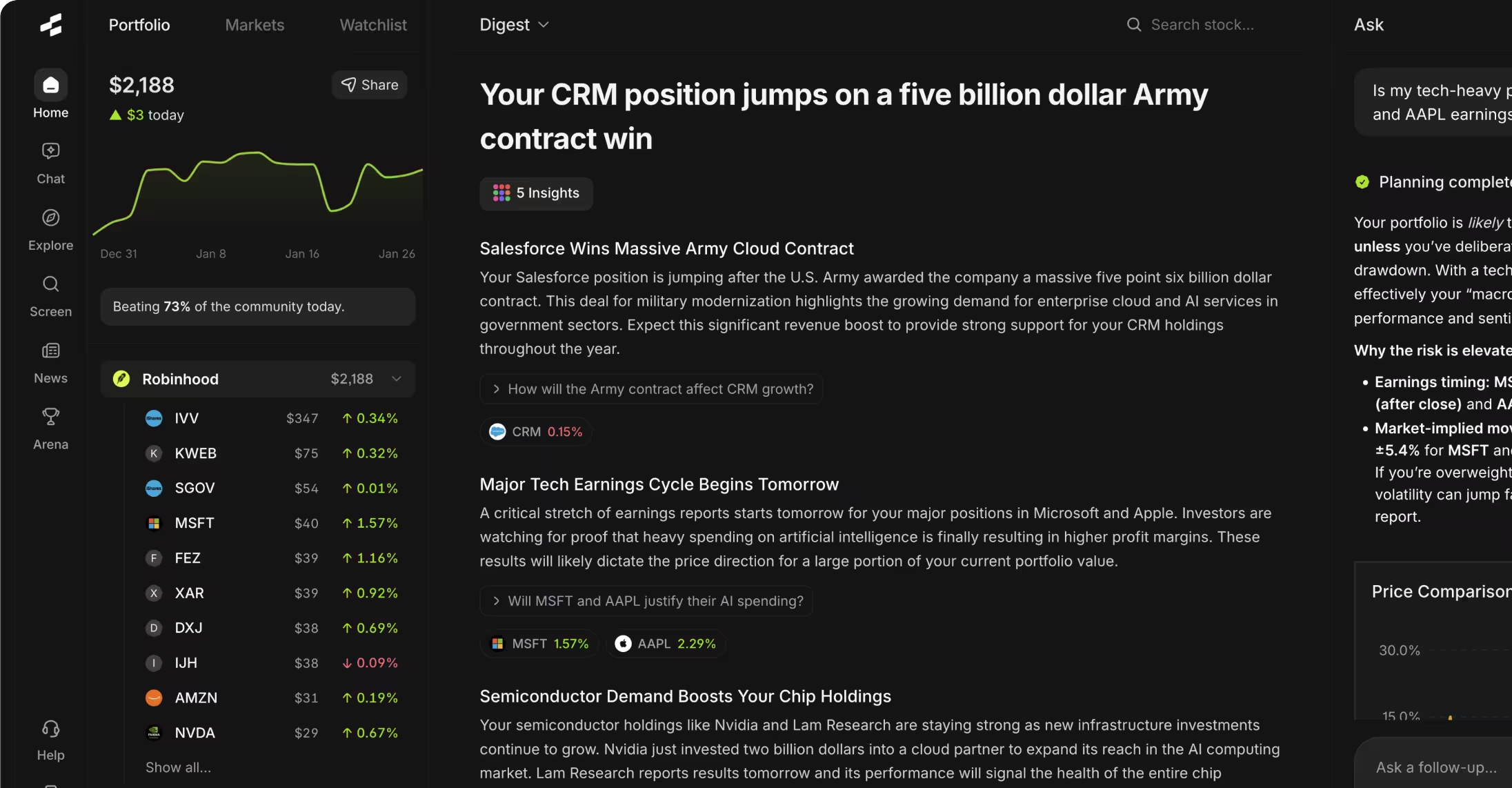
For portfolio construction, tracking market cap allocation matters as much as sector allocation. Your portfolio might unintentionally become too concentrated in large-caps or too heavy in small-caps. Portfolio tracking tools visualize your market cap exposure, showing whether you're actually diversified across size categories or clustered in one segment.
When screening for stocks, market cap filters help narrow vast universes into manageable lists. You might screen for mid-cap technology companies with positive earnings growth, or small-cap industrials with low debt-to-equity ratios. Natural language search tools let you describe criteria like "profitable small-cap stocks under $1 billion market cap with growing revenue" without manually setting multiple filters.
Frequently Asked Questions
1. Does a stock split change market capitalization?
No, stock splits don't change market cap. When a company executes a 2-for-1 split, the share count doubles and the price halves, leaving total market cap unchanged. If a stock traded at $200 with 1 billion shares outstanding ($200B market cap), after a 2-for-1 split it would trade at $100 with 2 billion shares outstanding—still $200B market cap. Splits improve liquidity by lowering the per-share price but don't alter company value.
2. Can market cap be negative?
No, market cap cannot be negative because both inputs (share price and shares outstanding) are positive numbers. Even financially distressed companies with negative book value maintain positive market caps as long as their stock trades above zero. Market cap only reaches zero if a company's shares become completely worthless, which typically happens through bankruptcy or delisting.
3. How often does market cap change?
Market cap changes every time the stock price moves during trading hours. For actively traded stocks, this means constant fluctuation throughout the day. After-hours trading also affects market cap, though with lower volume. Only the number of shares outstanding remains relatively static, typically changing quarterly when companies issue new shares or complete buybacks.
4. What happens to market cap during a buyback?
Share buybacks reduce shares outstanding, which mechanically increases market cap per remaining share if the stock price stays constant. However, buybacks typically boost the stock price as well (reducing supply while signaling management confidence), creating a dual effect on market cap. The net impact varies—market cap might increase, decrease, or stay flat depending on how much the company pays relative to resulting price appreciation.
5. Why do some small companies have huge market caps?
High-growth companies with minimal current revenue can achieve large market caps based on future potential. Tesla maintained a market cap above $500 billion while delivering fewer vehicles than Toyota (market cap around $250 billion) because investors priced in expected future dominance of electric vehicles, energy storage, and autonomous driving. Market cap reflects discounted future cash flows, not just current operations, which creates valuation disconnects between growth and value stocks.
6. How does market cap affect dividend investing?
Large-cap stocks typically offer more reliable dividends than small-caps. Of the S&P 500 (large-caps), roughly 80% pay dividends with a median yield around 1.8%. Among small-caps, only 40-50% pay dividends, and those payments are less consistent through economic cycles. Large companies have steadier cash flows and longer dividend histories. Investors seeking dividend income usually overweight large-caps while those targeting growth accept the lower dividend prevalence in small- and mid-caps.
Conclusion
Market cap provides a quick, standardized way to assess company size and compare businesses across sectors. By multiplying share price by shares outstanding, you get real-time insight into what the market believes a company is worth—though this reflects sentiment as much as fundamental value.
Understanding market cap classifications helps investors set appropriate expectations for risk, volatility, and growth potential. Large-caps offer stability and liquidity; small-caps provide growth opportunities with higher risk. Effective portfolios often blend categories rather than concentrating in a single size segment.
Market cap works best when combined with other investment metrics rather than used in isolation. Compare it to enterprise value for a fuller picture of total valuation. Pair it with price multiples and profitability ratios to assess whether current market cap reflects reasonable expectations for future performance. Consider it alongside sector diversification and your personal risk tolerance when constructing a portfolio.
Want to explore more valuation concepts? Read our complete Financial Metrics Encyclopedia or ask the AI Research Assistant to explain how different valuation ratios apply to specific stocks.
References
- U.S. Securities and Exchange Commission. "Form 10-Q Quarterly Report." https://www.sec.gov/forms
- Center for Research in Security Prices, University of Chicago Booth School of Business. "CRSP Stock Market Indexes." https://www.crsp.org/
- S&P Dow Jones Indices. "S&P 500 Index Methodology." https://www.spglobal.com/spdji/en/
- FTSE Russell. "Russell U.S. Equity Indexes." https://www.ftserussell.com/products/indices/russell-us
- Investment Company Institute. "2024 Investment Company Fact Book." https://www.ici.org/
Disclaimer: This article is for educational and informational purposes only. It does not constitute investment advice, financial advice, trading advice, or any other type of advice. Rallies.ai does not recommend that any security, portfolio of securities, transaction, or investment strategy is suitable for any specific person.
Risk Warning: All investments involve risk, including the possible loss of principal. Past performance does not guarantee future results. Before making any investment decision, you should consult with a qualified financial advisor and conduct your own research.
Written by: Gav Blaxberg
CEO of WOLF Financial | Co-Founder of Rallies.ai