


Researching stocks before buying involves analyzing a company's financial statements, evaluating its competitive position and management quality, understanding its business model, and assessing valuation metrics relative to peers and historical averages. The process typically includes reviewing SEC filings like 10-Ks and 10-Qs, examining revenue growth and profit margins, checking debt levels, and comparing price-to-earnings and other multiples to industry benchmarks before making an investment decision.
Key Takeaways
- Start with SEC filings—10-Ks provide annual financial data while 10-Qs offer quarterly updates on revenue, expenses, and risk factors
- Focus on five core metrics: revenue growth rate, profit margins, debt-to-equity ratio, free cash flow, and P/E ratio relative to industry peers
- Evaluate qualitative factors including management track record, competitive advantages (moats), and industry headwinds or tailwinds
- Compare valuation multiples against the company's 5-year historical average and at least 3-5 direct competitors in the same sector
- Document your research findings in a consistent framework to avoid emotional decision-making and track your thesis over time
Table of Contents
- Why Research Matters Before Buying Stocks
- Where to Find Reliable Company Information
- How to Read Financial Statements
- Which Metrics to Prioritize
- Evaluating Competitive Position and Moats
- How to Assess If a Stock Is Overpriced
- Analyzing Management and Corporate Governance
- Building Your Stock Research Framework
- Frequently Asked Questions
- Conclusion
Why Research Matters Before Buying Stocks
Stock research reduces the risk of buying overvalued companies or businesses with deteriorating fundamentals. Without proper due diligence, investors often chase momentum, react to headlines, or follow tips that lack factual basis.
A 2023 study by DALBAR found that the average equity investor earned just 6.8% annually over the 20-year period ending December 2022, while the S&P 500 returned 9.8% annually during the same period. This 3-percentage-point gap stems largely from poor timing decisions driven by emotional reactions rather than fundamental analysis.
Thorough research helps you understand what you own and why. When a stock drops 20%, investors who completed solid research can evaluate whether the decline reflects temporary market sentiment or genuine business deterioration. Those who bought without research typically panic sell at the worst time.
Where to Find Reliable Company Information
The SEC's EDGAR database at sec.gov provides free access to all public company filings, including 10-Ks, 10-Qs, 8-Ks, and proxy statements. These documents contain verified financial data that companies file under penalty of law, making them more reliable than press releases or media coverage.
Form 10-K: An annual report that public companies must file with the SEC, containing audited financial statements, management discussion and analysis, risk factors, and detailed business descriptions. It's the most comprehensive source for company fundamentals.
Form 10-K appears within 60-90 days after a company's fiscal year ends and typically runs 100-300 pages. Key sections include Item 1 (Business), Item 7 (Management's Discussion and Analysis), and Item 8 (Financial Statements). Item 1A (Risk Factors) lists everything that could go wrong with the business—reading this section prevents surprises.
Form 10-Q provides quarterly updates filed within 40-45 days of quarter-end. These documents are shorter (30-50 pages) and contain unaudited financials, but they help you track recent trends in revenue, expenses, and cash flow between annual reports.
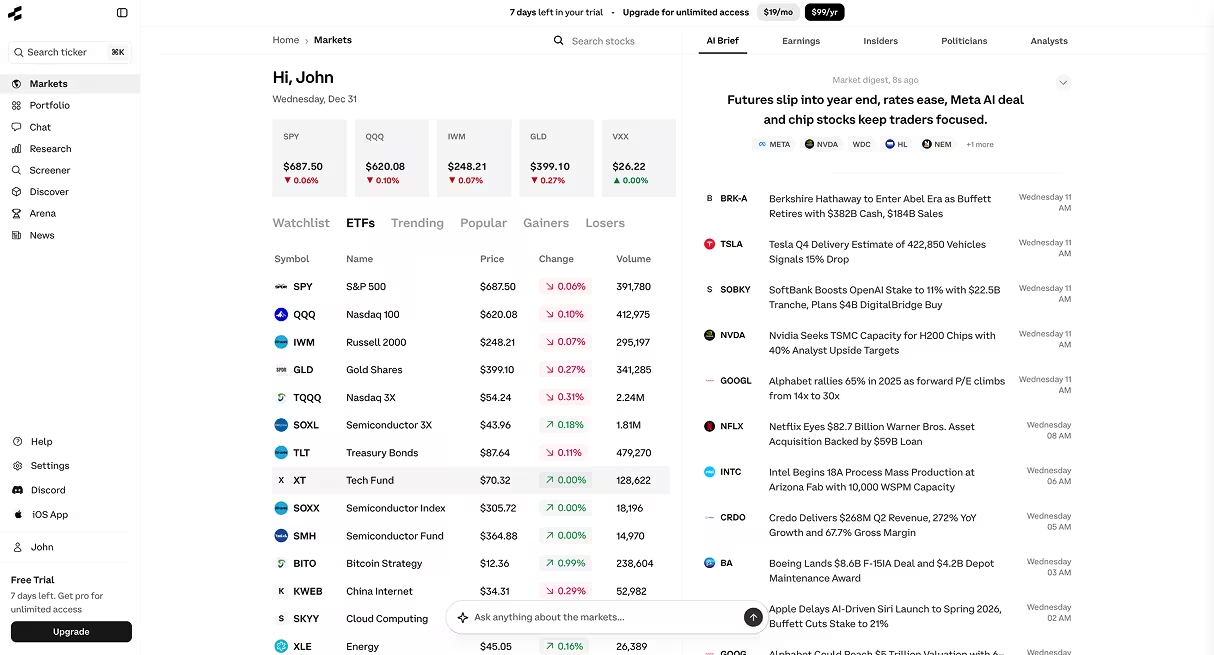
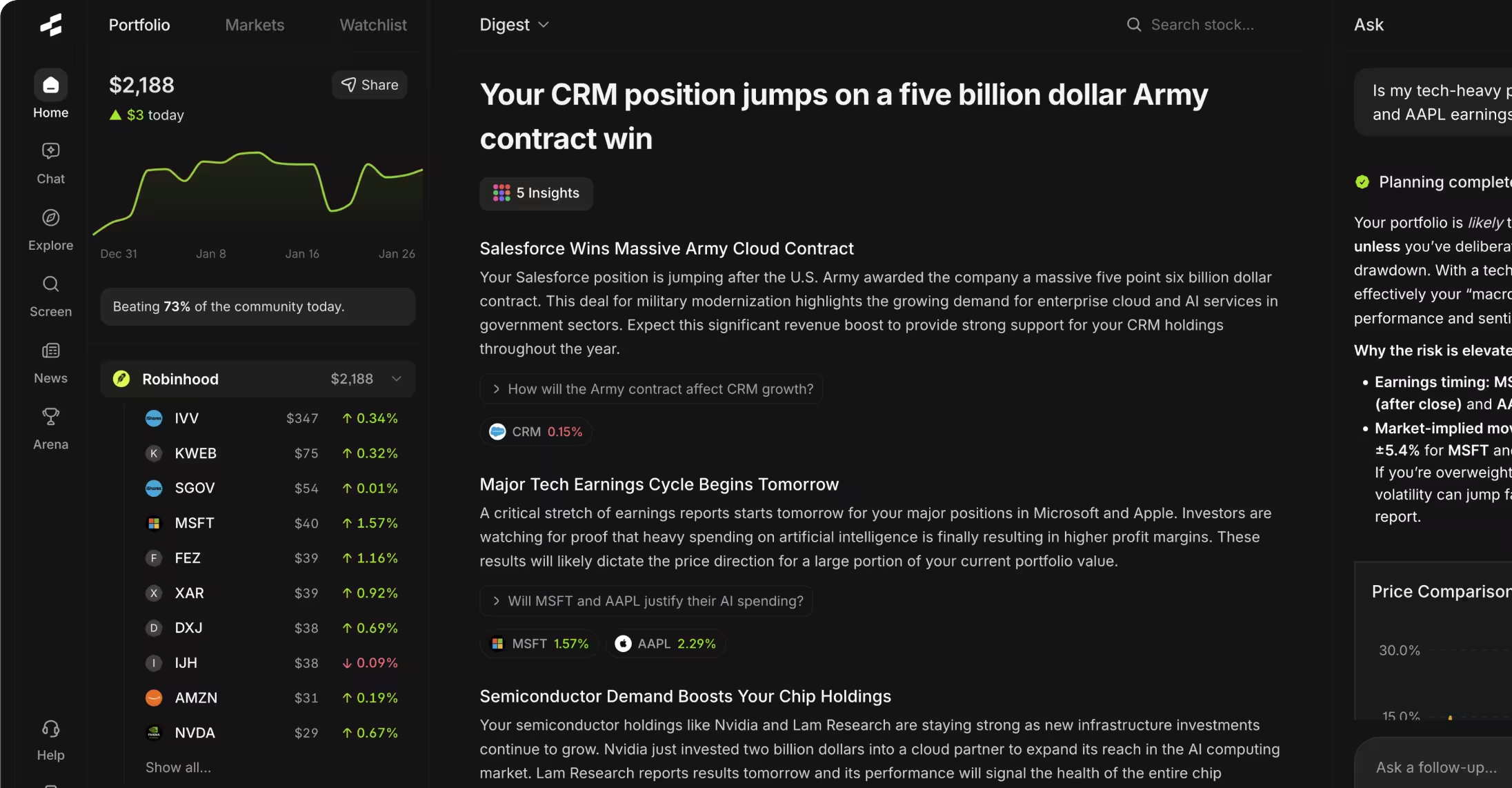
Beyond SEC filings, earnings call transcripts published on company investor relations pages reveal management's explanation of results and forward guidance. Sites like Rallies.ai's stock research pages aggregate this data alongside analyst ratings and news for faster access to multiple data sources.
Alternative Data Sources
Company investor relations pages offer presentations, earnings releases, and annual shareholder letters. Many institutional investors read Warren Buffett's Berkshire Hathaway shareholder letters to learn his research approach—these letters explain his investment thesis for each major holding in plain language.
Industry trade publications and regulatory databases provide context on sector trends. For healthcare stocks, check FDA approval databases. For energy companies, review EIA production data. Context matters because a company can execute well while the entire industry faces headwinds.
How to Read Financial Statements
Financial statements consist of three core documents: the income statement (shows revenue and expenses), the balance sheet (shows assets and liabilities at a point in time), and the cash flow statement (shows actual cash moving in and out). Understanding how these three statements connect is fundamental to stock research.
The income statement tells you if the business is profitable. Look at the top line (revenue) and bottom line (net income), but don't stop there. Gross profit margin reveals pricing power and cost structure. Operating income shows profitability before interest and taxes, indicating core business performance before financial engineering.
Statement What It Shows Key Line Items Income Statement Profitability over a period Revenue, gross profit, operating income, net income Balance Sheet Financial position at a moment Cash, total assets, total debt, shareholders' equity Cash Flow Statement Actual cash generation Operating cash flow, capex, free cash flow
The balance sheet reveals financial health. Current assets minus current liabilities equals working capital—positive working capital means the company can pay short-term obligations. Total debt compared to shareholders' equity (the debt-to-equity ratio) indicates leverage risk. Companies with debt-to-equity above 2.0 face higher bankruptcy risk during downturns.
Free Cash Flow: Cash from operations minus capital expenditures, representing the cash available for dividends, buybacks, debt repayment, or acquisitions. Positive free cash flow indicates a company generates more cash than it needs to maintain operations.
The cash flow statement is often the most revealing. A company can show net income on the income statement while burning cash—this happens when revenue is recorded before cash is collected or when non-cash charges distort net income. Operating cash flow that consistently exceeds net income indicates high-quality earnings.
Red Flags in Financial Statements
Watch for deteriorating metrics. If revenue grows 15% but receivables grow 30%, customers may not be paying their bills. If inventory grows faster than sales, products may be sitting unsold. If operating cash flow is consistently below net income, accounting choices may be inflating reported profits.
Frequent restatements of prior results signal accounting problems. Serial acquirers with goodwill exceeding 50% of total assets may have overpaid for acquisitions. Rising stock-based compensation dilutes existing shareholders and can mask true labor costs.
Which Metrics to Prioritize
Focus on five core metrics during initial research: revenue growth rate, net profit margin, return on equity (ROE), debt-to-equity ratio, and free cash flow yield. These metrics cover growth, profitability, efficiency, financial risk, and cash generation.
Revenue growth rate shows if the business is expanding. Calculate it by comparing this year's revenue to last year's: (Current Year Revenue - Prior Year Revenue) / Prior Year Revenue. Growth above 15% annually is considered strong for mature companies, though acceptable rates vary by industry. Technology companies often target 20-30% growth while utilities may grow just 2-5%.
Net Profit Margin: Net income divided by revenue, expressed as a percentage. It shows how much profit a company keeps from each dollar of sales after all expenses, taxes, and interest. Margins above 20% indicate strong pricing power or operational efficiency.
Net profit margin reveals efficiency and pricing power. Calculate it as Net Income / Revenue. Software companies often achieve 25-35% margins while retailers typically run 2-5% margins. Compare a company's current margin to its 5-year average and to at least three competitors.
Return on Equity and Capital Efficiency
Return on equity (ROE) measures how effectively a company uses shareholder money. Calculate it as Net Income / Shareholders' Equity. ROE above 15% is considered good, above 20% is excellent. Warren Buffett targets companies with consistent ROE above 15% over multiple years.
However, high debt inflates ROE because it reduces equity in the denominator. A company with $100 million in net income and $500 million in equity has 20% ROE. If it borrows $300 million and buys back stock, reducing equity to $200 million, ROE jumps to 50% without any improvement in actual business performance. Always check ROE alongside debt-to-equity ratio.
Metric Formula Good Benchmark Revenue Growth (Current - Prior) / Prior 15%+ for growth stocks Net Profit Margin Net Income / Revenue 15-20%+ (varies by sector) Return on Equity Net Income / Equity 15%+ consistently Debt-to-Equity Total Debt / Equity Below 1.0 for safety Free Cash Flow Yield FCF / Market Cap 5%+ indicates value
Free Cash Flow Yield
Free cash flow yield equals Free Cash Flow / Market Capitalization. This metric shows what percentage return you'd get if the company distributed all free cash to shareholders. A 5% free cash flow yield on a $10 billion company means it generates $500 million in annual free cash flow.
Companies with yields above 8% may be undervalued, though persistently high yields sometimes signal business deterioration rather than opportunity. Compare free cash flow yield to the 10-year Treasury yield (the risk-free rate)—stocks should offer higher yields to compensate for additional risk.
Evaluating Competitive Position and Moats
A competitive moat is a sustainable advantage that protects a company from competitors and allows it to maintain high returns on capital over time. Companies without moats face constant margin pressure as competitors undercut prices or customers switch to alternatives.
Warren Buffett popularized the moat concept and identified several types. Network effects create moats when a product becomes more valuable as more people use it—credit card networks like Visa benefit from this. Cost advantages from scale allow companies like Walmart to offer lower prices than smaller competitors. High switching costs keep customers locked in—enterprise software companies benefit when changing systems would disrupt operations.
Economic Moat: A structural competitive advantage that allows a company to earn excess returns on capital for extended periods. Moats protect profit margins from competitors and create predictable cash flows, making a company more valuable to long-term investors.
Signs of a Strong Moat
- Gross margins consistently 10+ percentage points above competitors
- ROE above 15% sustained for 10+ years
- Pricing power demonstrated by raising prices without losing customers
- High customer retention rates (95%+ for subscription businesses)
- Brand value allowing 20%+ price premiums over generic alternatives
Red Flags Indicating No Moat
- Frequent price wars or promotional discounting to maintain share
- Customer acquisition costs rising faster than lifetime value
- Inability to raise prices even when input costs increase
- High customer churn rates (15%+ annually)
- Declining market share despite maintaining price
How to Identify Moats in SEC Filings
The 10-K's Business section (Item 1) describes competitive advantages if management believes they exist. Look for specific claims about market share, patents, exclusive supplier relationships, or proprietary technology. Then verify these claims by checking if margins and returns on capital actually exceed competitors.
Patent portfolios create temporary moats but expire after 20 years. Pharmaceutical companies face "patent cliffs" when blockbuster drugs lose exclusivity—research if the company has new products in development to replace expiring patents. Check FDA databases to see what's in clinical trials.
Brand moats show up in pricing. Compare a branded product's price to generic alternatives. Coca-Cola commands 30-40% premiums over private-label colas because consumers perceive differentiation. Commodity businesses like steel manufacturers can't charge premiums because buyers see all products as interchangeable.
Industry Structure and Porter's Five Forces
Evaluate the broader competitive environment using Michael Porter's framework. Industries with few competitors, high barriers to entry, weak supplier power, and customers with few alternatives tend to generate better returns. Airlines face brutal competition, powerful suppliers (Boeing and Airbus), price-sensitive customers, and low barriers to entry for new routes—this structure explains why most airlines struggle to generate consistent returns.
Check industry concentration by reviewing market share data in trade publications. Industries where the top three players control 70%+ of market share (like credit cards or soft drinks) typically have better economics than fragmented industries where the top player has less than 10% share.
How to Assess If a Stock Is Overpriced
Valuation compares a stock's current price to its intrinsic value based on fundamentals. The price-to-earnings (P/E) ratio is the most common starting point—it shows how many dollars you pay for each dollar of annual earnings. A P/E of 25 means you're paying $25 for $1 of annual profit.
No single P/E ratio works for all stocks. Technology companies with 25% annual growth typically trade at P/E ratios of 30-50 while slow-growing utilities trade at P/E ratios of 12-18. Compare a company's P/E to three benchmarks: its own 5-year average, its industry peers, and the broader market (S&P 500 historically trades at P/E of 15-20).
Valuation Metric Best Used For Limitation P/E Ratio Profitable, mature companies Doesn't work for unprofitable companies Price-to-Sales Unprofitable growth companies Ignores profitability differences Price-to-Book Financial companies, asset-heavy businesses Irrelevant for asset-light business models EV/EBITDA Comparing companies with different capital structures EBITDA ignores capex requirements DCF Analysis Any company with predictable cash flows Highly sensitive to assumption changes PEG Ratio: The P/E ratio divided by the expected annual earnings growth rate. A PEG below 1.0 suggests a stock may be undervalued relative to its growth, while PEG above 2.0 suggests overvaluation. This metric adjusts for growth rate differences between companies.
Price-to-Sales and Growth Companies
Price-to-sales (P/S) ratio works for unprofitable companies that can't be valued on earnings. Calculate it as Market Capitalization / Annual Revenue. Fast-growing software companies often trade at P/S ratios of 10-20 if they're expected to reach high profit margins at scale. Retailers typically trade at P/S below 1.0 because they operate on thin margins.
A 2022 analysis by Morgan Stanley found that unprofitable technology companies with P/S ratios above 30 during 2020-2021 subsequently declined 70-90% as interest rates rose. High P/S ratios require extreme growth to justify valuations—a company at 20x sales needs to roughly double revenue while expanding margins significantly to deliver returns matching the broader market.
Discounted Cash Flow Analysis
Discounted cash flow (DCF) models estimate intrinsic value by projecting future free cash flows and discounting them to present value. This approach requires forecasting 5-10 years of cash flows and assuming a terminal growth rate, then applying a discount rate (typically 8-12% for stocks).
DCF valuations are highly sensitive to assumptions. Changing the discount rate from 10% to 12% can reduce estimated value by 25-30%. Changing the terminal growth rate from 3% to 4% can increase value 20-30%. Use DCF to understand the growth and margin assumptions baked into current prices rather than as a precise calculator of value.
Tools like Rallies.ai's AI Research Assistant can run DCF scenarios and show how value changes with different assumptions, helping you understand what needs to happen for current prices to make sense.
Analyzing Management and Corporate Governance
Management quality determines whether good businesses achieve their potential. Skilled managers allocate capital effectively, maintain strategic focus, and communicate honestly with shareholders. Poor managers destroy value through ill-timed acquisitions, excessive compensation, or misleading disclosures.
Review the proxy statement (DEF 14A) to understand executive compensation. Look for pay structures tied to long-term performance metrics like return on invested capital or total shareholder return over 3-5 years. Red flags include compensation that's 2-3 times higher than industry peers without corresponding superior performance, or bonus targets that encourage short-term thinking.
CEO Background and Track Record
Research the CEO's career history through LinkedIn and previous company disclosures. Founders who built the business often have different priorities than professional CEOs hired from outside. Founder-CEOs tend to think long-term but may resist needed changes. Outside CEOs bring fresh perspective but may focus on short-term stock price to secure their position.
Review the CEO's capital allocation decisions over the past 5-10 years. Did acquisitions create value or destroy it? Check if acquired companies are growing or if they've written down acquisition values (recorded goodwill impairment charges). Companies that consistently buy back stock when shares are overvalued destroy shareholder value—buybacks should happen when stock trades below intrinsic value.
Board Independence and Governance
The proxy statement lists board members and their backgrounds. Strong boards have majority-independent directors with relevant industry expertise. Warning signs include boards dominated by friends or family of the CEO, directors who serve on 5+ other boards (they lack time to provide oversight), or lack of financial expertise on the audit committee.
Check if directors own meaningful stock in the company. Directors with minimal ownership (less than 1x their annual board compensation) lack financial incentive to challenge management. Significant insider buying—when executives use personal funds to purchase stock in the open market—signals confidence in future prospects.
Management Quality Checklist
- ☐ CEO compensation in line with industry peers (check proxy DEF 14A)
- ☐ Stock-based compensation under 3% of shares outstanding annually
- ☐ History of successful capital allocation (ROIC exceeding cost of capital)
- ☐ Majority-independent board with relevant industry expertise
- ☐ Directors own stock worth 3x+ their annual board fees
- ☐ Clear succession plan documented in proxy materials
- ☐ Consistent communication style in earnings calls over multiple quarters
- ☐ No recent restatements or SEC enforcement actions
Reading Between the Lines in Earnings Calls
Earnings call transcripts reveal management's communication style and priorities. Strong management teams give specific guidance, acknowledge challenges directly, and answer questions substantively. Poor management teams use vague language, blame external factors for all problems, or dodge difficult questions.
Pay attention to changes in tone or terminology quarter-over-quarter. If management suddenly stops providing specific guidance they've given for years, it may signal reduced visibility or deteriorating business fundamentals. If they introduce new non-GAAP metrics that paint a rosier picture than GAAP results, be skeptical.
Building Your Stock Research Framework
A consistent research framework prevents emotional decisions and creates a documented thesis you can review later. The framework should cover quantitative factors (numbers from financial statements), qualitative factors (moats and management), and valuation, with clear criteria for what makes a stock worth buying.
Start by defining your investment approach. Value investors focus on low P/E, P/B, or P/S ratios relative to history and peers. Growth investors accept higher valuations for companies expanding revenue 25%+ annually with improving margins. Quality investors emphasize high ROE, low debt, and consistent free cash flow regardless of valuation. Most successful individual investors combine elements of all three.
Creating a Stock Research Template
Document research in a reusable template that includes these sections:
Section Key Questions Data Sources Business Model How does it make money? What's the revenue model? 10-K Item 1, company presentations Financial Health Revenue growth, margins, debt levels, cash flow? 10-K/10-Q financial statements Competitive Position What moats exist? How defensible are they? 10-K risk factors, market share data Management Quality Track record? Compensation structure? Governance? Proxy statement, earnings calls Valuation P/E vs. peers? Justified by growth? DCF estimate? Financial data, peer analysis Risk Factors What could go wrong? How likely? What's the impact? 10-K Item 1A risk factors
Use the Vibe Screener to find stocks matching your criteria—you can describe what you're looking for in plain language rather than setting manual filters. For example, "technology companies with revenue growth above 20%, positive free cash flow, and P/E ratios below 30" returns a focused list for deeper research.
Tracking Your Investment Thesis
Write a brief thesis statement explaining why you're considering the stock. Good thesis statements are specific and falsifiable: "Company X will grow revenue 25% annually for three years as its new product line gains market share, while margins expand from 20% to 25% due to operating leverage. At 30x earnings, this growth justifies the valuation if it hits targets."
This thesis gives you concrete milestones to check quarterly. If revenue growth slows to 15% or margins contract, your thesis is breaking down and you can reevaluate the position objectively rather than holding based on hope.
How Much Research Is Enough?
The depth of research should match your position size and conviction. Peter Lynch recommended spending roughly one hour of research per $1,000 invested for individual stocks—a $5,000 position warrants 5 hours of work reviewing financial statements, competitive position, and valuation.
For smaller positions or diversified portfolios, focus research on the biggest risk factors and basic financial health. For concentrated positions representing 10%+ of your portfolio, complete thorough research including reading multiple years of 10-Ks, listening to several quarters of earnings calls, and building detailed financial models.
Frequently Asked Questions
1. How long should I research a stock before buying?
Most investors should spend 3-5 hours on initial research for a meaningful position, including reading the most recent 10-K, reviewing 2-3 years of financial trends, checking valuation against peers, and understanding the business model and competitive position. You can revisit stocks on your watchlist quarterly to track changes and decide if new information strengthens or weakens the investment case.
2. What's the difference between fundamental and technical analysis?
Fundamental analysis evaluates intrinsic value based on financial statements, competitive position, and business quality to determine if a stock is underpriced or overpriced long-term. Technical analysis studies price charts and trading patterns to identify momentum and timing for short-term trades. Most long-term investors rely primarily on fundamentals while using technical analysis secondarily for entry and exit timing.
3. Should I research stocks myself or rely on analyst reports?
Analyst reports provide useful starting points and data compilation, but you should verify key claims by checking SEC filings directly because analysts can be wrong or have conflicts of interest if their firm has investment banking relationships with covered companies. Doing your own research helps you understand what you own and avoid panic selling when stocks decline, since you'll have conviction based on primary sources rather than secondhand opinions.
4. How many stocks should I research before building a portfolio?
Research at least 15-20 companies thoroughly before investing to develop pattern recognition for what good businesses look like and to create a watchlist for opportunities. Most individual investors should own 15-25 stocks for adequate diversification—researching 50+ candidates gives you selectivity to choose only the best opportunities rather than settling for mediocre companies to fill portfolio slots.
5. What are the most important metrics for stock research?
The five most important metrics are revenue growth rate (shows business expansion), net profit margin (reveals profitability and pricing power), return on equity above 15% (indicates efficient use of capital), debt-to-equity ratio below 1.0 (shows financial stability), and free cash flow yield above 5% (suggests reasonable valuation). Compare all metrics to the company's 5-year history and to 3-5 direct competitors for context.
6. How do I know if a stock is overvalued?
Compare the stock's P/E ratio to its own 5-year average, to industry peers, and to the broader market, then assess if the premium is justified by superior growth or profitability. A stock trading at 40x earnings when its historical average is 25x and peers trade at 20x is overvalued unless earnings are accelerating significantly. Also check if free cash flow yield is below 3-4%—this suggests you're paying too much relative to cash generation.
7. Where can I find unbiased stock information?
SEC filings at sec.gov provide unbiased primary sources including 10-Ks, 10-Qs, and proxy statements filed under penalty of law. Government databases like the Federal Reserve Economic Data (FRED) and Bureau of Labor Statistics offer economic context, while academic research through Google Scholar provides peer-reviewed studies on investment strategies without commercial bias. Cross-reference claims you find in media or analyst reports against these primary sources.
Conclusion
Learning how to research stocks before buying requires reviewing SEC filings for verified financial data, analyzing key metrics like revenue growth and profit margins, evaluating competitive moats and management quality, and comparing valuation multiples to historical averages and peer companies. A systematic research framework documented in a reusable template helps you make objective decisions based on facts rather than emotions or market noise.
Start with one thorough research project on a company you already know as a customer or employee. Read the most recent 10-K cover to cover, build a simple spreadsheet tracking five years of revenue and margins, and compare the company's P/E ratio to three competitors. This hands-on practice develops skills more effectively than reading about research in abstract terms. As you complete more analyses, pattern recognition improves and the process becomes faster.
For a comprehensive overview of different analytical approaches and frameworks, read our complete guide to how to analyze stocks. To research specific companies more efficiently, explore how the AI Research Assistant can answer questions about financial metrics, competitive positioning, and valuation in plain English.
Want to dig deeper? Read our complete guide to how to analyze stocks or ask the AI Research Assistant your specific questions about any company.
References
- U.S. Securities and Exchange Commission. "Form 10-K." https://www.sec.gov/forms/form10-k
- U.S. Securities and Exchange Commission. "EDGAR Database." https://www.sec.gov/edgar/searchedgar/companysearch.html
- DALBAR, Inc. "Quantitative Analysis of Investor Behavior 2023." https://www.dalbar.com/QAIB/Index
- Porter, Michael E. "The Five Competitive Forces That Shape Strategy." Harvard Business Review, January 2008. https://hbr.org/2008/01/the-five-competitive-forces-that-shape-strategy
- Buffett, Warren E. "Berkshire Hathaway Shareholder Letters." https://www.berkshirehathaway.com/letters/letters.html
Disclaimer: This article is for educational and informational purposes only. It does not constitute investment advice, financial advice, trading advice, or any other type of advice. Rallies.ai does not recommend that any security, portfolio of securities, transaction, or investment strategy is suitable for any specific person.
Risk Warning: All investments involve risk, including the possible loss of principal. Past performance does not guarantee future results. Before making any investment decision, you should consult with a qualified financial advisor and conduct your own research.
Written by: Gav Blaxberg
CEO of WOLF Financial | Co-Founder of Rallies.ai