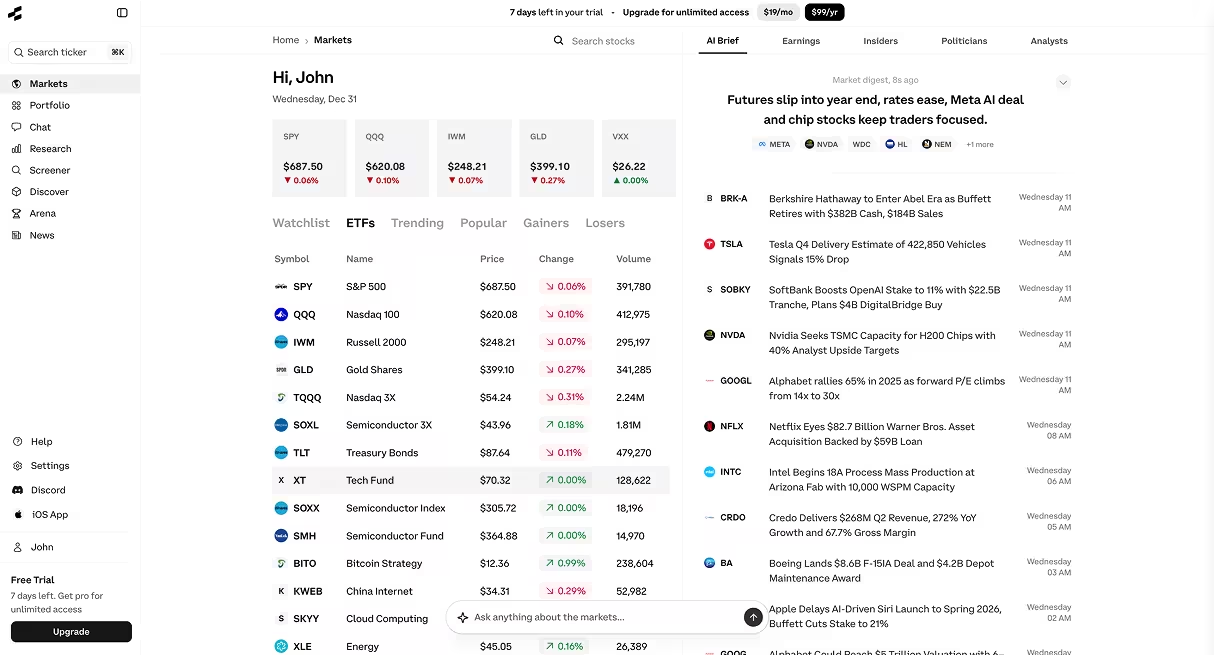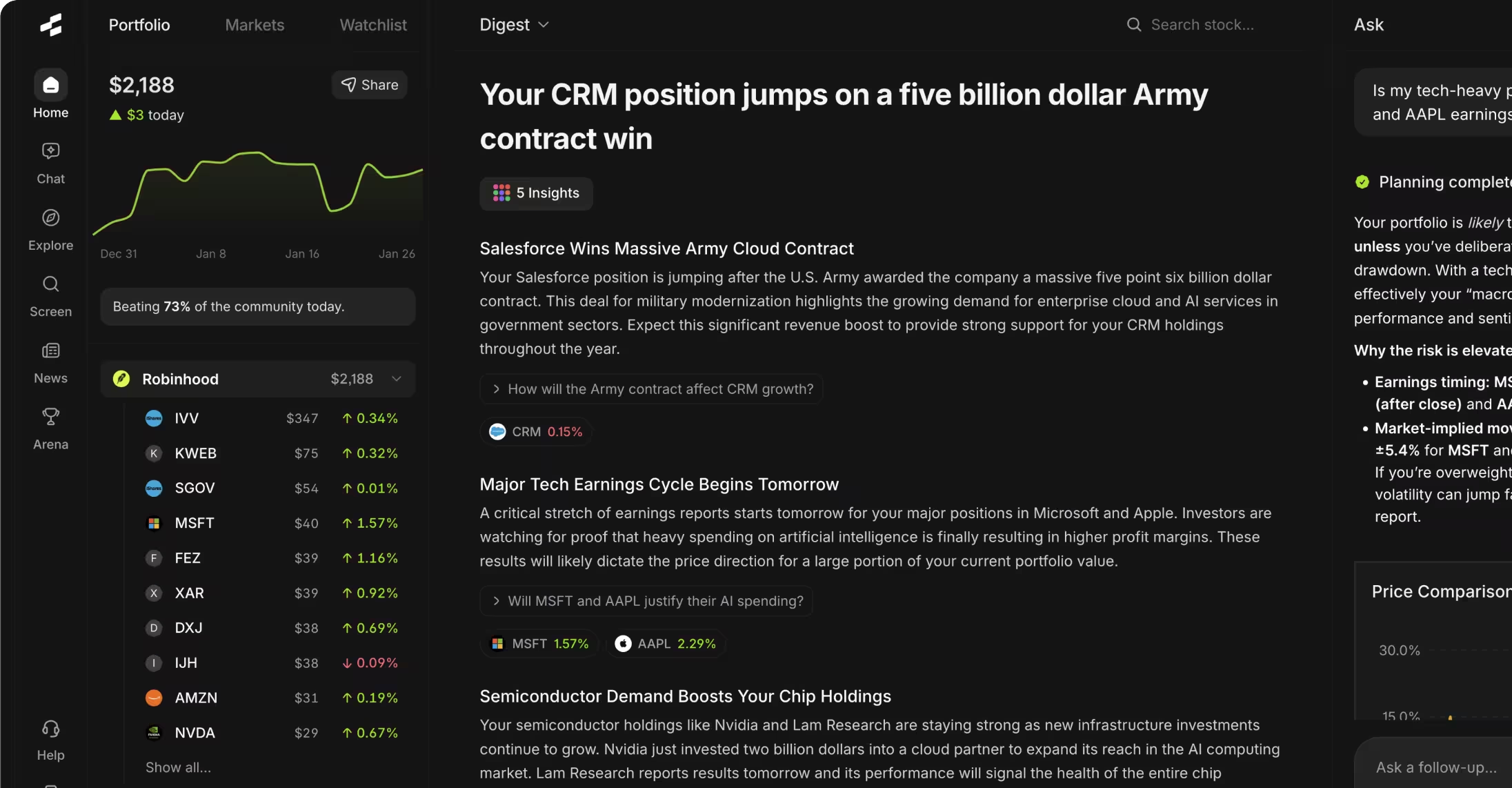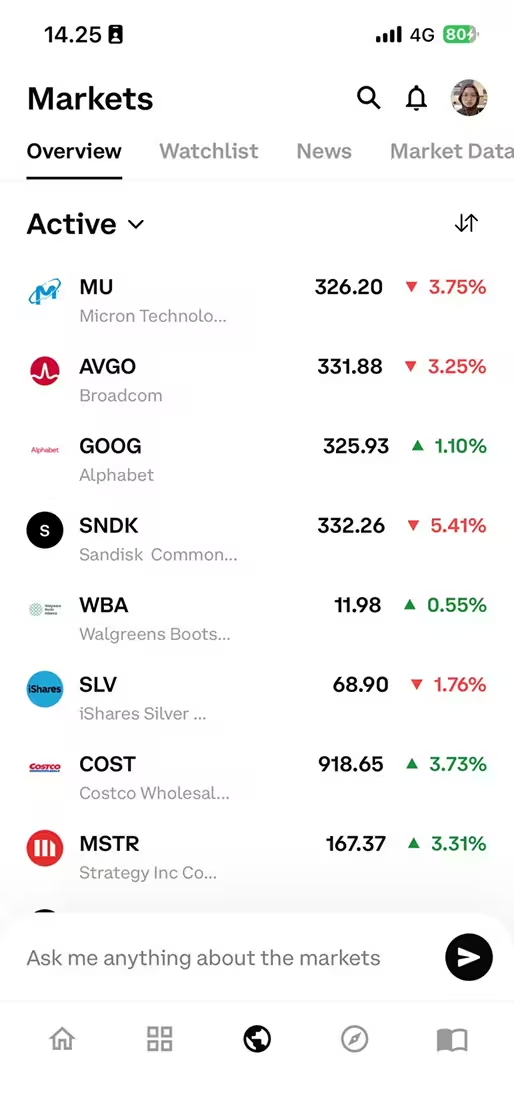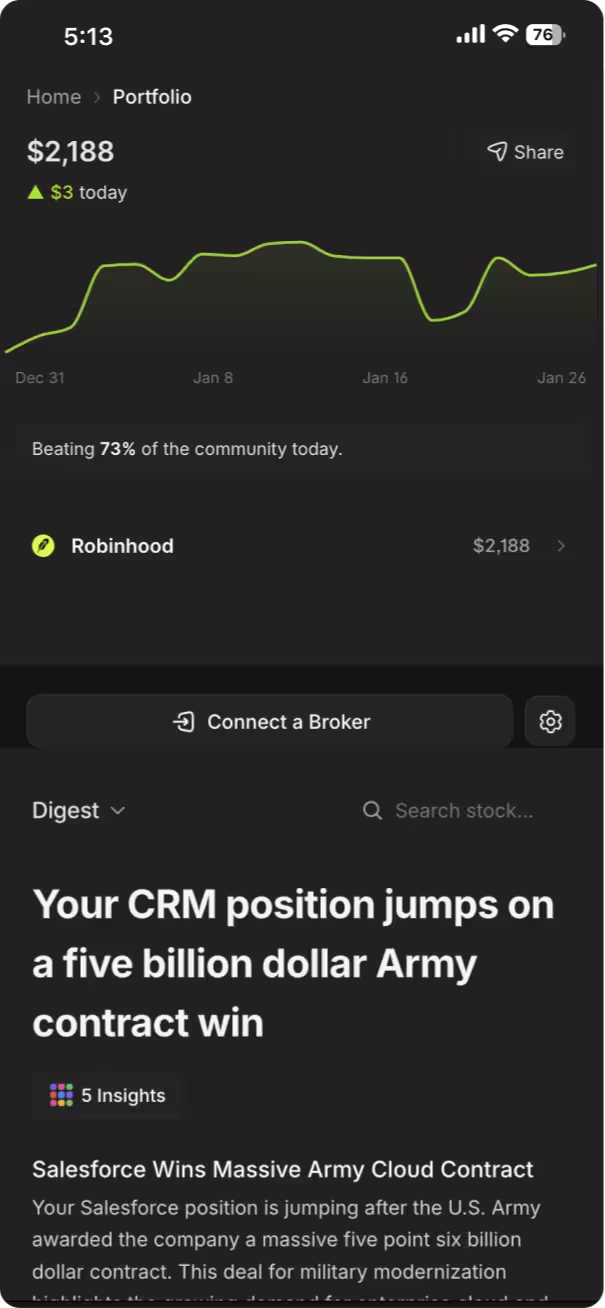



Yahoo Finance alternatives include platforms like Bloomberg Terminal, TradingView, Seeking Alpha, Finviz, and Rallies.ai, each offering different strengths in data depth, charting tools, community insights, and AI-powered research. While Yahoo Finance provides free basic stock quotes and news, alternatives often deliver more advanced screening tools, real-time data, institutional-grade analytics, or specialized features like natural language AI assistants that can answer complex research questions in seconds.
Key Takeaways
- Yahoo Finance serves 70+ million monthly users but lacks advanced screening, institutional data depth, and AI-powered research capabilities found in specialized alternatives
- Free alternatives like Finviz and TradingView offer superior charting and technical analysis tools, while paid platforms provide real-time data and deeper fundamental metrics
- Bloomberg Terminal and FactSet dominate institutional research at $24,000+ annually, but modern AI platforms deliver comparable insights at consumer-friendly prices
- The best alternative depends on your investor type—day traders need real-time data and advanced charts, while long-term investors benefit more from fundamental screening and AI research assistants
- Most serious investors use a combination of 2-3 platforms rather than relying on a single tool for all research needs
Table of Contents
- Why Look Beyond Yahoo Finance?
- Free Yahoo Finance Alternatives
- Paid Research Platforms Worth Considering
- AI-Powered Stock Research Tools
- Institutional-Grade Research Terminals
- How Do You Choose the Right Alternative?
- Platform Feature Comparison
- Frequently Asked Questions
- Conclusion
Why Look Beyond Yahoo Finance?
Yahoo Finance provides solid basic functionality for casual investors—free stock quotes, historical charts, and financial news aggregation. However, the platform shows its age when you need advanced screening capabilities, real-time institutional data, or modern AI-powered analysis tools that can answer complex research questions.
The platform's screening tool limits you to roughly 20 preset filters, while competitors offer 100+ customizable criteria. Yahoo Finance's 15-20 minute delayed quotes create problems for active traders who need to react to price movements. The news section aggregates content from other publishers rather than providing original research or analysis, and there's no way to ask questions in natural language or get AI-generated summaries of earnings reports.
Most significantly, Yahoo Finance lacks depth in alternative data sources. Modern investment research incorporates satellite imagery, credit card transaction data, social media sentiment, and other non-traditional metrics. These data points help investors spot trends before they appear in quarterly earnings reports, but Yahoo Finance doesn't integrate them into its platform.
Free Yahoo Finance Alternatives
Several free stock research platforms offer capabilities that match or exceed Yahoo Finance in specific areas. These platforms generate revenue through premium tiers, advertising, or data licensing rather than charging for basic access.
Finviz: Superior Screening and Visualization
Finviz provides one of the most powerful free stock screeners available, with 70+ filter criteria covering fundamentals, technical indicators, and descriptive metrics. The platform's heat map visualization shows the entire market's performance in a single color-coded grid, making it easy to spot sector rotation and market trends at a glance.
The free version includes 18 fundamental filters (P/E ratio, debt/equity, profit margin, etc.), 18 technical filters (moving averages, RSI, pattern recognition), and descriptive filters (sector, market cap, average volume). This beats Yahoo Finance's limited preset screens by a significant margin.
Heat Map: A data visualization technique that uses color intensity to represent numerical values across many data points simultaneously. In stock research, darker colors typically indicate stronger performance while lighter colors show weaker performance.
TradingView: Advanced Charting and Community
TradingView dominates free charting with professional-grade technical analysis tools and a social network of 50+ million traders sharing ideas. The platform offers 100+ technical indicators, custom indicator creation through Pine Script programming language, and drawing tools that rival paid alternatives.
The free tier allows one saved chart layout and three indicators per chart. You'll see ads and experience some feature limitations, but the core charting engine performs as well as platforms costing hundreds per month. The community aspect lets you follow experienced traders and see their analysis on specific stocks.
Seeking Alpha: Crowd-Sourced Research and Analysis
Seeking Alpha aggregates articles from thousands of independent contributors covering individual stocks, sectors, and market themes. While Yahoo Finance republishes news from major outlets, Seeking Alpha provides original analysis with specific price targets, thesis statements, and investment recommendations.
The free version limits you to 5-10 articles per month depending on content type. The comment sections often contain substantive debate between bulls and bears, helping you understand different perspectives on the same investment. Transcripts of earnings calls appear within hours of completion, faster than many paid services.
Paid Research Platforms Worth Considering
Paid stock research platforms justify their cost through real-time data, proprietary analytics, deeper historical databases, and professional-grade tools that serious investors use daily. These platforms typically range from $30 to $300 per month for retail investors.
Morningstar Premium: Fundamental Research Depth
Morningstar Premium costs $249 annually and provides the company's proprietary equity research on 1,500+ stocks, including fair value estimates, economic moat ratings, and uncertainty assessments. Analysts assign each stock a star rating (1-5 stars) based on their calculation of intrinsic value versus current market price.
The platform excels at mutual fund and ETF analysis with detailed breakdowns of holdings, expense ratios, manager tenure, and risk metrics. The X-Ray tool analyzes your entire portfolio to show hidden overlaps, sector concentrations, and fee totals across all your investments.
Stock Rover: Screening and Portfolio Analytics
Stock Rover starts at $7.99 monthly for Essentials and scales to $27.99 for Premium Plus. The platform provides 650+ metrics for screening—more than any competitor in its price range. You can create custom formulas combining multiple metrics, backtest screening strategies, and export results to spreadsheets.
Portfolio analytics include sector allocation, correlation matrices between holdings, and performance attribution showing which positions drove gains or losses. The Research Reports feature generates multi-page PDF analyses of individual stocks within seconds, covering financials, ratios, peers, and grades across multiple factors.
Koyfin: Professional Charts and Data for Retail Prices
Koyfin offers a free tier with substantial capabilities and paid plans at $39-$99 monthly. The platform combines institutional-quality charting with fundamental data, alternative data, and macro indicators. You can chart any financial metric from income statements or balance sheets going back decades.
The comparative analysis tools let you overlay multiple companies' margins, returns, or growth rates on a single chart. The macro dashboard tracks GDP, unemployment, inflation, and Fed policy in real-time. Premium tiers add real-time quotes, unlimited screens, and export capabilities.
AI-Powered Stock Research Tools
AI-driven investment research platforms represent the newest category of Yahoo Finance alternatives, using large language models and machine learning to answer questions, generate summaries, and surface insights that would take hours to find manually. These tools launched primarily after 2023 as AI capabilities improved.
Natural Language Research Assistants
Platforms like Rallies.ai's AI Research Assistant let you ask stock research questions in plain English rather than clicking through menus or building screener queries. You can type "What's Tesla's gross margin trend over the past 5 years?" or "Compare Apple's R&D spending to Microsoft's as a percentage of revenue" and get answers pulled from financial statements.
This approach reduces research time significantly. Traditional platforms require you to navigate to each company's financials, find the correct line item, note the figures, calculate percentages, and build comparisons manually. AI research assistants handle those steps automatically, presenting formatted answers with source citations.
Deep Research and Multi-Factor Analysis
Some AI platforms generate comprehensive research reports analyzing 100+ factors across financial health, growth trends, competitive position, management quality, and valuation. These reports synthesize data from multiple sources into structured analysis that would typically require reading through 10-Ks, earnings transcripts, and analyst reports.
The advantage over traditional research lies in consistency and coverage. Human analysts can't cover thousands of stocks with equal depth, so most research focuses on large-cap names. AI tools apply the same analytical framework across the entire market, finding opportunities in mid-caps and small-caps that lack analyst coverage.
Sentiment Analysis and Alternative Data
AI excels at processing unstructured data like earnings call transcripts, news articles, social media posts, and regulatory filings to extract sentiment signals. These platforms quantify management confidence levels during earnings calls, track unusual spikes in social media discussion, and identify material changes in SEC filings.
A 2023 study by Columbia Business School found that sentiment analysis of earnings call transcripts predicted stock performance over the following quarter with 58% accuracy, compared to 52% for traditional momentum indicators. This edge comes from AI's ability to detect subtle language patterns that humans miss.
Institutional-Grade Research Terminals
Bloomberg Terminal and FactSet dominate professional investment research with comprehensive data, real-time news, and specialized analytics used by hedge funds, asset managers, and investment banks. These platforms cost $24,000-$30,000 per user annually, putting them out of reach for most retail investors, but understanding their capabilities helps contextualize what's missing from consumer platforms.
Bloomberg Terminal
Bloomberg Terminal provides real-time quotes for every tradable security worldwide, proprietary news from 2,700+ journalists, and 30+ years of historical data across equities, fixed income, commodities, currencies, and derivatives. The command-line interface requires training but offers unmatched speed once mastered.
Key functions include BTMM (trade matching), PORT (portfolio analytics), FA (financial analysis with extensive historical data), and MSG (Bloomberg's professional messaging system used across Wall Street). The terminal also provides direct access to company investor relations teams and sell-side analysts.
FactSet and Refinitiv
FactSet competes with Bloomberg through deeper integration of third-party research, consensus estimates from 800+ research firms, and customizable workspace layouts. The platform excels at screening, portfolio analytics, and generating client reports for wealth managers.
Refinitiv (formerly Thomson Reuters) provides the Eikon platform with similar capabilities at comparable pricing. Both platforms integrate with Excel, allowing analysts to pull live data directly into spreadsheet models. This workflow remains standard in institutional research despite newer cloud-based alternatives.
Cost-Effective Alternatives
Several platforms aim to deliver institutional-quality data at retail prices. YCharts ($300-$500/month) provides clean financial data, charting, and screening used by registered investment advisors. Capital IQ from S&P Global ($10,000+) serves smaller institutions that need depth without Bloomberg's full feature set.
For retail investors, the gap between $300/year consumer tools and $24,000/year institutional platforms has narrowed significantly. Modern financial analysis software now includes much of the same fundamental data, just with less historical depth, slower data delivery, and fewer exotic asset classes.
How Do You Choose the Right Alternative?
Selecting the best Yahoo Finance alternative depends on your investing style, experience level, and specific research needs. Most investors benefit from matching platform capabilities to their actual workflow rather than choosing based on feature count alone.
Consider Your Investor Type
Day traders need real-time Level 2 quotes, advanced charting with sub-minute timeframes, and fast execution connections. TradingView Premium ($15-60/month) or TradeStation serve this use case better than fundamental research platforms. The 15-20 minute delay on free platforms creates unacceptable lag for intraday trading decisions.
Long-term fundamental investors benefit more from screening tools, financial statement analysis, and valuation models than from real-time quotes. Stock Rover or Morningstar provide better value here. Checking stock prices daily provides no advantage when your holding period spans years, so real-time data becomes a costly feature you don't use.
Options traders require advanced options chain analysis, implied volatility surfaces, and Greeks calculations. Specialized platforms like OptionStrat (free for basic, $30-50/month premium) or ThinkOrSwim focus on options-specific tools that general research platforms handle poorly.
Evaluate Data Quality and Sources
Not all financial data providers are equal. Some platforms source data from third-party aggregators who occasionally make errors in data normalization, especially for companies with complex capital structures, foreign operations, or recent acquisitions. Look for platforms that cite their data sources and provide access to original SEC filings.
Real-time data requires exchange fees. Platforms must pay Nasdaq, NYSE, and other exchanges for permission to display real-time quotes. These costs get passed to users either through subscription fees or by providing delayed data on free tiers. If you don't need real-time quotes, choosing a platform with 15-minute delays saves money without sacrificing research quality.
Test Platform Workflows
The best investing tools integrate smoothly into your existing research process. Most platforms offer free trials—use them to complete your typical research workflow from start to finish. Can you move quickly from screening to analysis to watchlist management? Are the features you need accessible within two clicks, or buried in submenus?
Pay attention to export and integration capabilities. If you maintain spreadsheet models, check whether the platform exports clean CSV files or integrates with Excel. If you use portfolio tracking software, verify that data syncs properly. Friction in your workflow costs time every single day, making seemingly minor usability issues meaningful over months of use.
Platform Feature Comparison
Direct comparison across multiple dimensions helps identify which platforms best match your specific needs. The table below compares key capabilities across popular Yahoo Finance alternatives.
Platform Cost Real-Time Data Screening Filters AI Features Best For Yahoo Finance Free 15-min delay ~20 preset None Basic quotes/news Finviz Free / $40/mo Paid tier only 70+ None Screening/visualization TradingView Free / $15-60/mo Paid tier only 50+ None Charting/technical Seeking Alpha $29/mo 15-min delay 40+ AI summaries Research/analysis Morningstar $249/yr 15-min delay 30+ None Fundamental research Stock Rover $8-28/mo 15-min delay 650+ None Advanced screening Rallies.ai Free / Premium tiers Real-time Natural language AI Assistant, Deep Research AI-powered research Bloomberg $24,000/yr Real-time Comprehensive Limited Professional research
Mobile App Capabilities
Mobile access matters for investors who research on the go or want to monitor positions during the trading day. Yahoo Finance's mobile app provides basic functionality, but alternatives often deliver better experiences for specific use cases.
TradingView's mobile app preserves most desktop charting capabilities, including custom indicators and drawing tools. The Rallies.ai mobile app lets you access the AI Research Assistant from your phone, asking questions and getting instant answers while away from your computer. Stock Rover and Morningstar offer mobile apps primarily for viewing existing screens and portfolios rather than creating new analyses.
Advantages of Platform Alternatives
- Specialized tools for specific investor types (technical, fundamental, quantitative)
- Deeper historical data spanning decades rather than years
- Real-time quotes and news for active monitoring
- Advanced screening with 100+ customizable filters
- AI-powered natural language research and analysis
- Portfolio analytics showing risk metrics and attribution
- Community features connecting investors with similar strategies
Limitations to Consider
- Subscription costs add up when using multiple platforms
- Learning curves for professional-grade tools can be steep
- Some platforms require minimum account sizes or professional status
- Data quality varies between providers, requiring verification
- Real-time data often requires exchange fee subscriptions
- Feature overlap between platforms leads to redundant spending
Frequently Asked Questions
1. Is Yahoo Finance accurate for stock prices?
Yahoo Finance displays accurate stock prices with a 15-20 minute delay for free users, sourcing data from major exchanges through licensed data providers. The delayed quotes match real-time prices once the delay period passes. For end-of-day prices, historical data, and long-term investors checking positions periodically, Yahoo Finance provides reliable data that matches broker statements and official exchange records.
2. What is the best free alternative to Yahoo Finance?
Finviz offers the best free alternative for investors focused on screening and technical analysis, providing 70+ filter criteria and heat map visualizations that Yahoo Finance lacks. TradingView serves as the best free alternative for charting with professional-grade technical indicators and drawing tools. The right choice depends on whether you prioritize screening stocks by fundamentals (Finviz) or analyzing price charts (TradingView).
3. Why do professionals use Bloomberg instead of free platforms?
Bloomberg Terminal provides three critical advantages that justify its $24,000 annual cost: real-time data across all global asset classes with zero delay, proprietary news from dedicated journalists that reaches Bloomberg users before public distribution, and the MSG communication system that connects all Wall Street professionals. The speed advantage—getting data and news seconds or minutes before free platforms—matters significantly when managing millions in assets, though most retail investors don't need this edge.
4. Can AI really improve stock research compared to traditional platforms?
AI research assistants reduce the time required to gather specific information from hours to seconds by automatically searching through financial statements, earnings transcripts, and filings to answer natural language questions. A query like "How has Microsoft's cloud revenue grown compared to Amazon's over the past 3 years?" would require manually downloading multiple 10-Qs, finding the right segments, and building comparisons—tasks AI handles instantly. However, AI doesn't improve investment decision quality by itself; it accelerates research so you can analyze more opportunities in less time.
5. How much should I spend on stock research tools?
Most individual investors benefit from spending $0-$300 annually on research tools, allocating budget based on portfolio size and trading frequency. A common guideline suggests spending no more than 0.1-0.2% of your portfolio value on research tools annually—a $100,000 portfolio justifies $100-$200 in annual subscriptions, while a $25,000 portfolio might better utilize free platforms. Active traders managing six-figure accounts often find that $500-$1,000 in annual tool costs pays for itself through better execution and research efficiency.
6. Do I need real-time stock quotes?
Long-term investors holding positions for months or years don't benefit from real-time quotes, since 15-minute delayed data provides the same information for analysis purposes. Day traders and options traders require real-time data because prices can move significantly within minutes, making delayed quotes unusable for entry and exit decisions. Swing traders who hold positions for days to weeks fall in between—real-time data helps with timing entries but isn't absolutely necessary if you're not trading intraday volatility.
7. Which platform has the best stock screener?
Stock Rover provides the most comprehensive screening with 650+ metrics and custom formula creation, though it requires a paid subscription starting at $7.99 monthly. For free screening, Finviz offers the best balance of capability and usability with 70+ filters and intuitive visualization. Natural language screeners like Rallies.ai's Vibe Screener offer a different approach, letting you describe what you're looking for in plain English rather than setting individual technical filters.
8. Can I use multiple platforms together?
Most serious investors use 2-3 complementary platforms rather than relying on a single tool, combining a screening platform, a charting platform, and a fundamental research source to create a complete workflow. A common setup pairs Finviz for screening, TradingView for charting, and either Seeking Alpha or an AI research assistant for detailed company analysis. The key is choosing platforms with distinct strengths rather than duplicating functionality, and ensuring your total subscription cost remains proportional to your portfolio size.
Conclusion
Yahoo Finance serves as a solid starting point for stock research, but specialized alternatives provide significant advantages in screening capabilities, real-time data, advanced charting, and AI-powered analysis. The best Yahoo Finance alternative depends on your investing style—technical traders benefit from TradingView's charting tools, fundamental investors gain from Stock Rover's screening depth, and those seeking efficiency find value in AI research assistants that answer questions in natural language.
For more comprehensive guidance on selecting research tools, check out our complete guide to investment tools and platform comparisons. If you want to experience AI-powered research, try asking the Rallies.ai Research Assistant your next stock question and see how natural language queries compare to traditional menu-driven platforms.
Ready to research stocks faster? Start with Rallies.ai free and ask your stock research questions in plain English—get answers in seconds instead of hours.
References
- Dimensional Fund Advisors. "Small Cap Value Premium: 1928-2022 Historical Returns Analysis." dimensional.com
- Columbia Business School. "Textual Analysis of Earnings Conference Calls and Stock Performance." Journal of Financial Economics, 2023. gsb.columbia.edu
- U.S. Securities and Exchange Commission. "EDGAR Company Filings." sec.gov/edgar
- Bloomberg L.P. "Bloomberg Terminal Product Specifications." bloomberg.com/professional
- Morningstar, Inc. "Equity Research Methodology and Star Ratings." morningstar.com/research
- CFA Institute. "Financial Data Standards and Best Practices for Investment Analysis." cfainstitute.org
Disclaimer: This article is for educational and informational purposes only. It does not constitute investment advice, financial advice, trading advice, or any other type of advice. Rallies.ai does not recommend that any security, portfolio of securities, transaction, or investment strategy is suitable for any specific person.
Risk Warning: All investments involve risk, including the possible loss of principal. Past performance does not guarantee future results. Before making any investment decision, you should consult with a qualified financial advisor and conduct your own research.
Written by: Gav Blaxberg
CEO of WOLF Financial | Co-Founder of Rallies.ai