


```html
Free AI stock analysis tools use machine learning and natural language processing to help investors research stocks without paying subscription fees. These platforms analyze financial statements, market data, and company metrics through conversational interfaces, making institutional-grade research accessible to individual investors. While free tools offer significant capabilities, they typically have limitations compared to paid alternatives in data depth, analysis speed, and advanced features.
Key Takeaways
- Free AI stock analysis tools provide access to automated research capabilities that previously cost hundreds or thousands of dollars annually
- Most free platforms limit query counts, data refresh rates, or analysis depth compared to premium tiers
- Natural language interfaces let you ask questions like "What's Tesla's profit margin?" instead of manually searching financial statements
- Free tools work best when combined with traditional research methods and cross-referenced with multiple sources
- Understanding each tool's data sources and AI model limitations helps you interpret results accurately
Table of Contents
- What Are Free AI Stock Analysis Tools?
- How Do Free AI Tools Analyze Stocks?
- Top Free AI Stock Analysis Platforms
- What Can Free Tools Actually Do?
- Free vs. Paid AI Stock Analysis Tools
- How to Get the Most From Free AI Tools
- Common Mistakes When Using Free AI Research
- Frequently Asked Questions
- Conclusion
What Are Free AI Stock Analysis Tools?
Free AI stock analysis tools are platforms that use artificial intelligence to process financial data and answer investment research questions without charging subscription fees. These tools apply machine learning algorithms to parse earnings reports, financial statements, and market data, then present findings through conversational interfaces or automated reports. Unlike traditional stock screeners that require manual filter configuration, AI-powered platforms let you describe what you're looking for in plain English.
The "free" designation typically means the platform offers a no-cost tier with specific limitations. You might get 10-50 queries per day, access to delayed data rather than real-time feeds, or basic analysis without advanced features like backtesting or portfolio optimization. The AI models powering these tools range from proprietary algorithms trained on financial data to adapted versions of large language models like GPT-4 or Claude.
Natural Language Processing (NLP): A branch of AI that enables computers to understand and respond to human language. In stock analysis, NLP lets you ask "Which tech stocks have profit margins above 20%?" instead of manually setting numerical filters.
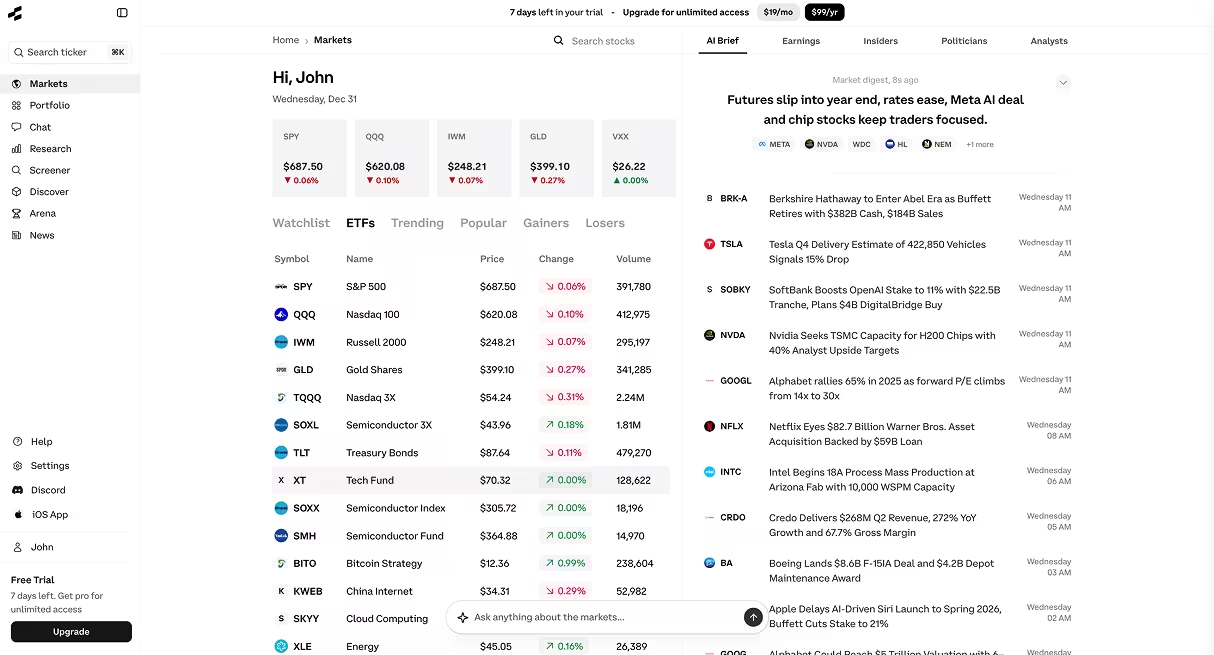
Most free AI investing tools fall into three categories: conversational research assistants that answer specific questions about stocks, automated screeners that find companies matching your criteria, and portfolio analyzers that evaluate your current holdings. Some platforms combine all three approaches. The AI Research Assistant model represents the conversational approach, pulling data from financial statements to answer targeted questions.
How Do Free AI Tools Analyze Stocks?
Free AI stock analysis tools work by ingesting structured financial data from sources like SEC filings, then applying machine learning models to extract relevant information based on your queries. When you ask a question, the AI parses your natural language input, identifies the financial metrics or data points you're seeking, retrieves that information from its database, and formats a response. This process happens in seconds rather than the minutes or hours manual research would require.
The data pipeline typically starts with automated collection of public filings. Tools pull 10-K annual reports, 10-Q quarterly filings, 8-K current reports, and proxy statements directly from the SEC's EDGAR database. Some platforms also incorporate earnings call transcripts, press releases, and analyst estimates. The AI then structures this unstructured text data, tagging revenue figures, expense categories, share counts, and other metrics into queryable databases.
When you submit a query, the system uses NLP to determine your intent. "What's Apple's revenue growth?" triggers a search for Apple's ticker symbol (AAPL), identifies "revenue" as the target metric, and "growth" as indicating you want year-over-year or quarter-over-quarter comparison. The AI retrieves the relevant figures, calculates the percentage change, and presents the result with context like the time period and comparison baseline.
Analysis Step Traditional Research AI-Powered Tools Data Collection Manual download of SEC filings Automated ingestion from EDGAR Metric Extraction Reading through 100+ page documents AI parsing and tagging in seconds Calculation Manual spreadsheet formulas Automated computation Comparison Building custom comparison tables Natural language queries
The accuracy of free AI stock analysis depends heavily on data quality and model training. Tools trained specifically on financial documents typically outperform general-purpose AI adapted for stock research. Free tiers may use older data (delayed 15-20 minutes) or less sophisticated models that occasionally misinterpret complex accounting treatments or non-standard reporting.
Top Free AI Stock Analysis Platforms
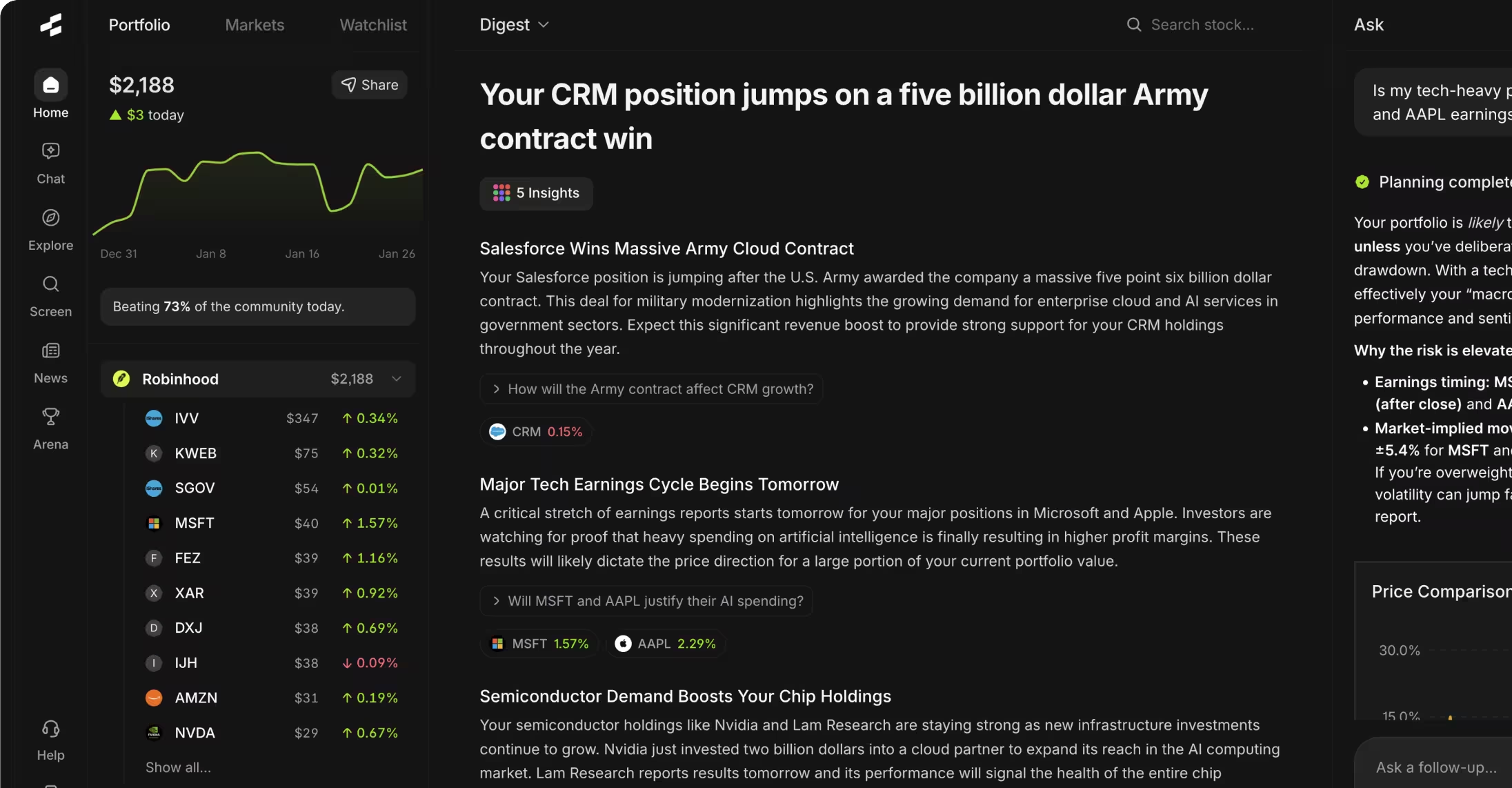
Several platforms offer free AI-powered stock research with different strengths and limitations. Rallies.ai provides free access to its AI Research Assistant, which answers questions about fundamentals, technicals, and company news using conversational AI. The free tier includes daily query limits but covers thousands of stocks with data pulled from SEC filings and market feeds.
ChatGPT and Claude can perform basic stock analysis when provided with current data, though they don't have built-in access to real-time financial information. You'll need to supply the data yourself or use plugins that connect to financial APIs. These general-purpose AI models excel at explaining financial concepts and walking through valuation calculations but lack the specialized financial databases of dedicated stock research platforms.
Google's Bard (now Gemini) integrates with Google Finance data, allowing it to pull current stock prices and basic metrics. It works well for quick price checks and simple comparisons but doesn't offer deep fundamental analysis or historical data access in its free tier. Bing's AI search similarly provides surface-level data with citations to financial news and market data providers.
Query Limit: The maximum number of questions or requests you can submit to an AI tool within a specific timeframe. Free tiers typically range from 10 to 100 queries per day to manage computational costs.
Yahoo Finance has incorporated AI-powered features into its free platform, including automated earnings summaries and sentiment analysis of news articles. While not a dedicated AI research assistant, it combines traditional financial data with machine learning-based insights at no cost. The Vibe Screener approach represents another model—natural language screening where you describe the type of stock you want rather than setting manual filters.
Each platform makes different tradeoffs. Dedicated AI stock research tools offer deeper financial analysis but may have stricter usage limits. General-purpose AI models provide unlimited queries but require more work to supply accurate data. Hybrid platforms like enhanced financial news sites fall somewhere in between, offering AI features alongside traditional data displays.
What Can Free Tools Actually Do?
Free AI stock analysis tools can handle a wide range of research tasks that previously required manual work or paid subscriptions. They excel at retrieving specific data points from financial statements, calculating standard valuation metrics, comparing companies within the same industry, and summarizing recent news or earnings reports. You can ask "What's Microsoft's price-to-earnings ratio?" or "How does Amazon's profit margin compare to Walmart's?" and get accurate answers in seconds.
Most free platforms handle fundamental analysis questions well. They can pull revenue, earnings, cash flow, debt levels, and other metrics from the most recent filings. They calculate ratios like P/E, P/S, debt-to-equity, and return on equity automatically. Some tools also provide year-over-year growth rates, quarterly trends, and peer comparisons without requiring you to build spreadsheets.
What Free AI Tools Do Well
- Retrieve current financial metrics from recent filings
- Calculate standard valuation ratios (P/E, P/B, P/S)
- Compare metrics across 2-5 companies simultaneously
- Summarize earnings reports and identify key changes
- Answer straightforward questions about company fundamentals
- Screen for stocks meeting basic criteria
- Explain financial concepts in plain language
Common Limitations of Free Tiers
- Limited historical data (often 1-3 years vs. 10+ for paid)
- Delayed market data (15-20 minute lag vs. real-time)
- Query caps (10-100 per day vs. unlimited)
- No advanced features (backtesting, portfolio optimization)
- Limited international stock coverage
- Slower processing speeds during peak usage
- Less sophisticated AI models than premium tiers
- Restricted export and API access
Where free tools struggle is with complex multi-step analysis, extensive historical comparisons, and real-time trading signals. A question like "Show me all stocks that had earnings beats in the last 3 quarters and P/E expansion over 5 years" might exceed free tier capabilities. Advanced technical analysis, options data, and institutional ownership tracking typically require paid subscriptions.
Free AI tools also have data freshness constraints. You might get quarterly financial data updated within days of SEC filings, but intraday price movements and breaking news may lag. For long-term investors researching fundamentals, this delay rarely matters. For active traders making daily decisions, it's a significant limitation.
Free vs. Paid AI Stock Analysis Tools
The gap between free and paid AI stock analysis tools varies significantly by platform. Some providers offer 80-90% of functionality for free with only advanced features behind paywalls, while others severely restrict free tiers to drive upgrades. Understanding what you're giving up helps determine whether free tools meet your needs or if paid subscriptions justify their cost.
Feature Typical Free Tier Typical Paid Tier ($10-50/month) Daily Queries 10-50 questions Unlimited or 500+ Data Freshness 15-20 minute delay Real-time Historical Data 1-3 years 10-20 years Stock Coverage Major U.S. exchanges Global markets AI Model Standard/older versions Latest/most capable models Advanced Analysis Basic metrics only Backtesting, scenarios, forecasts Export Options Limited or none CSV, PDF, API access
For casual investors checking fundamentals weekly or monthly, free tiers often suffice. You can research 10-20 stocks per day, track basic metrics, and get AI-powered summaries without paying. The 15-minute data delay doesn't matter when you're evaluating long-term value rather than making split-second trades. A portfolio of 20-30 stocks can be monitored adequately within typical free tier limits.
Paid tiers become valuable when you need depth over breadth. Analyzing a company's 10-year revenue trend, comparing it to 15 competitors, running valuation scenarios with different assumptions, and backtesting a screening strategy all push beyond free capabilities. Professional investors and active traders typically find the efficiency gains of paid tools worth $20-100 monthly.
Some platforms use hybrid models where core AI research remains free but premium data sources cost extra. You might get free access to SEC filing data and basic market prices, with real-time Level 2 quotes, alternative data sources, or institutional research behind paywalls. This lets you start with automated stock research at no cost, then add specific data feeds as needed.
How to Get the Most From Free AI Tools
Maximizing free AI stock analysis tools requires strategic use of limited queries and understanding each platform's strengths. Start by identifying what specific questions you need answered, then formulate precise queries that extract maximum information in minimal interactions. Instead of asking "Tell me about Apple," ask "What's Apple's revenue growth, profit margin, and P/E ratio over the last 4 quarters?"
Batch related questions to conserve query limits. If you're researching the semiconductor sector, compile a list of companies and metrics first, then ask comparative questions that cover multiple stocks simultaneously. "Compare NVDA, AMD, and INTC profit margins" uses one query instead of three separate requests. The Rallies.ai platform optimizes for this kind of efficient multi-company analysis.
Checklist for Effective Free AI Research
- ☐ Define your specific research question before querying
- ☐ Use precise metric names (revenue, EBITDA) not vague terms (performance)
- ☐ Batch comparisons to cover multiple stocks in one query
- ☐ Cross-reference AI results with original SEC filings
- ☐ Focus on fundamental data where free tools excel
- ☐ Supplement with free traditional sources (EDGAR, company IR)
- ☐ Track query limits and prioritize high-value research
- ☐ Save or export results to avoid re-querying the same data
Cross-reference AI-generated answers with original sources, especially for critical investment decisions. If an AI tool reports unusual figures—like a company's debt suddenly tripling—verify by checking the actual 10-Q or 10-K filing on the SEC's EDGAR database. AI models occasionally misinterpret non-standard accounting treatments or one-time charges. This verification step costs no queries and catches potential errors.
Combine multiple free tools rather than relying on a single platform. Use one AI assistant for conversational research questions, another platform's screener for finding candidates, and traditional free sources like Yahoo Finance for price charts. Each tool has blind spots, but together they provide comprehensive coverage. Diversifying also spreads usage across multiple query limits.
Time your research strategically if using tools with daily query resets. Concentrate deep research sessions when limits refresh rather than scattering queries throughout the day. This prevents hitting caps mid-analysis when you're comparing multiple investment options. For quarterly earnings seasons, prioritize researching your current holdings and top watchlist candidates while allocating queries to new opportunities afterward.
Common Mistakes When Using Free AI Research
The biggest mistake investors make with free AI stock analysis tools is treating AI outputs as definitive investment recommendations rather than data retrieval assistance. AI tools excel at finding and calculating information but don't provide investment advice or account for your personal financial situation, risk tolerance, or goals. A response that "Company X has strong fundamentals" is a factual observation about metrics, not a suggestion that you should buy the stock.
Failing to understand data limitations causes frequent problems. Free tiers often use delayed data, so if you're looking at a stock price reported as $150 when the current trading price is $155, you're working with stale information. Similarly, quarterly financial data might be 30-60 days old if a company hasn't filed its latest 10-Q yet. Always check the data date stamps and understand refresh schedules.
Over-reliance on AI without developing your own financial literacy creates blind spots. If you don't understand what profit margin means or how P/E ratios work, you can't evaluate whether AI-generated answers make sense. Use AI tools to accelerate research, but invest time in learning fundamental concepts. When an AI reports a company's P/E ratio is 5 (unusually low), you should recognize this as either a value opportunity or a red flag requiring deeper investigation—not just accept it passively.
Hallucination: When an AI model generates plausible-sounding but factually incorrect information. In stock analysis, this might mean citing metrics that don't exist or misattributing data to the wrong company or time period.
Trusting AI calculations without spot-checking introduces error risk. AI models sometimes hallucinate figures or apply formulas incorrectly, especially with non-standard financial reporting. If a company reports adjusted EBITDA excluding certain expenses, AI might calculate margins using standard EBITDA instead. Verify unusual or critical figures by checking source documents. According to a 2024 study by the CFA Institute, even sophisticated AI models showed 5-8% error rates on complex accounting questions.
Wasting queries on information easily found elsewhere misses the point of AI tools. Don't ask "What's Microsoft's stock price?" when any financial site shows this instantly. Reserve AI queries for questions requiring calculation, comparison, or synthesis—tasks where AI provides real time savings. "How has Microsoft's operating margin trended versus Google's over the last 8 quarters?" is a query worth the interaction limit.
Ignoring the difference between correlation and causation when interpreting AI-identified patterns creates false confidence. An AI might note that a stock's price rose 30% in quarters when revenue grew above 15%, but this doesn't mean revenue growth causes price appreciation or that future revenue growth will drive similar returns. Market pricing reflects countless factors beyond any single metric.
Frequently Asked Questions
1. Are free AI stock analysis tools accurate enough for investment decisions?
Free AI stock analysis tools are generally accurate for retrieving factual data from financial statements—metrics like revenue, earnings, and debt levels typically have 95%+ accuracy when pulled from SEC filings. However, you should verify critical figures before making investment decisions and remember that AI tools provide data and analysis, not personalized advice. Cross-reference unusual findings with original sources, and understand that AI accuracy depends on data quality, model training, and question complexity. Complex queries involving multi-step calculations or non-standard accounting have higher error rates.
2. What's the difference between free AI tools and paid Bloomberg or FactSet?
Professional platforms like Bloomberg Terminal ($24,000/year) and FactSet ($12,000-40,000/year) offer institutional-grade data depth, real-time feeds, extensive historical archives, proprietary research, and advanced analytical tools that free AI platforms can't match. However, individual investors rarely need this level of capability. Free AI stock analysis tools provide sufficient fundamental data for personal portfolio research, with the main tradeoffs being delayed data, limited history (1-3 years vs. 20+), and fewer advanced features. For analyzing long-term value investments, free tools typically suffice. For professional day trading or institutional research, paid platforms justify their cost.
3. Can I use free AI tools for day trading or short-term trading?
Free AI tools have significant limitations for day trading due to data delays and query restrictions. Most free tiers provide market data with 15-20 minute lags, which makes them unsuitable for split-second trading decisions. You'll also hit query limits quickly if checking multiple stocks throughout the trading day. Free AI tools work better for swing trading (holding positions days to weeks) or long-term investing where data delays don't materially affect decisions. If you're committed to active trading, real-time data subscriptions ($10-30/month from brokers) paired with AI analysis tools make more sense than relying solely on free delayed feeds.
4. How do I know if an AI-generated stock analysis is wrong?
Red flags for incorrect AI analysis include: numbers that seem extreme compared to industry norms (like 300% profit margins), conflicting information between different queries about the same metric, data that doesn't match what you see on the company's investor relations page, and responses lacking specific citations or time periods. Always verify critical figures by checking the original SEC filing—if an AI reports Q3 revenue of $5 billion, find that number in the company's 10-Q. Be especially cautious with complex calculations involving adjusted earnings, non-GAAP metrics, or segment-specific data where AI models are more likely to make errors.
5. Which free AI stock tool is best for beginners?
The best free AI stock analysis tool for beginners is one with a conversational interface that explains both data and concepts, rather than just returning raw numbers. Platforms like Rallies.ai that answer questions in plain English and provide context work well for learning. Avoid tools that require understanding technical jargon upfront. Look for platforms that offer example questions or guided research flows. The ideal beginner tool should explain what metrics mean (not just report them), handle follow-up questions naturally, and integrate educational content with data retrieval. Try several free options to see which interface feels most intuitive for your learning style.
6. Do free AI tools work for international stocks?
Free AI stock analysis tools typically focus on U.S. exchanges (NYSE, NASDAQ) with limited or no coverage of international markets. You might find basic data for large international companies that trade as ADRs (American Depositary Receipts) on U.S. exchanges, but direct analysis of stocks on the London Stock Exchange, Tokyo Stock Exchange, or other international venues usually requires paid subscriptions. Data availability varies by platform—some offer free coverage of Canadian stocks, while others stick strictly to U.S.-listed securities. If you invest internationally, check each platform's coverage list before relying on it for non-U.S. stocks.
7. Can AI tools help with portfolio management or just individual stock research?
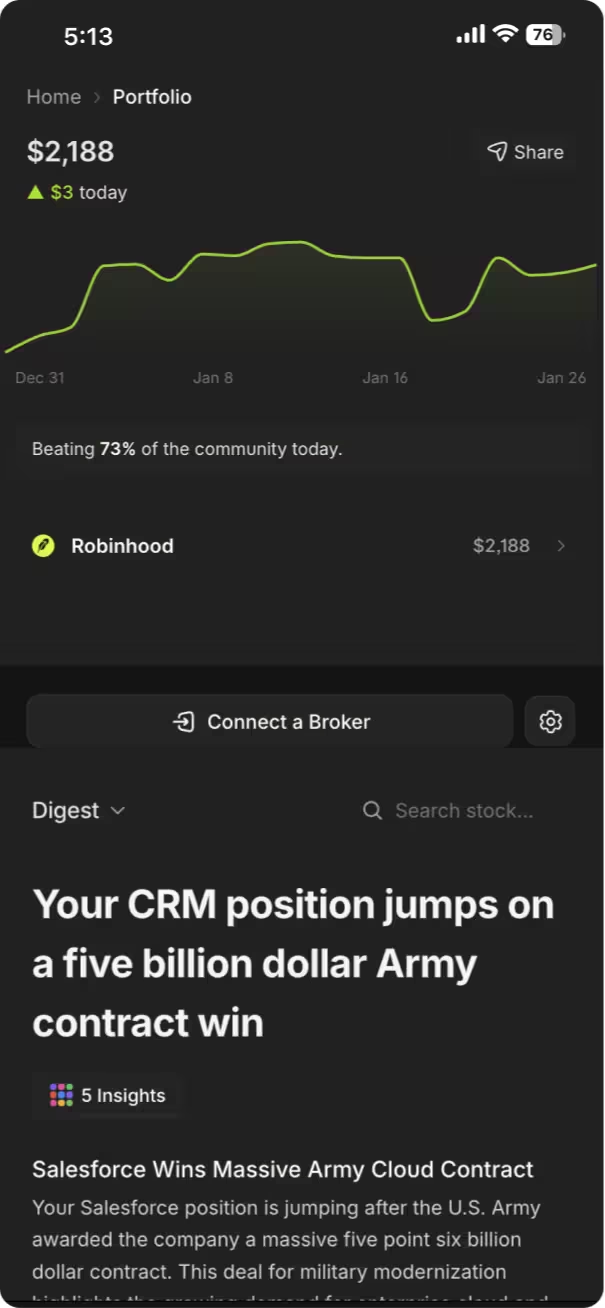
Many free AI tools now offer portfolio-level features beyond individual stock research, though capabilities vary widely. Some platforms analyze your entire portfolio allocation, identify concentration risks, calculate sector exposures, and track overall performance metrics. Others focus solely on single-stock queries and require you to aggregate information manually. The portfolio tracking features on platforms like Rallies.ai can monitor multiple holdings simultaneously. Free tiers typically limit portfolio size (15-30 stocks) compared to paid unlimited tracking. Advanced portfolio optimization, correlation analysis, and rebalancing recommendations usually require premium subscriptions.
8. How often is the data updated in free AI stock tools?
Data refresh rates in free AI stock analysis tools vary by data type and platform. Financial statement data from SEC filings typically updates within 24-48 hours after companies file 10-Qs and 10-Ks, since this data is public and standardized. Stock prices in free tiers usually have 15-20 minute delays, refreshing throughout the trading day but never in true real-time. News and earnings summaries might update within hours of release. Analyst estimates and ratings can lag by days or weeks. Always check timestamps on AI responses—most platforms indicate data as-of dates. For critical decisions, verify current prices and recent news through real-time sources before acting.
Conclusion
Free AI stock analysis tools have made automated research accessible to individual investors without the thousands of dollars previously required for institutional-grade platforms. These tools excel at retrieving financial metrics, calculating ratios, comparing companies, and answering specific research questions in natural language. While free tiers come with limitations—query caps, delayed data, and restricted features—they provide sufficient capability for fundamental analysis and long-term investing research.
The key to effective use is understanding what free AI tools do well (data retrieval and standard calculations) versus their limitations (real-time data, complex multi-step analysis, unlimited queries). Cross-reference critical information with original sources, combine multiple free tools to offset individual platform weaknesses, and use AI to accelerate research rather than replace your own financial education. As artificial intelligence investing technology continues advancing, the gap between free and paid tools may narrow, but thoughtful application of available resources matters more than tool cost.
Start with clear research questions, formulate precise queries, verify unusual results, and remember that AI provides information and analysis—not personalized investment advice. For most individual investors building long-term portfolios, free AI stock research tools offer a powerful starting point that can be upgraded selectively as specific needs demand premium features.
Ready to try AI-powered stock research yourself? Start with Rallies.ai free and ask questions about any stock in plain English. No credit card required.
References
- U.S. Securities and Exchange Commission. "EDGAR Database." https://www.sec.gov/edgar
- CFA Institute. "AI in Investment Management: Applications and Implications." 2024. https://www.cfainstitute.org/research
- Financial Industry Regulatory Authority. "Investment Analysis Tools." https://www.finra.org/investors
- Dimensional Fund Advisors. "Long-Term Returns by Asset Class." 2023. https://www.dimensional.com/research
- Harvard Business School. "Machine Learning Applications in Finance." Working Paper 2024. https://www.hbs.edu/faculty
- Stanford University Graduate School of Business. "Natural Language Processing in Financial Analysis." 2024. https://www.gsb.stanford.edu/faculty-research
Disclaimer: This article is for educational and informational purposes only. It does not constitute investment advice, financial advice, trading advice, or any other type of advice. Rallies.ai does not recommend that any security, portfolio of securities, transaction, or investment strategy is suitable for any specific person.
Risk Warning: All investments involve risk, including the possible loss of principal. Past performance does not guarantee future results. Before making any investment decision, you should consult with a qualified financial advisor and conduct your own research.
Written by: Gav Blaxberg
CEO of WOLF Financial | Co-Founder of Rallies.ai
```