


The best AI stock analysis tools use natural language processing and machine learning to process financial data, answer research questions in plain English, and automate time-consuming analysis tasks. Leading platforms combine real-time data feeds with conversational interfaces, allowing investors to query company fundamentals, screen for stocks matching specific criteria, and generate comprehensive research reports in seconds rather than hours. These tools range from free chatbot-style assistants to enterprise-grade platforms with deep financial modeling capabilities.
Key Takeaways
- AI stock analysis tools process 10-Ks, earnings transcripts, and market data in seconds, identifying patterns human analysts might miss over weeks of manual review
- Natural language screeners let you describe investment criteria conversationally ("dividend stocks with consistent 10-year growth") instead of setting dozens of manual filters
- Most AI research platforms cost $0-$50/month for retail investors, with institutional tools ranging from $500-$5,000+ monthly
- AI tools work best for data-heavy tasks like financial statement analysis and pattern recognition, but struggle with qualitative factors like management quality and industry disruption timing
- Combining AI tools with traditional research methods produces better results than relying exclusively on either approach
Table of Contents
- What Are AI Stock Analysis Tools?
- How AI Analyzes Stocks
- Top AI Stock Analysis Tools for 2024
- Natural Language Stock Screeners
- AI Research Assistants
- AI vs Traditional Research Methods
- When to Use AI Stock Analysis Tools
- Limitations of AI in Stock Analysis
- How to Choose the Right AI Stock Analysis Tool
- Frequently Asked Questions
- Conclusion
What Are AI Stock Analysis Tools?
AI stock analysis tools are software platforms that use machine learning algorithms and natural language processing to automate investment research tasks. These tools ingest financial statements, earnings transcripts, SEC filings, market data, and news to answer research questions, identify investment opportunities, and generate analytical reports. Unlike traditional stock screeners that require manual filter configuration, modern AI tools accept conversational queries and return contextual answers drawn from multiple data sources.
The technology behind these platforms combines large language models trained on financial data with real-time market feeds. When you ask a question like "What's Tesla's operating margin compared to Ford?", the AI retrieves current financial data, performs the calculation, and presents the comparison in plain language. More advanced systems can analyze 10-K filings for risk factors, parse earnings call transcripts for management sentiment, and screen thousands of stocks based on complex multi-factor criteria described in natural language.
Natural Language Processing (NLP): A branch of artificial intelligence that enables computers to understand, interpret, and generate human language. In stock analysis, NLP powers conversational interfaces and extracts insights from text-based financial documents.
These tools target different user needs. Some focus on answering specific research questions about individual stocks. Others specialize in portfolio screening and discovery. Enterprise-grade platforms offer deep financial modeling, backtesting capabilities, and integration with trading systems. The common thread is using AI to reduce the time between asking an investment question and getting a data-backed answer.
How AI Analyzes Stocks
AI stock analysis follows a multi-step process that starts with data ingestion and ends with generating human-readable insights. The system continuously pulls data from SEC EDGAR filings, company investor relations pages, financial data providers like FactSet or Bloomberg, and news feeds. This raw data gets structured into databases that machine learning models can query efficiently.
When you submit a query, the AI uses natural language understanding to identify what you're asking. A question like "Which tech stocks have revenue growth above 20% and P/E below 25?" gets parsed into discrete components: sector filter (technology), metric filters (revenue growth >20%, P/E <25), and output type (list of matching stocks). The system then queries its financial database, applies the filters, and returns results.
For more complex analyses, AI tools employ multiple specialized models. Sentiment analysis algorithms scan earnings transcripts and news articles to gauge positive or negative tone. Computer vision systems extract data from charts and tables in PDF documents. Time-series models identify patterns in historical price and volume data. These specialized outputs get combined into comprehensive research reports.
Analysis TypeAI ApproachTypical SpeedFinancial Statement AnalysisExtract metrics from 10-K/10-Q, calculate ratios, compare to peers2-5 secondsEarnings Call AnalysisTranscribe audio, perform sentiment analysis, extract key topics30-60 secondsStock ScreeningParse natural language criteria, query database, rank results3-10 secondsDeep Research ReportCompile 100+ data points across fundamentals, technicals, sentiment45-90 seconds
The accuracy of AI analysis depends heavily on data quality and model training. Tools trained specifically on financial data using SEC filings and verified financial statements produce more reliable outputs than general-purpose chatbots that pull information from web search results. This is why purpose-built financial AI tools typically outperform generic AI assistants for investment research.
Top AI Stock Analysis Tools for 2024
The AI stock analysis landscape includes platforms targeting different experience levels and use cases. Retail-focused tools prioritize ease of use and conversational interfaces, while institutional platforms emphasize data depth and customization. Here's a breakdown of leading options as of 2024.
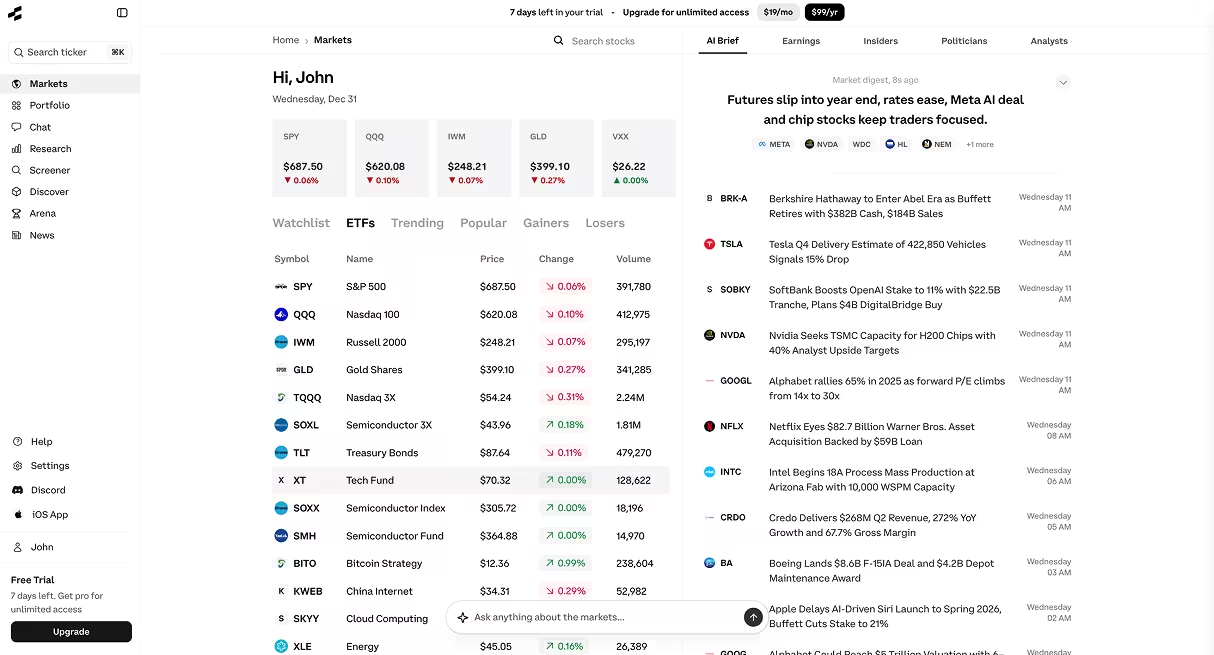
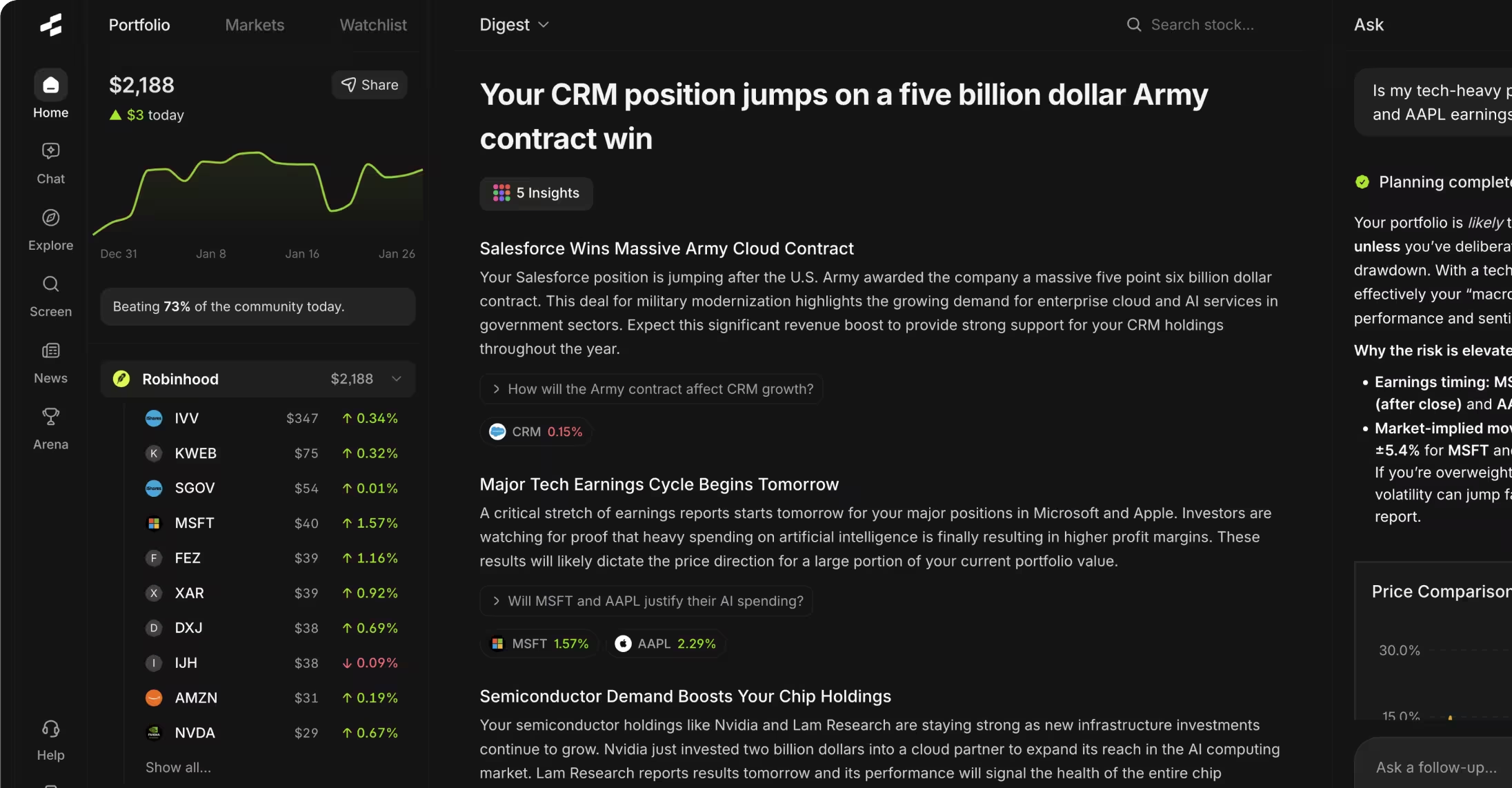
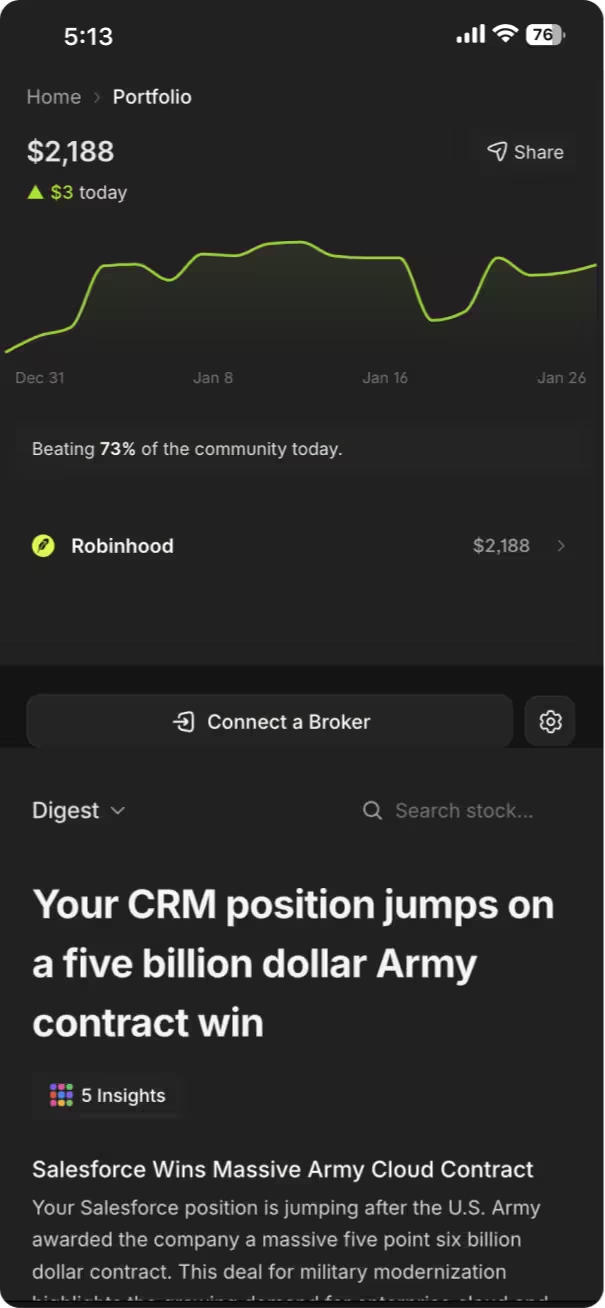
Rallies.ai provides an AI Research Assistant that answers stock questions using data from financial statements rather than general web search. You can ask conversational questions like "What's Microsoft's free cash flow trend?" and receive specific numerical answers with source citations. The platform includes a natural language screener called the Vibe Screener, where you describe what you're looking for ("undervalued dividend stocks in healthcare") and receive matching results. Portfolio tracking and thematic discovery features round out the offering, with a free tier available for basic research.
AlphaSense targets institutional investors with AI-powered search across earnings transcripts, broker research, SEC filings, and proprietary research databases. The platform excels at surfacing specific mentions across thousands of documents. Pricing starts around $1,200/month, making it primarily an institutional tool. The AI search can identify when specific topics (supply chain issues, pricing pressure) appear across multiple companies' earnings calls, helping identify industry-wide trends.
Bloomberg Terminal's Natural Language Query lets users ask questions in plain English and receive data, charts, and analysis. With access to Bloomberg's comprehensive financial database, it can answer complex multi-factor queries instantly. The Terminal costs approximately $2,000/month and serves professional investors who need institutional-grade data breadth.
TipRanks uses AI to analyze analyst ratings, insider transactions, hedge fund holdings, and news sentiment to generate stock scores. The platform aggregates thousands of analyst ratings and uses machine learning to weight them based on each analyst's historical accuracy. The smart score system combines eight factors into a single 1-10 rating. Pricing ranges from free basic access to $100/month for premium features.
Sentiment Analysis: The use of natural language processing to determine whether text expresses positive, negative, or neutral sentiment. In stock analysis, sentiment algorithms scan news articles, social media, and earnings transcripts to gauge market mood toward specific companies.
For investors just exploring AI investing tools, starting with free or low-cost platforms makes sense. As research needs become more sophisticated, specialized tools for specific tasks (screening, sentiment analysis, financial modeling) can be added to your toolkit. Most serious investors use 2-3 complementary tools rather than relying on a single platform.
Natural Language Stock Screeners
Natural language stock screeners let you describe investment criteria conversationally instead of setting manual filters across dozens of dropdown menus. Instead of navigating through "P/E < 15 AND Dividend Yield > 3% AND Market Cap > $10B," you can type "large-cap value stocks with solid dividends" and receive relevant results.
These screeners work by mapping common investment phrases to underlying quantitative filters. When you say "undervalued," the AI might translate that to P/E ratios below industry median or price-to-book below 1.5. "Growth stocks" might map to revenue growth >15% and EPS growth >20%. The best systems learn from usage patterns and can handle synonyms, industry jargon, and complex multi-factor requests.
The Vibe Screener from Rallies.ai exemplifies this approach. You describe the type of stocks you want using natural language, and the system interprets your criteria, applies appropriate filters, and returns matching stocks. The interface shows which filters were applied, letting you verify the AI understood your intent correctly. You can refine results conversationally by adding constraints like "but exclude anything in the energy sector."
Natural language screeners save substantial time for investors who know what they want but find traditional screener interfaces cumbersome. A request that might take 5 minutes to configure manually across multiple filter tabs can be expressed in a single sentence and return results in seconds. This speed advantage is particularly valuable when exploring multiple investment themes in one research session.
The tradeoff is precision. Traditional screeners with explicit numerical filters give you exact control. Natural language screeners interpret your intent, which might not always match your specific mental model. Good platforms show their filter translation so you can verify the interpretation matches your intent. Some offer hybrid interfaces where you start with natural language then fine-tune with manual filters.
AI Research Assistants
AI research assistants function as conversational interfaces to financial databases, answering specific questions about companies, industries, and market data. Rather than navigating through multiple web pages or spreadsheets to find a metric, you ask a direct question and receive an immediate answer with source citations.
These tools excel at retrieving specific data points. Questions like "What was Apple's gross margin in Q3 2024?" or "How many employees does Nvidia have?" get answered in seconds with exact numbers pulled from the most recent SEC filings. More sophisticated assistants can perform calculations on the fly: "Compare Amazon's operating margin to Walmart's over the past five years" returns both a numerical answer and often a visualization.
The AI Research Assistant at Rallies.ai answers questions using structured financial data rather than scraping web search results. This distinction matters because web search might return outdated information or misattributed data, while purpose-built financial AI pulls from verified sources like 10-K filings and earnings releases. The system cites its sources, letting you verify the underlying data if needed.
AI research assistants work best for factual, data-driven questions. They can tell you what a company's revenue was, how debt levels have changed, what percentage of revenue comes from international markets, and similar metrics-based queries. They struggle with subjective questions requiring judgment, like "Is this management team competent?" or "Will this industry be disrupted in five years?" These questions involve qualitative analysis that current AI systems can't reliably perform.
Advantages of AI Research Assistants
- Answer specific questions in seconds versus minutes of manual searching
- Pull from structured databases with verified, up-to-date financial data
- Perform calculations across multiple metrics and time periods instantly
- Cite sources for verification
- Available 24/7 without fatigue or inconsistency
Limitations of AI Research Assistants
- Limited to quantitative analysis; weak at qualitative judgment calls
- Can't predict future events or assess management quality reliably
- Accuracy depends on underlying data quality and model training
- May misinterpret ambiguous questions
- No substitute for understanding fundamental analysis principles yourself
Investors get the most value from AI research assistants by treating them as rapid retrieval tools for factual information, then applying their own judgment to interpret what that data means for investment decisions. The AI handles the time-consuming lookup work; you handle the strategic thinking.
AI vs Traditional Research Methods
Traditional stock research relies on manually reading financial statements, building spreadsheet models, tracking news, and synthesizing information across multiple sources over hours or days. AI-powered research automates data retrieval and initial analysis, compressing timelines from hours to seconds for many tasks. Each approach has distinct strengths that complement each other.
Traditional research forces deeper engagement with source documents. When you manually read a 10-K filing, you notice details and context that automated extraction might miss. You develop intuition about how a business actually works, what risks management worries about, and how different parts of the operation connect. This contextual understanding is difficult to replicate with AI summarization, which tends to extract discrete facts but miss narrative threads.
AI research excels at scale and speed. Comparing a single company's metrics across 20 quarters of historical data takes minutes manually but seconds with AI. Screening 5,000 stocks for specific criteria combinations is impractical by hand but trivial for AI. Pattern recognition across hundreds of earnings transcripts to identify industry trends is something AI can do that manual research practically can't at reasonable time scales.
TaskTraditional MethodAI MethodBest ApproachFinding specific metricsNavigate SEC filings, 5-10 minutesAsk question, get answer in 5 secondsAIUnderstanding business modelRead annual report, assess strategyAI summary available but lacks depthTraditionalScreening 1000+ stocksImpractical manuallySeconds with natural language queryAIAssessing management qualityWatch interviews, read letters, track historyAI can't reliably judge competenceTraditionalCalculating financial ratiosManual calculation, 2-5 minutes eachInstant retrievalAIIdentifying industry disruption riskDeep industry research and judgmentCan surface data but poor at predictionTraditional
Most effective research workflows combine both approaches. Use AI for data-heavy tasks: pulling historical metrics, screening for candidates, comparing quantitative factors across companies. Use traditional methods for judgment-intensive tasks: evaluating competitive positioning, assessing management credibility, understanding qualitative risk factors, and synthesizing everything into an investment thesis.
The investors who gain the most from AI investment research are those who understand fundamental analysis well enough to know which questions to ask and how to interpret the answers. AI tools make competent investors more efficient, but they don't replace the need to understand how businesses and markets work.
When to Use AI Stock Analysis Tools
AI tools provide the most value in specific research scenarios where automation offers clear advantages over manual methods. Understanding when to reach for AI versus traditional research improves both efficiency and analytical quality.
Stock screening and discovery: When you need to identify investment candidates from thousands of possibilities, natural language screeners compress hours of manual filtering into seconds. This is particularly valuable when exploring new sectors or testing investment themes. A query like "industrial stocks with improving margins and low debt" would take extensive manual work to screen properly but returns results immediately with AI.
Quick metric lookups: During research or portfolio monitoring, you often need specific data points: current P/E ratios, recent revenue figures, debt levels, insider ownership percentages. AI research assistants retrieve these instantly, maintaining research flow instead of interrupting it with manual lookups across multiple sources.
Historical comparisons: Tracking how metrics have changed over time (margin trends, revenue growth rates, efficiency ratios) involves pulling data across multiple quarterly and annual reports. AI tools compile this historical data instantly, generating trend charts and calculating changes automatically.
Multi-company comparisons: Comparing metrics across 5-10 peer companies manually requires opening multiple documents and tracking data in spreadsheets. AI can pull the same metrics for all companies simultaneously and present them in comparison tables, dramatically speeding up competitive analysis.
Fundamental Analysis: A method of evaluating stocks by analyzing financial statements, business models, competitive advantages, and economic factors to determine intrinsic value. AI tools assist with data collection and metric calculation but don't replace the judgment required for comprehensive fundamental analysis.
Earnings report analysis: AI tools can summarize key points from earnings transcripts, highlight unusual language or topics, and compare current quarter metrics to historical performance. This gives you a rapid initial read before deciding whether deeper manual analysis is warranted.
Conversely, AI tools are less useful for tasks requiring judgment, creativity, or synthesis. Evaluating whether a company's strategy makes sense given competitive dynamics, assessing whether management is being candid about challenges, or predicting how technological changes might disrupt an industry all require human judgment that AI can't replicate reliably.
A practical approach is starting with AI for the quantitative foundation, then applying traditional research methods to the qualitative layer. Screen with AI to generate a candidate list, use AI to compile key metrics quickly, then manually evaluate business quality, competitive positioning, and risk factors for your top candidates.
Limitations of AI in Stock Analysis
AI stock analysis tools have specific weaknesses that investors need to understand to avoid over-relying on automated research. These limitations stem from how AI systems work and the nature of investment analysis itself.
No predictive power for future events: AI tools analyze historical and current data but can't predict future developments like new product success, regulatory changes, or competitive disruption. When an AI tool presents historical growth rates, it's describing the past, not forecasting the future. Some platforms offer "AI predictions," but these are extrapolations from historical patterns, not genuine foresight about future business performance.
Weak at qualitative analysis: Factors like management quality, competitive moat strength, brand value, and cultural advantages are difficult to quantify and therefore difficult for AI to assess reliably. An AI can tell you that a company's ROE is 20%, but it can't tell you whether that ROE is sustainable given competitive pressures or whether management has the competence to maintain it.
Limited by training data: AI models trained primarily on large-cap U.S. stocks may perform poorly when analyzing small-caps, international companies, or specialized industries. The quality of AI analysis correlates directly with the breadth and quality of its training data. Tools trained on SEC filings and verified financial databases outperform those relying on web scraping.
Can't handle unprecedented situations: AI identifies patterns in historical data. When truly novel situations arise (pandemic impacts, new regulatory regimes, technological disruptions), AI lacks historical patterns to reference and its analysis becomes unreliable. The AI has no basis for understanding how a company will navigate conditions it's never encountered before.
Potential for misinterpretation: Natural language interfaces can misinterpret ambiguous questions. If you ask "What's Apple's growth rate?" without specifying whether you mean revenue growth, earnings growth, or user growth, and over what time period, the AI might return an answer that doesn't match what you intended to ask. Always verify that AI tools understood your question correctly.
Data lag issues: Real-time claims notwithstanding, most AI tools have some data lag. Earnings data might take hours or days after release to get incorporated. News sentiment might be processed with delays. For time-sensitive trading decisions, this lag can matter. Understanding each tool's data update frequency is important.
Questions to Ask About Any AI Stock Analysis Tool
- ☐ What data sources does it use (SEC filings, financial databases, web scraping)?
- ☐ How frequently is data updated?
- ☐ How was the AI model trained, and on what dataset?
- ☐ Does it cite sources for its claims?
- ☐ Can you verify its outputs against primary sources?
- ☐ What types of analysis does it explicitly not attempt?
- ☐ Does it provide confidence levels or uncertainty indicators?
The most effective use of AI tools acknowledges these limitations. Use AI for what it does well—retrieving data, performing calculations, screening at scale, identifying historical patterns. Apply human judgment for what AI can't do—assessing qualitative factors, predicting novel situations, synthesizing disparate information into an investment thesis. This division of labor between automated analysis and human judgment produces better results than relying exclusively on either.
How to Choose the Right AI Stock Analysis Tool
Selecting an AI stock analysis tool depends on your specific research needs, experience level, and budget. Different platforms optimize for different use cases, and the "best" tool varies based on what you're trying to accomplish.
Define your primary use case: Are you mainly screening for new ideas, researching specific companies in depth, tracking portfolio holdings, or building quantitative models? Tools specialize. Some excel at conversational Q&A about individual stocks. Others focus on screening and discovery. Institutional platforms emphasize breadth and integration with trading systems. Start by identifying which tasks consume most of your research time, then prioritize tools that automate those specific activities.
Evaluate data sources and quality: The reliability of AI analysis depends entirely on underlying data quality. Tools that pull from SEC filings, verified financial databases, and official company sources produce more accurate results than those relying on web scraping or unverified crowdsourced data. Look for platforms that cite their sources and let you verify outputs against primary documents. For tools offering financial metrics, test accuracy by comparing several outputs to company financial statements manually.
Consider the interface and learning curve: Natural language interfaces are intuitive for basic questions but may lack precision for complex queries. Traditional screener interfaces with AI enhancement give you more control but require learning the system. Some platforms offer both options. Try interfaces before committing—a tool that matches your thinking style will get used; one that doesn't will be abandoned regardless of capabilities.
Assess pricing relative to value: Free tools work for basic research but typically limit query volume, data history, or features. Paid tools range from $10-50/month for retail platforms to $500-5,000+ for institutional systems. Calculate whether time saved justifies the cost. If a tool saves you three hours per week and you value your time at $50/hour, a $100/month subscription pays for itself. For casual investors researching a few positions quarterly, free tools likely suffice.
Check coverage for your investing focus: Tools vary in market coverage. Some focus primarily on U.S. large-caps. Others cover international markets, small-caps, or specific sectors more comprehensively. If you invest primarily in dividend stocks, verify the tool provides robust dividend data and screening. If you focus on growth stocks, confirm it includes growth metrics and forward estimates. Match tool strengths to your investment approach.
Test accuracy with known data: Before relying on any AI tool, test it against information you've already verified. Look up metrics you know from recent research and see if the tool returns matching data. Ask questions with known answers. This calibration helps you understand the tool's reliability and where its weaknesses lie.
For investors new to AI-powered investment research, starting with a free general-purpose platform like Rallies.ai makes sense. As you identify specific needs—deeper data, faster screening, particular analytical capabilities—you can add specialized tools. Most serious investors end up using 2-3 complementary platforms rather than finding a single tool that does everything optimally.
Frequently Asked Questions
1. Are AI stock analysis tools accurate enough to base investment decisions on?
AI tools are generally accurate for retrieving factual data and calculating metrics from financial statements, but they should inform decisions, not make them independently. For quantitative tasks like pulling historical P/E ratios or comparing revenue growth, accuracy typically exceeds 95% when tools use verified data sources. For qualitative assessments like evaluating management quality or predicting future performance, AI reliability drops significantly. Use AI analysis as input to your decision process alongside traditional research and your own judgment, not as a sole decision criterion.
2. What's the difference between free and paid AI stock analysis tools?
Free tools typically limit query volume (10-20 questions per day), provide less historical data depth (often 1-2 years versus 10+ years), and offer fewer features. Paid tools generally include unlimited queries, comprehensive historical data, advanced screening capabilities, real-time alerts, portfolio tracking, and integration features. For casual investors researching a few positions, free tools often suffice. Active investors analyzing multiple stocks weekly usually find paid tools worthwhile for time savings and depth of analysis.
3. Can AI tools analyze small-cap and international stocks as well as large-caps?
Coverage quality varies significantly. Most AI tools perform best on U.S. large-cap stocks since they have the most comprehensive data and analyst coverage. Small-cap analysis may be limited by data availability—many small companies provide minimal disclosure beyond required SEC filings. International coverage depends on whether the platform includes non-U.S. financial databases and supports international regulatory filings. Check specific coverage for markets you invest in before committing to a platform, as capabilities vary widely.
4. How do AI stock screeners differ from traditional screeners like Finviz or Yahoo Finance?
Traditional screeners require manually setting filters across multiple criteria using dropdowns and numerical inputs. AI screeners accept natural language descriptions of what you're looking for and translate them into filters automatically. Traditional screeners offer more precision for exact specifications; AI screeners provide faster exploration for general concepts. Many investors use AI screeners for initial discovery and idea generation, then refine candidates using traditional screeners for precise filter control. Some platforms like Rallies.ai offer both natural language and traditional interfaces.
5. Do AI tools provide real-time stock data or is there a delay?
Most retail AI stock analysis tools have 15-minute delayed market data for stock prices, which is standard for free and low-cost platforms. Fundamental data from financial statements typically updates within hours to days after earnings releases, depending on the platform's data pipeline. Institutional tools often provide real-time price data and faster fundamental data integration but cost significantly more. For fundamental analysis and longer-term investing, slight delays rarely matter. For day trading or time-sensitive decisions, verify the specific data latency of your chosen platform.
6. Can AI tools help with portfolio management and rebalancing?
Many AI platforms include portfolio tracking features that monitor holdings, calculate performance, visualize allocation, and identify when positions drift from target percentages. Some can suggest rebalancing actions when allocations exceed thresholds you set. However, these tools typically don't make automated rebalancing decisions—they alert you to consider rebalancing and show calculations, but you execute trades manually. Advanced platforms can model hypothetical rebalancing scenarios and show tax implications before you act. Portfolio tracking tools vary from basic (track holdings and calculate returns) to sophisticated (tax-loss harvesting identification, risk analysis, correlation mapping).
7. How do I know if an AI tool is giving me accurate information?
Verify outputs against primary sources for critical decisions. Check several metrics the AI provides against the company's actual financial statements or SEC filings. Reliable platforms cite their sources—look for tools that link to the specific document or database they pulled information from. Test the tool with questions you already know the answers to and see if it returns correct information. Be particularly skeptical of AI-generated predictions, stock ratings, or qualitative assessments, which have much higher error rates than factual data retrieval. If a tool consistently matches primary sources for factual queries, it's likely reliable for similar factual questions.
8. Are there AI tools specifically designed for dividend investors or value investors?
While most AI stock analysis tools cover all investment styles, some platforms include features particularly useful for specific approaches. For dividend investors, look for tools with robust dividend history data, payout ratio tracking, dividend growth screening, and yield calculations. Value investors benefit from tools offering comprehensive valuation multiple comparisons, historical valuation ranges, and peer benchmarking. General-purpose platforms like Rallies.ai allow natural language queries tailored to any style—you can screen for "dividend aristocrats with rising payouts" or "undervalued stocks below historical P/E averages." Specialized platforms focusing exclusively on one investment style exist but are less common than general tools with style-specific features.
Conclusion
AI stock analysis tools have changed how investors conduct research by automating time-consuming data retrieval, calculation, and screening tasks. The best platforms combine natural language interfaces with verified financial databases, letting you ask research questions conversationally and receive accurate answers in seconds. These tools excel at quantitative analysis—comparing metrics across companies, screening thousands of stocks, tracking historical trends, and pulling specific data points instantly.
The limitation is that AI can't replace the judgment required for investment decisions. While AI tells you what a company's metrics are, you still need to determine what those metrics mean for future performance, assess qualitative factors like competitive positioning and management quality, and synthesize information into an investment thesis. The most effective approach combines AI for data-heavy tasks with traditional research methods for judgment-intensive analysis.
For investors looking to improve research efficiency, start by identifying which tasks consume most of your time. If you spend hours manually pulling financial data or screening for candidates, AI tools offer immediate time savings. Test free platforms first to understand capabilities and limitations before committing to paid subscriptions. Use AI analysis as one input to your decision process, not as the sole basis for investment choices.
Ready to try this yourself? Start with Rallies.ai free and research stocks in seconds with AI-powered tools.
References
- U.S. Securities and Exchange Commission. "EDGAR Database." https://www.sec.gov/edgar
- CFA Institute. "Artificial Intelligence in Asset Management." https://www.cfainstitute.org/en/research/industry-research/ai-asset-management
- Dimensional Fund Advisors. "Small Cap Value Returns 1928-2022." https://www.dimensional.com/us-en/insights
- Financial Industry Regulatory Authority. "FINRA Investor Education." https://www.finra.org/investors
- Journal of Financial Data Science. "Natural Language Processing in Finance." https://jfds.pm-research.com/
- Rallies.ai. "AI Research Assistant." https://rallies.ai/chat
Disclaimer: This article is for educational and informational purposes only. It does not constitute investment advice, financial advice, trading advice, or any other type of advice. Rallies.ai does not recommend that any security, portfolio of securities, transaction, or investment strategy is suitable for any specific person.
Risk Warning: All investments involve risk, including the possible loss of principal. Past performance does not guarantee future results. Before making any investment decision, you should consult with a qualified financial advisor and conduct your own research.
Written by: Gav Blaxberg
CEO of WOLF Financial | Co-Founder of Rallies.ai