


```html
Asset allocation basics involve dividing your investment portfolio among different asset classes—stocks, bonds, cash, and sometimes alternatives like real estate or commodities. This foundational strategy determines roughly 90% of your portfolio's long-term performance variability, making it more important than individual security selection. The right allocation depends on your investment timeline, risk tolerance, and financial goals.
Key Takeaways
- Asset allocation means spreading investments across stocks, bonds, cash, and other asset classes to balance risk and return potential
- Studies show asset allocation determines approximately 90% of portfolio performance variability over time, according to research published in Financial Analysts Journal
- A common starting rule: subtract your age from 110 to find your stock percentage (a 30-year-old might hold 80% stocks, 20% bonds)
- Rebalancing your portfolio once or twice yearly keeps your allocation on track as different assets grow at different rates
- Your investment timeline matters most—longer horizons typically support higher stock allocations, while shorter timelines favor more bonds and cash
Table of Contents
- What Is Asset Allocation?
- Why Asset Allocation Matters More Than Stock Picking
- The Main Asset Classes Explained
- How Do You Determine Your Asset Allocation?
- Common Asset Allocation Strategies
- Rebalancing Your Portfolio
- Common Asset Allocation Mistakes
- Frequently Asked Questions
- Conclusion
What Is Asset Allocation?
Asset allocation is the process of dividing your investment portfolio among different asset categories like stocks, bonds, and cash. Rather than putting all your money into a single investment or asset type, you spread it across multiple categories that tend to perform differently under various economic conditions. This diversification helps manage risk while pursuing your investment goals.
Asset Allocation: The percentage of your portfolio invested in each major asset class (stocks, bonds, cash, alternatives). This mix determines most of your portfolio's risk level and expected returns over time.
Think of asset allocation as building a balanced meal instead of eating only one food group. A portfolio with 70% stocks, 25% bonds, and 5% cash represents a specific asset allocation designed to match someone's goals and risk tolerance. When market conditions change, these different asset classes respond differently—stocks might rise while bonds stay stable, or bonds might hold steady while stocks fall.
The core principle: different assets behave differently. Stocks offer higher growth potential but bigger swings in value. Bonds provide steadier income with less volatility. Cash offers stability and liquidity but minimal returns. By combining them strategically, you can target a specific risk-return profile that fits your situation.
Why Asset Allocation Matters More Than Stock Picking
Asset allocation determines about 90% of a portfolio's performance variability over time, according to a landmark 1991 study in Financial Analysts Journal by Brinson, Singer, and Beebower. The specific stocks or bonds you choose matter far less than the overall mix of asset classes you hold. This finding has been validated repeatedly across decades of investment research.
Consider two investors: Investor A spends hours researching individual stocks but maintains a random mix of assets. Investor B uses index funds but carefully maintains a 60/40 stock-bond allocation matched to their 15-year timeline. Research consistently shows Investor B will likely achieve more predictable results aligned with their goals, despite spending less time on security selection.
Your asset allocation sets your portfolio's baseline behavior. A portfolio with 90% stocks will swing in value much more than one with 40% stocks, regardless of which specific stocks you own. During the 2008 financial crisis, the S&P 500 dropped 37%. A portfolio with 60% stocks and 40% bonds typically fell only 20-25%. That difference comes entirely from asset allocation, not from picking "better" stocks.
This doesn't mean security selection is worthless—it matters around the margins. But getting your asset allocation right matters more for achieving your long-term goals. You can survive mediocre stock picks with good allocation. You can't reliably overcome a mismatched allocation with brilliant stock picks.
The Main Asset Classes Explained
Most investors build portfolios using three primary asset classes, each with distinct characteristics and roles. Understanding how these behave helps you construct an appropriate investment mix for your situation.
Stocks (Equities)
Stocks represent ownership in companies. They offer the highest long-term return potential among major asset classes—the S&P 500 has returned about 10% annually since 1928, according to data from NYU Stern School of Business. The tradeoff: significant short-term volatility. Stocks can drop 20-50% during recessions and bear markets.
Within stocks, you can allocate across subcategories: U.S. versus international, large-cap versus small-cap, growth versus value. These subdivisions let you fine-tune your equity exposure based on additional factors like geographic diversification or company size preferences.
Bonds (Fixed Income)
Bonds are loans you make to governments or corporations in exchange for regular interest payments. They typically provide lower returns than stocks—investment-grade bonds have returned roughly 5-6% annually over long periods—but with much less volatility. When stocks fall sharply, bonds often hold steady or even rise, providing portfolio ballast.
Bond types include government bonds (U.S. Treasuries, municipal bonds), corporate bonds, and inflation-protected securities (TIPS). Longer-term bonds generally pay higher interest but fluctuate more in value as interest rates change.
Cash and Cash Equivalents
This category includes savings accounts, money market funds, and short-term Treasury bills. Cash provides stability and liquidity but minimal returns—often 3-5% in normal interest rate environments, sometimes barely above inflation. Cash serves as your safety reserve and opportunity fund, letting you cover emergencies or invest when opportunities appear.
Alternative Investments
Some investors add real estate (REITs), commodities (gold, oil), or other alternatives to their allocation. These can provide additional diversification but often come with higher complexity, costs, or liquidity constraints. Most beginners should master the basics with stocks, bonds, and cash before adding alternatives.
Asset Class Typical Annual Return Volatility Level Primary Role Stocks 9-10% High Growth Bonds 4-6% Low to Medium Stability, Income Cash 2-4% Very Low Liquidity, Safety Real Estate (REITs) 8-10% Medium to High Diversification, Income
How Do You Determine Your Asset Allocation?
Your ideal asset allocation depends on three primary factors: your investment timeline, risk tolerance, and financial goals. These variables work together to define how much volatility you can accept in pursuit of returns.
Investment Timeline (Time Horizon)
This is the single most important factor. If you need money in 2-3 years for a house down payment, you can't afford a stock-heavy portfolio that might drop 30% right when you need to withdraw. A 25-year-old saving for retirement 40 years away can ride out multiple market cycles and benefit from stocks' higher long-term returns.
General guidelines: less than 3 years until you need the money suggests mostly bonds and cash. 3-10 years allows moderate stock exposure (30-60%). More than 10 years supports higher stock allocations (60-90% or more). These aren't rules—they're starting points for consideration.
Risk Tolerance
Risk tolerance means your ability—both financial and emotional—to handle portfolio declines. Can you watch your portfolio drop 25% without panicking and selling? If a market crash would cause severe stress or force you to sell at the worst time, you need a more conservative allocation regardless of your timeline.
A helpful test: imagine your $100,000 portfolio drops to $70,000 in a month. What's your honest reaction? If you'd stay calm and maybe even invest more, you have high risk tolerance. If you'd lose sleep and consider selling everything, you need more bonds and less stock exposure.
Financial Goals
Different goals suggest different allocations. Retirement savings 30 years out can be aggressive. An emergency fund should be entirely in cash or cash equivalents. A college fund for a high school sophomore needs conservative positioning. Many investors maintain multiple portfolios or "buckets" with different allocations for different goals.
Risk Tolerance: Your financial and emotional capacity to endure portfolio losses without making poor decisions. It combines objective factors (income stability, savings rate) with subjective ones (how market drops affect your stress and behavior).
Common Asset Allocation Strategies
Several established approaches help investors determine their portfolio mix. Each offers a framework for thinking about allocation, though you should adapt any strategy to your specific situation.
Age-Based Allocation (Rule of 110)
This simple rule suggests subtracting your age from 110 to get your stock percentage. A 30-year-old would hold 80% stocks (110 - 30 = 80) and 20% bonds. A 65-year-old would hold 45% stocks and 55% bonds. The formula automatically shifts you toward more conservative positions as you age and your timeline shortens.
Some advisors prefer "120 minus age" for people with longer life expectancies and retirement timelines. Others use "100 minus age" for more conservative positioning. The specific number matters less than the principle: reduce stock exposure gradually as you approach your goal date.
Target-Date Allocation
Target-date funds automatically adjust allocation as you approach a specific date (usually retirement). They start aggressive (90% stocks) when you're young and gradually shift conservative (30-40% stocks) as the target date nears. The adjustments happen automatically according to a predetermined "glide path."
This approach removes decision-making and rebalancing work but offers less customization. Two people retiring in 2050 might have very different risk tolerances, yet they'd get identical allocations from the same target-date fund.
Strategic (Fixed) Allocation
Strategic allocation means choosing a specific mix—say 60% stocks, 35% bonds, 5% cash—and maintaining it through regular rebalancing. You're not trying to time the market or adjust based on conditions. You've decided this mix matches your goals and you stick with it.
The classic 60/40 portfolio (60% stocks, 40% bonds) has been a benchmark strategic allocation for decades. From 1926 to 2023, this mix returned roughly 9% annually with about two-thirds the volatility of an all-stock portfolio, according to Vanguard research.
Tactical Allocation
Tactical allocation involves actively adjusting your mix based on market conditions or opportunities. You might increase stock exposure when valuations look attractive or shift to bonds when recession risks rise. This requires more active management and market knowledge.
Research shows most investors struggle to execute tactical allocation successfully. Market timing is difficult, and the costs of being wrong (missing rallies, selling before recoveries) often exceed potential benefits. Strategic allocation generally produces better results for most people.
Strategic Allocation Advantages
- Simple to implement and maintain
- Removes emotional decision-making
- Lower costs (less trading)
- Evidence supports long-term effectiveness
Strategic Allocation Limitations
- Doesn't adapt to changing market conditions
- May feel wrong during obvious extremes
- Requires discipline during volatile periods
- One-size-fits-all approach within age groups
Rebalancing Your Portfolio
Rebalancing means periodically adjusting your holdings back to your target allocation. If your portfolio starts at 60% stocks and 40% bonds, and stocks perform well for a year, you might end up at 68% stocks and 32% bonds. Rebalancing involves selling some stocks and buying bonds to return to 60/40.
This serves two purposes: it maintains your intended risk level, and it forces a "buy low, sell high" discipline. You're selling assets that have outperformed (now expensive) and buying assets that have underperformed (now cheaper). Over time, this can add 0.5-1% to annual returns according to some studies.
When to Rebalance
Two main approaches work: calendar-based (rebalancing every 6-12 months regardless of drift) or threshold-based (rebalancing when any asset class drifts more than 5 percentage points from target). Research from Vanguard suggests both methods work similarly well, with annual or semi-annual rebalancing providing a good balance of discipline and simplicity.
Rebalancing too frequently generates unnecessary trading costs and taxes. Rebalancing too rarely lets your portfolio drift far from your target risk level. Once or twice yearly strikes a reasonable middle ground for most investors.
Tax-Efficient Rebalancing
In taxable accounts, selling winners to rebalance creates capital gains taxes. You can rebalance more tax-efficiently by directing new contributions to underweight asset classes, using tax-loss harvesting to offset gains, or concentrating rebalancing in tax-advantaged retirement accounts where trades don't trigger taxes.
Tools like portfolio tracking platforms can show you current allocation versus targets and flag when rebalancing is needed, helping you maintain your intended portfolio strategy without manual calculations.
Common Asset Allocation Mistakes
Even experienced investors make predictable errors when setting and maintaining their allocation. Recognizing these patterns helps you avoid them.
Being Too Conservative Early
Young investors with 30-40 year timelines sometimes hold too many bonds, fearing short-term volatility. This caution costs compound growth—the difference between 6% and 9% returns over 35 years is enormous. A $10,000 investment growing at 6% reaches $76,000. The same investment at 9% reaches $204,000. Early-career investors can typically afford higher stock allocations.
Being Too Aggressive Late
The opposite error: approaching retirement with 80-90% stocks. A 50% market crash right before you retire can destroy your plans. You might need to work years longer or dramatically cut retirement spending. As your timeline shortens, gradually reducing stock exposure protects you from "sequence of returns risk"—the danger of large losses early in retirement.
Ignoring Rebalancing
Many investors set an allocation and never adjust it. During the 1990s bull market, "60/40" portfolios drifted to 80/20 as stocks soared. Investors who never rebalanced ended up with far more risk than intended right before the 2000-2002 crash. Regular rebalancing prevents this drift.
Panic-Selling During Downturns
The most damaging mistake: abandoning your allocation during market crashes. Selling stocks in March 2020 when the market dropped 34% locked in losses right before one of the fastest recoveries in history. An appropriate allocation should be one you can maintain through crashes without panicking.
Confusing Diversification with Allocation
Owning 50 different stocks isn't asset allocation—that's just diversification within one asset class. True asset allocation means spreading across different types of assets (stocks, bonds, cash) that respond differently to economic conditions. You need both diversification and proper allocation.
Asset Allocation Review Checklist
- ☐ Calculate your current allocation percentages across stocks, bonds, and cash
- ☐ Define your investment timeline for each major goal
- ☐ Assess your honest risk tolerance (financial and emotional)
- ☐ Set target allocation percentages based on timeline and risk tolerance
- ☐ Identify which specific funds or securities represent each asset class
- ☐ Schedule rebalancing reviews (calendar or threshold-based)
- ☐ Document your allocation strategy and reasoning
Frequently Asked Questions
1. What is the difference between asset allocation and diversification?
Asset allocation is dividing your portfolio among different asset classes (stocks, bonds, cash), while diversification is spreading investments within those classes. You might allocate 70% to stocks, then diversify that stock portion across 30 different companies, industries, and countries. Both matter, but allocation determines most of your risk and return profile.
2. How often should I adjust my asset allocation?
Most investors should review their target allocation annually or when major life changes occur (marriage, career change, approaching retirement). Rebalance back to your targets once or twice yearly, or when any asset class drifts more than 5 percentage points from target. Avoid changing your strategic allocation based on short-term market movements.
3. Can I use the same allocation across all my accounts?
You can manage allocation at the household level across multiple accounts, which offers more tax-efficiency options. For example, you might hold bonds in tax-deferred retirement accounts (where interest isn't immediately taxed) and stocks in taxable accounts (where you can harvest tax losses). What matters is your total allocation across all accounts combined.
4. Is a 60/40 portfolio still relevant in 2024?
The classic 60/40 stock-bond allocation remains a reasonable moderate-risk approach, though some analysts question whether bonds will provide the same diversification and returns they did in past decades. Your personal allocation should depend on your specific timeline and risk tolerance rather than following any generic formula. A 30-year-old might prefer 80/20, while someone retiring soon might choose 40/60.
5. Should I include real estate or commodities in my allocation?
Alternative investments like REITs (real estate investment trusts), commodities, or gold can add diversification beyond stocks and bonds. However, they also add complexity and often higher costs. Most financial planners suggest mastering basic stock-bond-cash allocation before adding alternatives. If you do add them, limit to 5-15% of your portfolio initially.
6. How does my 401(k) allocation fit with my other investments?
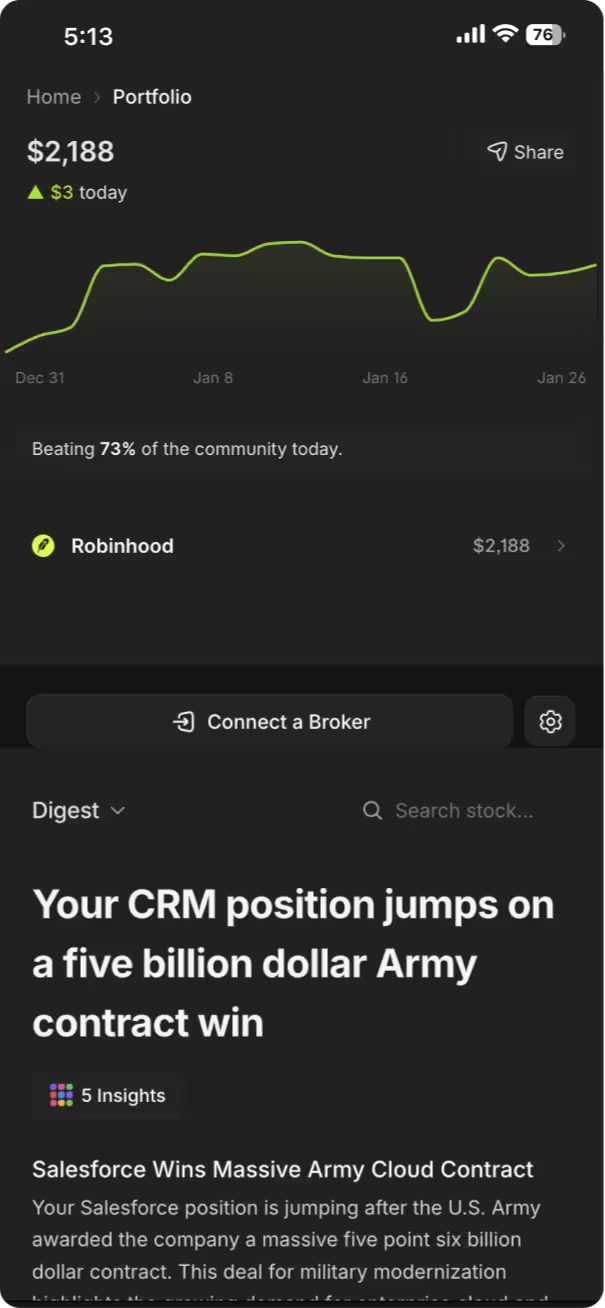
Consider your target allocation across all accounts combined—401(k), IRA, taxable brokerage, and other holdings. If you want 70% stocks overall and your 401(k) represents half your investments, you might hold 80% stocks there and 60% in other accounts to achieve 70% total. Tools like the Rallies.ai portfolio tracker can help you see your complete allocation picture.
7. What allocation should I use for a goal 5 years away?
For a 5-year timeline, most advisors suggest moderate allocations around 40-60% stocks and 40-60% bonds, with some cash. This provides growth potential while limiting the risk of a large loss right before you need the money. As you approach year 5, gradually shift more conservative—maybe 30% stocks and 70% bonds/cash in the final year.
8. Do I need to rebalance if I'm still contributing regularly?
You can often rebalance simply by directing new contributions to whichever asset class has fallen below target. If stocks have outperformed and you're now 65% stocks instead of 60%, direct your next several contributions entirely to bonds until you're back at 60/40. This avoids selling appreciated assets and triggering taxes in taxable accounts.
Conclusion
Asset allocation basics come down to dividing your portfolio among stocks, bonds, and cash in proportions that match your timeline and risk tolerance. This decision drives about 90% of your portfolio's performance variability, making it more important than which specific investments you choose. Start with your investment timeline—longer horizons support more stocks, shorter timelines need more bonds and cash.
The right allocation is one you can maintain through market turbulence without panicking. Set your targets, rebalance once or twice yearly to maintain them, and adjust gradually as your timeline shortens or circumstances change. For more comprehensive guidance on building and managing your investment portfolio, see our complete portfolio management guide.
Want to dig deeper? Read our complete guide to portfolio management or ask the AI Research Assistant your specific questions about portfolio allocation.
References
- Brinson, Gary P., L. Randolph Hood, and Gilbert L. Beebower. "Determinants of Portfolio Performance." Financial Analysts Journal, 1986. CFA Institute
- Damodaran, Aswath. "Annual Returns on Stock, T.Bonds and T.Bills: 1928 - Current." NYU Stern School of Business. pages.stern.nyu.edu/~adamodar/
- Vanguard Research. "Best practices for portfolio rebalancing." 2023. institutional.vanguard.com
- U.S. Securities and Exchange Commission. "Beginners' Guide to Asset Allocation, Diversification, and Rebalancing." sec.gov
- Morningstar, Inc. "Asset Allocation: The Building Blocks of a Portfolio." Morningstar Investment Research Center. morningstar.com
- Federal Reserve Bank of St. Louis. "Economic Research - Historical Stock Market Returns." FRED Economic Data. fred.stlouisfed.org
Disclaimer: This article is for educational and informational purposes only. It does not constitute investment advice, financial advice, trading advice, or any other type of advice. Rallies.ai does not recommend that any security, portfolio of securities, transaction, or investment strategy is suitable for any specific person.
Risk Warning: All investments involve risk, including the possible loss of principal. Past performance does not guarantee future results. Before making any investment decision, you should consult with a qualified financial advisor and conduct your own research.
Written by: Gav Blaxberg
CEO of WOLF Financial | Co-Founder of Rallies.ai
```