


AI stock research uses machine learning and natural language processing to analyze financial data, earnings reports, and market trends in seconds, while traditional research relies on manual analysis by human analysts reading through documents and building models. AI tools can process thousands of data points simultaneously and answer questions in plain English, but they lack the nuanced judgment and industry expertise that experienced human analysts bring to evaluating qualitative factors like management quality or competitive positioning.
Key Takeaways
- AI stock research tools can analyze financial statements and answer specific queries in under 10 seconds, compared to 30-60 minutes for manual analysis of the same documents
- Traditional research methods provide deeper context on management quality, competitive dynamics, and industry relationships that AI systems currently struggle to evaluate
- AI excels at quantitative analysis—processing ratios, trends, and historical patterns—while human analysts better assess qualitative factors like brand strength and strategic positioning
- Cost differences are significant: AI research platforms typically charge $20-50/month while traditional analyst reports can cost $500-5,000 per detailed company analysis
- Most professional investors now use hybrid approaches, combining AI tools for data processing with human judgment for final investment decisions
Table of Contents
- What Is AI Stock Research?
- How Traditional Stock Research Works
- Speed and Efficiency: How Do They Compare?
- Accuracy and Reliability Considerations
- Cost Analysis: AI vs Traditional Methods
- What Each Method Does Best
- Data Coverage and Scope
- Which Approach Should You Use?
- Frequently Asked Questions
- Conclusion
What Is AI Stock Research?
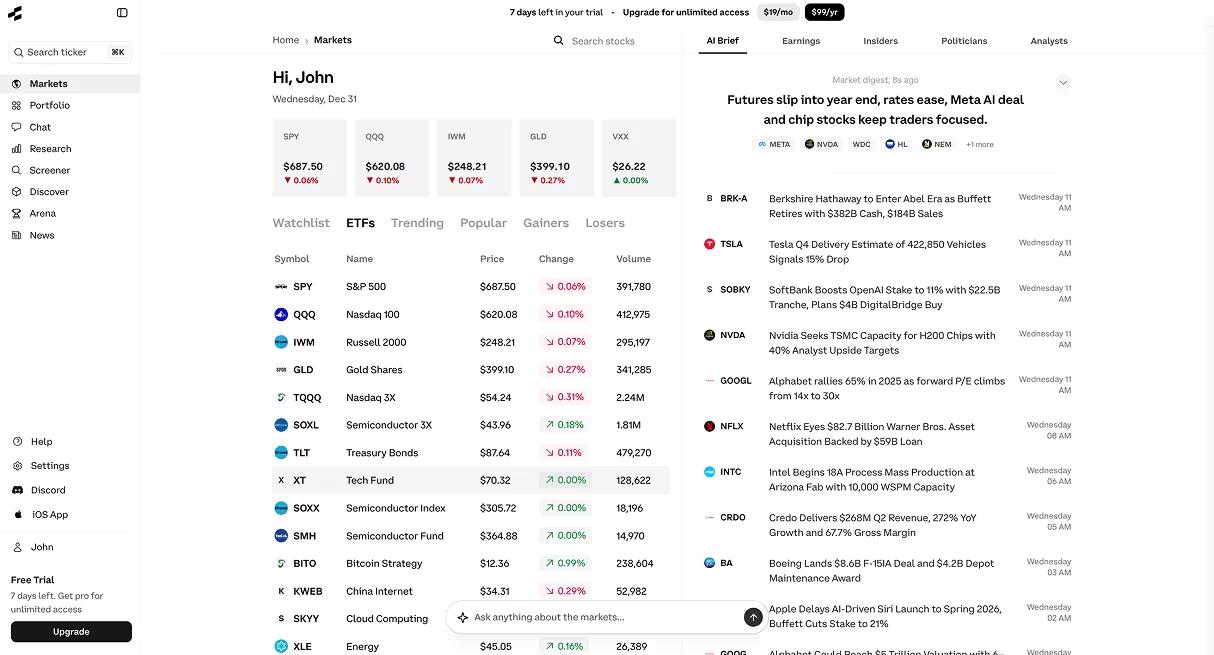
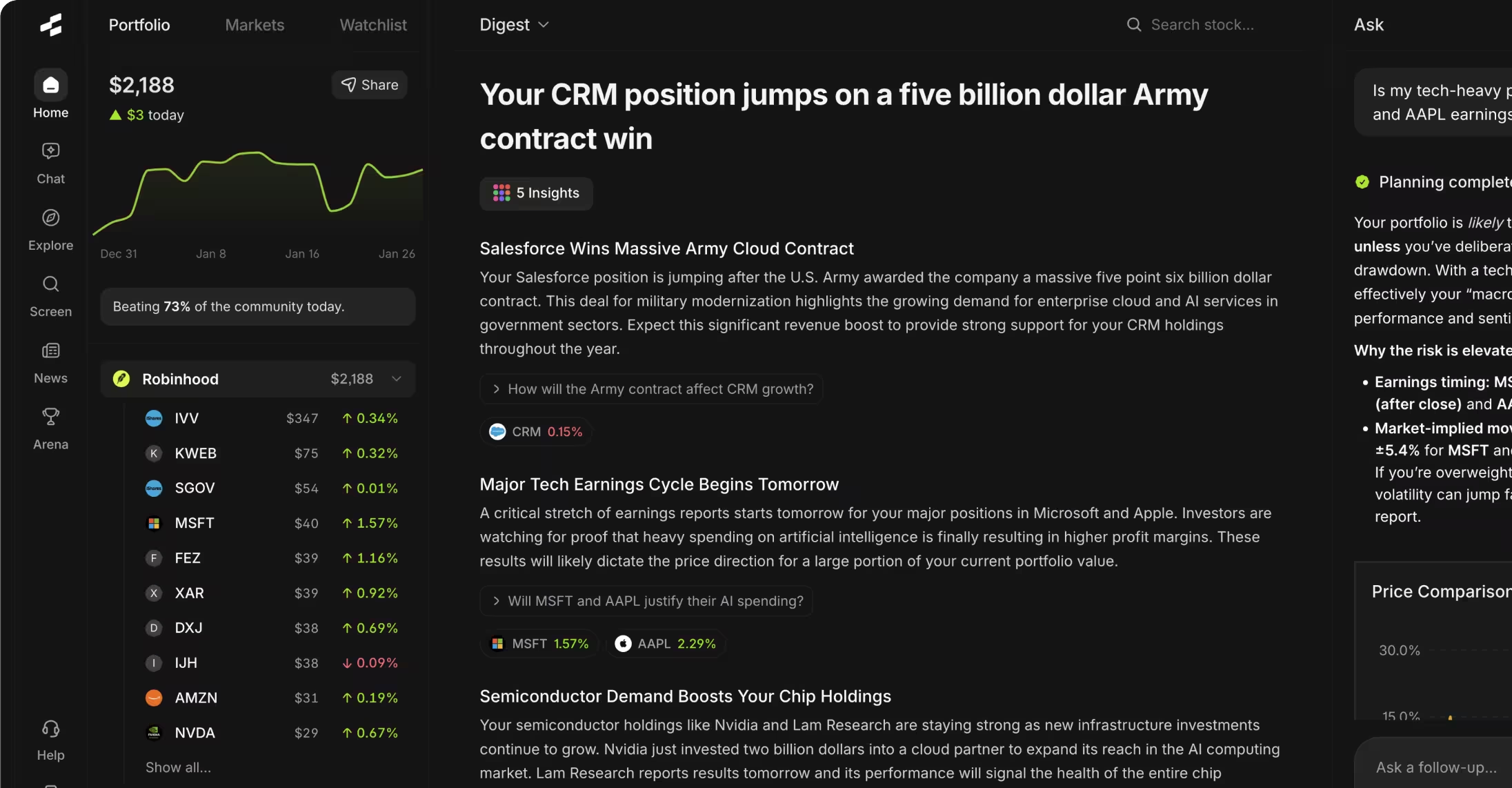
AI stock research uses algorithms trained on financial data to analyze companies, answer investor questions, and identify patterns in market behavior. These systems process structured data like balance sheets and income statements alongside unstructured data like earnings call transcripts and news articles, then surface relevant insights through conversational interfaces or automated reports.
Natural Language Processing (NLP): A branch of artificial intelligence that enables computers to understand and respond to human language. In stock research, NLP allows you to ask questions like "What's Tesla's gross margin?" and receive direct answers pulled from financial documents.
Modern AI investing tools fall into several categories. Automated research assistants answer specific questions about company financials. Algorithmic analysis tools scan thousands of stocks to find patterns or screen for criteria. Real-time AI data platforms monitor news and filing updates to alert investors to material changes. Some platforms combine multiple functions, offering conversational finance AI that handles various research tasks.
The core advantage lies in processing speed and scale. Where a human analyst might review 10-20 companies per week in depth, AI systems can analyze thousands simultaneously. Tools like the AI Research Assistant can pull specific metrics from 10-K filings and compare them across an entire sector in seconds.
These systems work by training machine learning models on historical financial data. They learn to recognize patterns—what typically happens when a company's inventory grows faster than revenue, or how different industries react to interest rate changes. When you ask a question, the AI retrieves relevant data and applies these learned patterns to generate answers.
How Traditional Stock Research Works
Traditional stock analysis centers on human analysts reading financial documents, building financial models in spreadsheets, and synthesizing their findings into investment theses. An equity research analyst typically follows 15-25 companies in a specific industry, developing expertise in the competitive dynamics, regulatory environment, and business models unique to that sector.
The process starts with document review. Analysts read quarterly and annual reports, focusing on the Management Discussion & Analysis section, footnotes, and risk factors that explain the story behind the numbers. They listen to earnings calls, noting management tone and responses to analyst questions. They track competitor announcements and industry trade publications.
Next comes financial modeling. Analysts build three-statement models projecting income statements, balance sheets, and cash flow statements forward three to five years. These models incorporate assumptions about revenue growth, margin expansion, capital expenditure needs, and financing decisions. Sensitivity analysis shows how different scenarios affect valuation.
Three-Statement Model: A financial projection that links income statement, balance sheet, and cash flow statement to show how business decisions flow through a company's financials. Changes in one statement automatically update the others, maintaining accounting consistency.
Valuation follows modeling. Analysts typically use multiple approaches: discounted cash flow analysis projects future cash flows and calculates present value, comparable company analysis compares valuation multiples to similar businesses, and precedent transaction analysis examines acquisition prices for comparable deals. The final price target reflects a weighted average of these methods.
The best traditional research includes qualitative assessment that's hard to quantify. Analysts evaluate management credibility based on track record and capital allocation decisions. They assess competitive positioning through customer conversations and market share trends. They judge the sustainability of competitive advantages based on factors like brand strength, network effects, and switching costs.
Institutional research desks at banks like Goldman Sachs or Morgan Stanley employ hundreds of analysts producing this type of research. Independent research firms like Morningstar or CFRA offer similar analysis for retail investors. The process remains labor-intensive and expensive, which limits how many companies receive coverage and how often reports update.
Speed and Efficiency: How Do They Compare?
AI stock analysis tools complete basic financial queries in 5-10 seconds that would take human analysts 30-60 minutes to research manually. For example, answering "How has Microsoft's operating margin changed over the past 5 years?" requires an AI system to query a database and format results—about 8 seconds. A human analyst needs to locate five years of 10-K filings, find the relevant line items, calculate the margins, and create a summary—roughly 40 minutes for a thorough job.
Task AI Time Traditional Time Pull specific financial metric 5-10 seconds 15-30 minutes Compare metric across 10 companies 30-60 seconds 3-5 hours Screen 5,000 stocks for criteria 1-2 minutes Not feasible manually Summarize earnings call transcript 2-3 minutes 45-90 minutes Build complete investment thesis Limited depth 20-40 hours
The efficiency gap widens with comparative analysis. Screening the entire market for stocks trading below 15x earnings with revenue growth above 10% takes an AI tool about 90 seconds. A human analyst couldn't manually check 5,000 stocks—they'd need to rely on pre-built screeners or limit the sample size.
However, speed doesn't equal thoroughness. AI systems quickly retrieve and calculate quantitative data but struggle with tasks requiring judgment. Evaluating whether a CEO's explanation for missing guidance seems credible, or assessing whether a company's competitive moat will hold up against a new entrant, requires contextual understanding that takes humans time to develop but that AI systems handle poorly.
The practical implication: AI tools work well for initial screening and data gathering, compressing hours of grunt work into minutes. Traditional methods remain necessary for the deeper analysis that leads to conviction—understanding the "why" behind the numbers and making probabilistic judgments about future scenarios.
Accuracy and Reliability Considerations
AI stock research achieves near-perfect accuracy on quantitative tasks like calculating financial ratios or pulling data from structured documents, with error rates typically below 1% for established platforms. Traditional research by experienced analysts shows similar accuracy on numerical work but adds interpretation that can be right or wrong—analyst price targets hit within 10% of actual outcomes only 30-35% of the time over 12-month periods, according to studies tracking Wall Street research accuracy.
The accuracy difference reflects task type. AI systems excel at calculation and data retrieval. If you ask for Apple's price-to-earnings ratio, the AI will query a database and return the correct number 99%+ of the time. Errors occur mainly from data source issues—if the underlying database has incorrect information, the AI reproduces that error.
Hallucination: When an AI system generates false information presented as fact, rather than retrieving actual data. This happens more often with general language models than specialized financial AI tools built to query structured databases.
Where AI struggles is interpretation and prediction. Asking "Will this company beat earnings next quarter?" requires judgment about business momentum, competitive pressures, and execution capability. AI models can analyze historical patterns (companies with X characteristics beat estimates Y% of the time), but they can't incorporate soft information like recent management changes or emerging competitive threats the way a human analyst can.
Traditional analysts bring inconsistency. Research quality varies significantly based on analyst experience, industry knowledge, and inherent biases. A 15-year veteran covering semiconductor stocks will produce more reliable analysis than a junior analyst in their first year. Humans also make mathematical errors—typos in spreadsheet formulas, incorrect formula references, or basic calculation mistakes appear in professional research with surprising frequency.
Bias affects both methods differently. AI systems reflect biases in their training data, potentially overweighting historical patterns that don't apply to new situations. Human analysts face conflicts of interest (investment banking relationships affecting buy/sell ratings) and behavioral biases (anchoring to initial views, confirmation bias). Some research suggests AI tools show more consistency across companies because they apply the same methodology to each, while human research quality varies more based on analyst attention and interest.
For investors, this means verification matters regardless of source. Cross-check AI-provided numbers against original sources when making important decisions. View both AI and human research as inputs to your own analysis rather than final answers you can trust completely.
Cost Analysis: AI vs Traditional Methods
AI-powered investment research platforms charge $15-50 per month for retail access, while professional-grade institutional access runs $500-2,000 monthly depending on features and user seats. Traditional equity research costs vary dramatically: free broker research for clients who trade with the firm, $500-5,000 per detailed report from independent research boutiques, or $20,000-100,000+ annually for institutional access to full research platforms like Bloomberg Terminal or FactSet.
Research Method Retail Cost Professional Cost AI research platforms $15-50/month $500-2,000/month Broker research (with account) Free with trades Free with commission revenue Independent research reports $50-500/report $500-5,000/report Bloomberg Terminal Not available $24,000/year/user FactSet Not available $12,000-50,000/year Morningstar Premium $249/year $199-999/year
The cost structure reflects different business models. AI platforms achieve scale economics—once built, the system serves additional users at minimal marginal cost. Traditional research requires human labor for each report and each update, keeping costs high. A single equity research analyst costs a firm $150,000-500,000 annually in compensation plus overhead, and each analyst covers only 15-25 stocks.
For individual investors, the practical choice often comes down to free broker research plus a low-cost AI tool versus paying for premium independent research. Platforms like Rallies.ai offer AI-driven insights at accessible price points that make sense for portfolios above $10,000-25,000, where better research decisions might add $500-1,000 in annual returns—far exceeding subscription cost.
Institutional investors face different math. A hedge fund managing $500 million might spend $500,000 annually on research data and tools, representing just 0.1% of assets. That same fund likely employs multiple analysts at $200,000-400,000 each. The research budget, while large in absolute terms, remains small relative to assets and potential value added.
Hidden costs matter too. Traditional research takes time to read and synthesize—an investor spending 10 hours weekly reading analyst reports is investing 520 hours annually, worth $26,000-52,000 at a $50-100/hour opportunity cost. AI tools reduce this time commitment, though you still need to validate outputs and make your own decisions.
What Each Method Does Best
AI stock research excels at processing quantitative data, screening large universes of stocks, and providing instant answers to specific factual questions. Traditional research methods shine in qualitative assessment, industry context, and synthesizing multiple factors into coherent investment theses.
AI Research Strengths
- Analyzes thousands of stocks simultaneously to find patterns or meet specific criteria
- Processes financial statements and pulls precise metrics in seconds
- Monitors news and filings in real-time, alerting to material changes
- Maintains consistency—applies the same methodology to every company
- Handles repetitive tasks without fatigue or declining attention
- Costs 90-95% less than equivalent human analyst coverage
- Answers natural language queries without requiring you to learn complex tools
AI Research Limitations
- Struggles with qualitative factors like management quality or company culture
- Can't assess nuanced competitive dynamics or industry relationships
- Limited ability to identify genuinely novel situations or paradigm shifts
- Relies on historical patterns that may not apply to future scenarios
- Lacks industry expertise and contextual knowledge veteran analysts possess
- May hallucinate or provide confident-sounding but incorrect answers
- Doesn't have conviction—can't tell you what really matters vs what's noise
Traditional Research Strengths
- Deep industry expertise from analysts covering the same sector for years
- Qualitative assessment of management, strategy, and competitive position
- Contextual understanding of what metrics matter most in each industry
- Primary research including customer conversations and channel checks
- Judgment about which factors are temporary vs structural
- Synthesis of multiple data points into coherent narratives
- Ability to identify truly novel situations historical patterns don't cover
Traditional Research Limitations
- Slow—detailed reports take weeks to produce and update quarterly at best
- Limited coverage—most analysts follow only 15-25 stocks
- Expensive—quality independent research costs hundreds to thousands per report
- Inconsistent quality varying significantly by analyst experience
- Subject to conflicts of interest and behavioral biases
- Human errors in calculations and spreadsheet formulas occur regularly
- Can't analyze thousands of stocks to find opportunities systematically
The pattern that emerges: use machine learning stocks analysis for breadth and speed, traditional methods for depth and judgment. AI tools help you go from 5,000 potential stocks to 50 worth examining. Human research—either your own or professional analysts'—helps you go from 50 candidates to 5-10 you actually buy.
Consider the task of evaluating a bank stock. AI can instantly tell you the price-to-book ratio, efficiency ratio, net interest margin trend, and how these compare to peers. But assessing loan quality requires understanding local market conditions, management's underwriting discipline during the last cycle, and competitive pressure from fintech—judgment calls where experienced banking analysts add real value.
Data Coverage and Scope
AI-powered investment research tools typically cover 8,000-12,000 U.S. stocks plus international equities on major exchanges, with automated data extraction from financial filings, earnings calls, and news sources updated within minutes of publication. Traditional analyst research covers only 2,000-3,000 U.S. companies actively, with most coverage concentrated in large-cap stocks—roughly 85% of actively traded market capitalization receives professional analyst coverage, but 65% of listed companies have zero or minimal coverage.
The coverage gap matters for different strategies. If you invest in S&P 500 companies, you'll find extensive traditional research—Apple has coverage from 40+ analysts, Microsoft from 35+, and most index components from 15-30 analysts. These stocks also have comprehensive AI coverage. You're choosing between abundant options from both methods.
Small-cap and mid-cap investors face different dynamics. A company with $500 million market cap might have 2-3 analysts covering it, or zero if it's in an out-of-favor industry. AI tools provide the same depth of financial data analysis for these smaller companies as for large-caps—the algorithms don't care about market capitalization. This levels the information playing field somewhat.
Coverage Gap: The difference between companies that receive regular professional analyst attention versus those that don't. Smaller companies and those in niche industries often have minimal or zero analyst coverage despite being publicly traded.
International coverage shows similar patterns. Traditional research from U.S. firms concentrates on developed markets and larger companies. AI platforms increasingly include international stocks, though data quality varies by country. Markets with strong disclosure requirements (UK, Canada, Australia, Japan) work well with automated research. Markets with weaker disclosure or language barriers pose more challenges.
Data types matter as much as company coverage. AI tools excel with structured data—anything in financial statements, SEC filings, or standardized databases. Traditional research incorporates unstructured qualitative information that's harder to systematize: conversations with management or customers, observations from store visits, industry conference takeaways, or insights from supplier conversations.
Stock screening tools demonstrate the coverage advantage of AI. You can screen the entire market for specific criteria combinations in seconds. No human analyst team could manually check 10,000 stocks against five simultaneous criteria, but algorithmic analysis handles this easily.
Which Approach Should You Use?
Most investors benefit from combining both methods—using AI tools for initial screening, data gathering, and monitoring, while applying traditional analytical techniques or professional research for final decision-making on individual positions. The optimal mix depends on your portfolio size, time availability, investing style, and expertise level.
Scenarios Where AI Research Works Well
AI-powered tools make the most sense when you need breadth, speed, or systematic processes. If you're screening hundreds or thousands of stocks to find candidates matching specific criteria, automated stock research handles this efficiently. If you want quick answers to factual questions about multiple companies—comparing revenue growth rates, checking current valuations, or monitoring earnings dates—AI responds in seconds.
Quantitative strategies particularly benefit from AI. If your approach relies on factors like value metrics, momentum signals, or quality scores applied systematically across many stocks, AI tools calculate and update these metrics continuously. Passive investors who buy index funds or ETFs might use AI tools to understand holdings or compare fund characteristics without needing deep individual stock research.
Time-constrained investors gain efficiency. If you have 2-3 hours weekly for investment research rather than 10-20 hours, AI tools extract more insight from limited time by handling data retrieval and basic analysis, letting you focus on judgment and decisions.
Scenarios Where Traditional Research Matters
Traditional analytical methods become important for concentrated portfolios, complex situations, or when qualitative factors drive outcomes. If you hold 8-12 individual stocks making up significant portions of your portfolio, deep research on each position justifies the time investment—you need conviction about your holdings.
Turnaround situations, management changes, industry disruption, or other complex scenarios require judgment that AI systems handle poorly. Understanding whether a new CEO can successfully restructure operations, or whether an incumbent can fend off a disruptive competitor, involves synthesis of many qualitative factors.
Professional investors with time and expertise should still do traditional analysis as their final step. Even if AI tools handle initial screening and data gathering, making high-conviction decisions requires your own modeling, valuation work, and thesis development. Read the complete guide to AI stock research for more on building this workflow.
The Hybrid Approach
A practical workflow combines both methods' strengths. Start with AI tools to screen the market and identify candidates worth deeper research—this might take 30 minutes and surface 10-15 interesting stocks. Use AI to gather detailed data on these candidates quickly—financial metrics, recent news, analyst estimates. This might add another 30 minutes.
Then apply traditional techniques to your top 3-5 ideas: read the most recent annual report, build a simple financial model, assess management quality and competitive position, develop a thesis about what would make the stock go up or down. This might take 3-5 hours per stock but focuses that time on genuinely promising opportunities already vetted by AI screening.
Monitor positions using AI tools that alert you to material changes—earnings releases, filing updates, significant news. This automation catches important developments without requiring you to manually check each holding daily. Reserve your attention for situations requiring judgment—do you still believe the thesis after negative news? Does a competitor's announcement change your view?
Frequently Asked Questions
1. Can AI replace human stock analysts completely?
AI cannot fully replace human analysts for comprehensive stock research, though it handles many component tasks better than humans. AI excels at data processing, quantitative analysis, and systematic screening, but struggles with qualitative assessment, industry context, and making judgment calls about uncertain future scenarios. Most professional investors now use AI tools to handle time-consuming data work while reserving human attention for tasks requiring experience and intuition. The consensus among investment firms is that human analysts augmented by AI tools produce better results than either alone.
2. How accurate are AI stock predictions compared to traditional analyst forecasts?
AI systems and traditional analysts show similar accuracy rates for earnings predictions and price targets, both hitting within 10% of actual outcomes roughly 30-35% of the time over 12-month periods. AI tends to perform slightly better on short-term quantitative predictions based on historical patterns, while human analysts add more value on longer-term forecasts requiring judgment about business model changes or industry shifts. Neither method predicts stock prices reliably enough to use predictions alone for investment decisions—both work better as inputs to a broader research process that considers multiple factors.
3. What are the main risks of relying solely on AI for investment research?
The primary risks include AI systems hallucinating false information, overreliance on historical patterns that don't apply to new situations, inability to assess qualitative factors like management quality, and missing context about industry dynamics or competitive threats. AI tools also can't tell you which factors matter most in a given situation—they present data without the conviction that comes from deep expertise. Investors using only AI research might make decisions based on incomplete analysis that looks comprehensive but misses critical qualitative elements. Always verify AI outputs against primary sources and combine with your own judgment or human research on significant positions.
4. How much does professional AI stock research cost versus traditional research?
AI research platforms charge $15-50 monthly for retail investors and $500-2,000 monthly for professional users, while traditional research costs range from free broker reports to $500-5,000 per detailed independent analyst report. Institutional data platforms like Bloomberg Terminal cost $24,000 annually per user. For most individual investors, AI tools cost 90-95% less than equivalent traditional research coverage would, making comprehensive research accessible to smaller portfolios. The cost advantage of AI stems from scale economics—once built, AI systems serve additional users at minimal marginal cost, while human research requires ongoing labor expense for each report and update.
5. Can beginners use AI stock research effectively without finance knowledge?
Beginners can use AI tools to access data and get answers to basic questions, but finance knowledge remains necessary to ask the right questions, interpret answers correctly, and make sound decisions. AI research assistants answer what you ask—if you don't know to check cash flow alongside earnings, or compare metrics to industry peers rather than absolute terms, you'll miss important context. New investors should use AI tools while simultaneously building finance knowledge through educational resources. The combination of accessible AI tools and online learning actually creates better conditions for beginners than existed before, when lack of knowledge and lack of data access were both barriers.
6. Do professional investors and hedge funds use AI stock research?
Yes, most institutional investors now incorporate AI tools into their research process, though implementation varies widely. A 2023 survey by Greenwich Associates found that 78% of institutional investors use some form of AI or machine learning in their investment process, primarily for data processing, screening, and pattern recognition. Hedge funds use AI for quantitative strategies, sentiment analysis, and automating repetitive research tasks. However, few rely exclusively on AI—the typical approach combines AI-driven data analysis with human judgment for final investment decisions. Large firms increasingly hire both traditional analysts and data scientists who build custom AI tools tailored to their specific strategies.
7. What types of stocks or situations does AI research analyze best?
AI research works best for analyzing established companies with extensive historical data, straightforward business models, and quantifiable metrics—think mature businesses in traditional industries. Large-cap stocks with years of financial history, regular analyst coverage, and stable business models provide rich datasets for AI analysis. AI also excels at comparing companies within the same industry or screening for specific factor combinations across many stocks. Situations AI handles poorly include early-stage companies with limited history, turnaround situations requiring judgment about management capability, complex holding company structures, and industries undergoing fundamental disruption where historical patterns provide limited guidance.
8. How do I verify that AI-provided stock data is accurate?
Verify AI-provided data by cross-referencing against original sources—check financial metrics against the actual 10-K or 10-Q filings on the SEC's EDGAR database, confirm price data against your broker or financial websites, and validate news summaries against original articles. For critical decisions, spot-check at least 3-5 data points from the AI output against primary sources. Reputable AI platforms indicate their data sources and provide links to original documents. Be especially cautious with older data (AI may have outdated information) and complex calculations (verify the AI used the formula you intended). If data seems surprising or contradicts other sources you've seen, investigate further before relying on it.
Conclusion
AI stock research and traditional methods each serve distinct purposes in the investment process. AI tools provide unmatched speed, breadth, and efficiency for quantitative analysis—screening thousands of stocks, pulling financial data instantly, and monitoring markets continuously at accessible cost. Traditional research brings depth, context, and judgment to qualitative assessment—evaluating management capability, competitive dynamics, and complex situations where historical patterns provide limited guidance.
The practical path forward for most investors combines both approaches. Use AI-driven insights for initial screening and data gathering, focusing human time and attention on the judgment calls that determine investment success. Start with AI tools for systematic screening, then apply traditional analytical techniques to your highest-conviction ideas. Neither method alone provides complete answers, but together they offer a more robust research process than either in isolation.
As AI capabilities continue improving, the division of labor will shift—machines will handle increasingly complex analysis while human expertise focuses on areas requiring intuition, industry knowledge, and probabilistic thinking about uncertain futures. For now, understanding what each method does well lets you build a research process that leverages both for better investment decisions.
Ready to experience AI-powered research? Start with Rallies.ai free and analyze stocks in seconds using conversational AI tools.
References
- U.S. Securities and Exchange Commission. "EDGAR Company Filings." https://www.sec.gov/edgar
- CFA Institute. "The AI Revolution in Investment Management." Research Foundation Literature Review, 2023. https://www.cfainstitute.org
- Greenwich Associates. "Institutional Investment in Artificial Intelligence." Industry Survey, 2023.
- Dimensional Fund Advisors. "Long-Term Returns by Asset Class 1928-2022." Matrix Book 2023. https://www.dimensional.com
- Financial Industry Regulatory Authority (FINRA). "Investor Education: Understanding Stock Research." https://www.finra.org/investors
- Harvard Business Review. "How AI Is Changing Financial Analysis." 2023. https://hbr.org
Disclaimer: This article is for educational and informational purposes only. It does not constitute investment advice, financial advice, trading advice, or any other type of advice. Rallies.ai does not recommend that any security, portfolio of securities, transaction, or investment strategy is suitable for any specific person.
Risk Warning: All investments involve risk, including the possible loss of principal. Past performance does not guarantee future results. Before making any investment decision, you should consult with a qualified financial advisor and conduct your own research.
Written by: Gav Blaxberg
CEO of WOLF Financial | Co-Founder of Rallies.ai