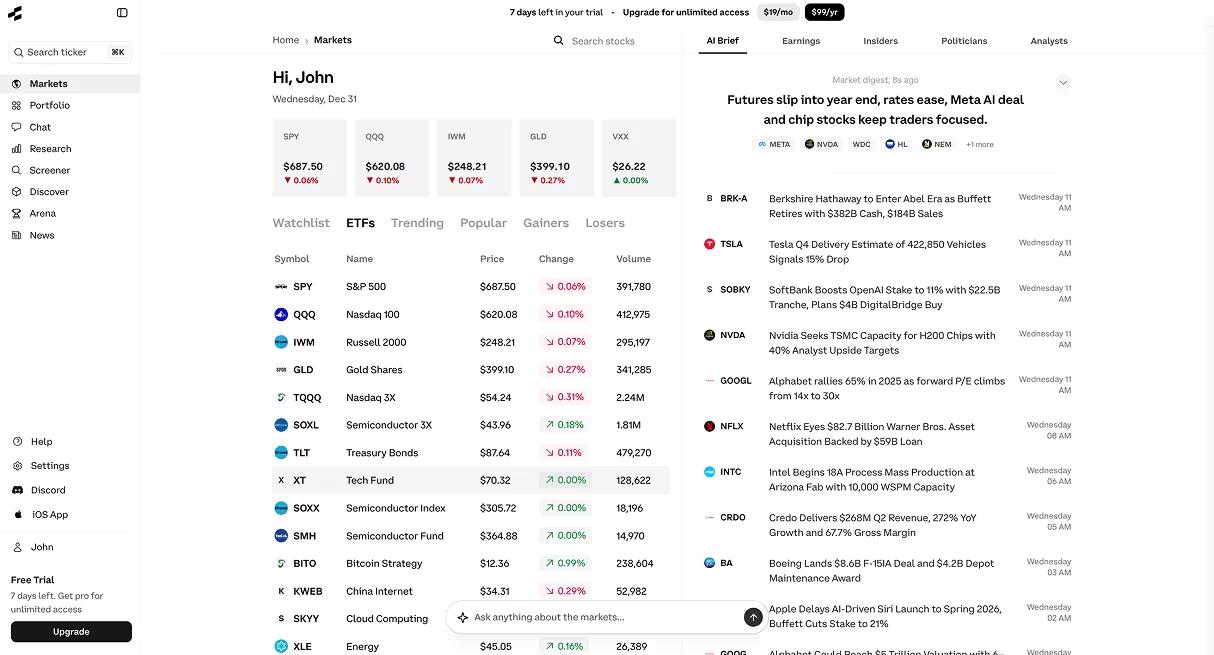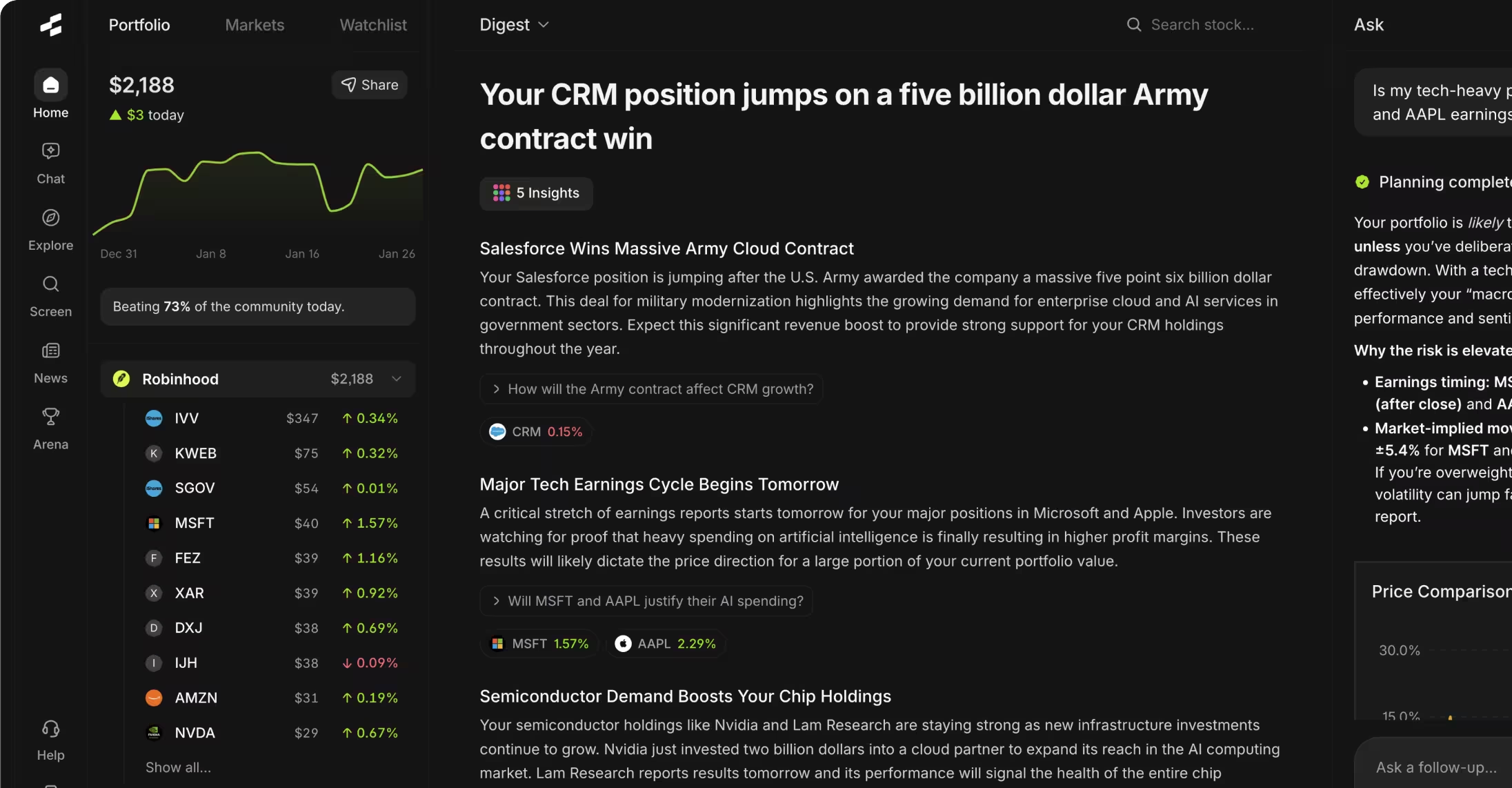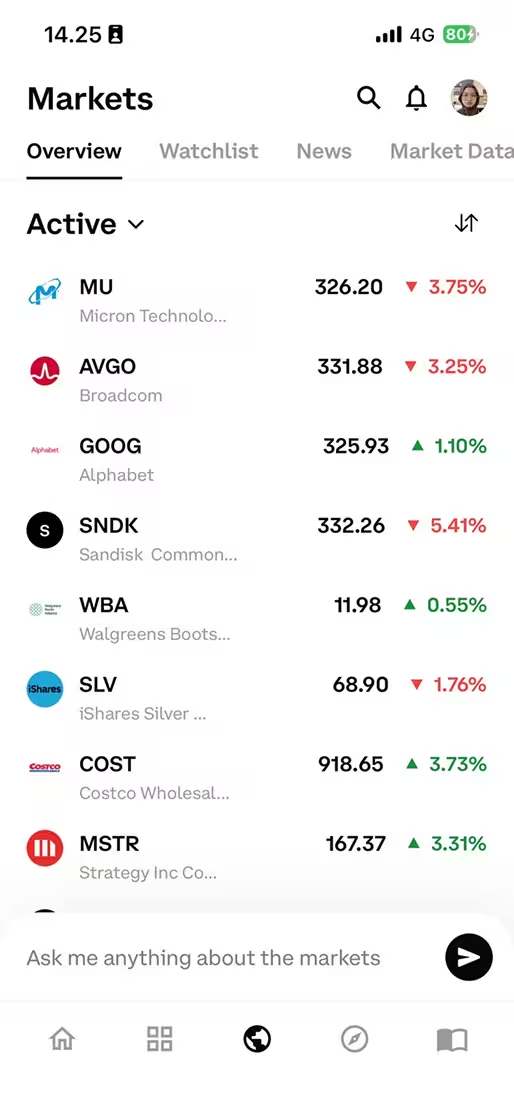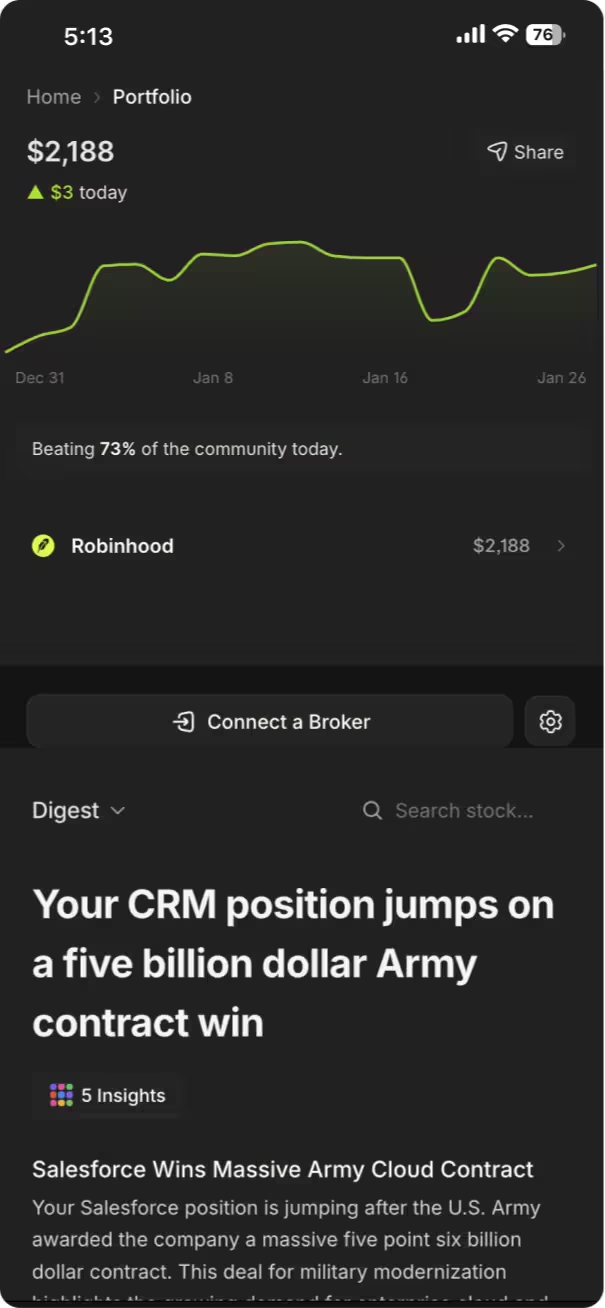



AI stock research uses artificial intelligence and machine learning algorithms to analyze financial data, company fundamentals, market trends, and news sentiment to generate investment insights. Unlike traditional manual research that relies on human analysts reviewing documents and spreadsheets, AI systems can process thousands of data points across multiple companies simultaneously, identifying patterns and relationships that might take human researchers weeks or months to uncover.
Key Takeaways
- AI stock research automates the analysis of financial statements, earnings reports, SEC filings, and market data using natural language processing and machine learning algorithms
- Machine learning models can analyze 100+ financial metrics simultaneously, compared to the 10-15 factors most human analysts can reasonably track at once
- Conversational AI tools let investors ask research questions in plain English like "What's Apple's debt-to-equity ratio?" instead of manually searching through financial documents
- AI-driven analysis reduces research time from hours to seconds but requires human judgment to interpret results and make final investment decisions
- Algorithmic systems excel at quantitative analysis and pattern recognition but struggle with qualitative factors like management quality and competitive moat assessment
Table of Contents
- What Is AI Stock Research?
- How AI Analyzes Stocks
- AI vs Traditional Research Methods
- Benefits of AI-Powered Research
- Limitations of AI in Investing
- How to Use AI for Stock Analysis
- Best Practices for AI Research
- The Future of AI Investing
- Frequently Asked Questions
What Is AI Stock Research?
AI stock research applies artificial intelligence technologies to investment analysis, using algorithms to process financial data, identify trends, and generate insights about publicly traded companies. These systems combine natural language processing, machine learning, and data analytics to perform tasks traditionally done by human equity analysts, from reading earnings reports to calculating valuation metrics.
Natural Language Processing (NLP): A branch of artificial intelligence that enables computers to understand, interpret, and generate human language. In stock research, NLP allows AI systems to read and extract meaning from earnings calls, news articles, and SEC filings.
The technology works by ingesting structured data (financial statements, stock prices, economic indicators) and unstructured data (news articles, social media, analyst reports) to build comprehensive profiles of companies and market conditions. Modern AI investing tools can answer specific questions about stocks, screen for companies meeting particular criteria, and flag important changes in a company's fundamentals or competitive position.
Most AI stock research platforms fall into three categories: automated research assistants that answer questions in conversational language, screening tools that find stocks matching specific criteria, and deep analysis systems that generate comprehensive reports on individual companies. Some platforms combine all three approaches, while others focus on a single use case.
The rise of intelligent stock research tools reflects broader trends in financial technology, where computational power and data availability have reached levels that make sophisticated algorithmic analysis accessible to individual investors. What once required a team of analysts and Bloomberg terminals now fits in a web browser or mobile app.
How AI Analyzes Stocks
AI systems analyze stocks through a multi-step process that begins with data collection and ends with synthesized insights presented to users. The process typically involves gathering financial data from regulatory filings, extracting key metrics using machine learning models, comparing those metrics against historical patterns and peer companies, then generating natural language summaries or answering specific user queries.
Data Collection and Processing
Automated research tools continuously pull data from sources like SEC EDGAR (for 10-K and 10-Q filings), earnings call transcripts, press releases, and market data feeds. NLP algorithms parse these documents to extract specific information: revenue figures, profit margins, debt levels, management commentary, and forward guidance. This happens in real-time as companies release new information.
The accuracy of this extraction depends on the training data and algorithms used. Well-designed systems achieve 95%+ accuracy on structured financial data from standardized forms but may struggle with unusual accounting presentations or companies that report metrics in non-standard ways.
Quantitative Analysis
Once data is extracted, machine learning models calculate dozens of financial ratios and metrics automatically. A typical AI stock analysis includes:
- Valuation ratios (P/E, P/B, P/S, EV/EBITDA)
- Profitability metrics (gross margin, operating margin, net margin, ROE, ROA)
- Growth rates (revenue growth, earnings growth, both year-over-year and compound annual)
- Financial health indicators (debt-to-equity, current ratio, interest coverage)
- Cash flow metrics (free cash flow, operating cash flow, capital expenditures)
Free Cash Flow: The cash a company generates after accounting for capital expenditures needed to maintain or expand its asset base. It represents money available for dividends, debt repayment, or reinvestment, making it a key metric for assessing financial flexibility.
Sentiment Analysis
AI-driven sentiment analysis evaluates the tone and content of earnings calls, news coverage, and social media discussion around a stock. NLP models scan for positive language ("exceeded expectations," "strong demand," "record quarter") versus negative language ("headwinds," "challenges," "disappointed") to gauge overall sentiment.
A 2023 study by the Journal of Financial Economics found that earnings call sentiment predicted stock returns in the following quarter with 60% accuracy, better than traditional surprise metrics alone. However, sentiment analysis works best as one input among many rather than a standalone signal.
Pattern Recognition
Machine learning excels at identifying patterns across large datasets. AI models can spot correlations like "companies with improving operating margins and accelerating revenue growth in this sector typically outperform by 8% over the next 6 months." These pattern-based insights emerge from analyzing thousands of historical cases that would be impractical for human analysts to review comprehensively.
The limitation is that patterns are probabilistic, not deterministic. Markets change, historical relationships break down, and correlation doesn't prove causation. Investors should view pattern-based insights as hypotheses to investigate rather than guarantees.
AI vs Traditional Research Methods
Traditional stock research relies on human analysts who read financial statements, build financial models in spreadsheets, attend investor presentations, and synthesize their findings into written reports with buy/hold/sell recommendations. AI stock research automates much of this data processing but approaches analysis differently, with distinct trade-offs in speed, scale, and depth.
FactorTraditional ResearchAI Stock ResearchSpeedDays to weeks for comprehensive analysisSeconds to minutes for initial analysisScaleAnalysts typically cover 15-20 stocksCan analyze thousands simultaneouslyCost$50K-$200K+ per analyst annually$0-$50/month for most platformsQuantitative AnalysisLimited to metrics analyst calculates100+ metrics calculated automaticallyQualitative AssessmentDeep industry expertise and judgmentLimited to sentiment analysisBias SusceptibilitySubject to confirmation bias, anchoringReflects biases in training dataAdaptabilityCan assess novel situationsStruggles with unprecedented events
Where Traditional Research Excels
Human analysts bring contextual understanding that current AI systems can't replicate. An experienced analyst covering the pharmaceutical industry understands drug development timelines, FDA approval processes, patent cliffs, and competitive dynamics in ways that pure data analysis misses. They can assess whether management's strategy makes sense, evaluate the strength of a company's competitive moat, and identify risks that haven't manifested in historical data yet.
Traditional research also incorporates primary research like visiting stores, talking to suppliers and customers, and attending industry conferences. These qualitative data points often provide early signals that show up in financial statements only months later.
Where AI Research Excels
Automated stock research eliminates the capacity constraints of human analysis. An AI system can screen every company in the S&P 500 for specific criteria in seconds, whereas a human analyst might cover 20 companies maximum. This breadth helps investors discover opportunities they wouldn't have found manually.
AI also removes certain cognitive biases. Human analysts suffer from anchoring bias (over-relying on initial impressions), confirmation bias (seeking data that supports existing views), and availability bias (overweighting recent or memorable information). Algorithmic analysis applies consistent criteria across all stocks without these psychological distortions, though it introduces different biases based on training data.
The Hybrid Approach
Many professional investors now combine both methods: using AI investing tools for initial screening and quantitative analysis, then applying human judgment for final decision-making. This workflow leverages the speed and scale of automated research while preserving the contextual understanding and qualitative assessment that humans provide.
Benefits of AI-Powered Research
AI-powered investment research delivers measurable advantages in research efficiency, coverage breadth, and analytical consistency. Individual investors gain access to institutional-grade analysis tools that were unavailable or prohibitively expensive just a few years ago.
Key Advantages
- Time Savings: Reduces research time from hours to minutes by automating data collection and metric calculation
- Comprehensive Coverage: Analyzes multiple companies simultaneously instead of researching one stock at a time
- Real-Time Updates: Monitors thousands of stocks continuously and alerts users to material changes
- Accessibility: Provides sophisticated analysis to individual investors without requiring finance degrees or expensive tools
- Consistency: Applies the same analytical framework across all stocks without fatigue or emotional bias
- Natural Language Interface: Answers questions in plain English without requiring knowledge of where data is located
Democratization of Research
Before AI-driven research tools, comprehensive stock analysis required either professional training or significant time investment to learn financial modeling, accounting principles, and where to find relevant data. Conversational AI interfaces change this by letting users ask questions like "What's Tesla's operating margin trend over the last 5 years?" and receiving accurate answers with source citations, no spreadsheet required.
This democratization extends beyond just data access. Machine learning models can identify relationships and patterns that even trained analysts might miss when reviewing hundreds of data points manually. A 2024 study by MIT found that retail investors using AI research tools made more diversified portfolio choices and exhibited lower volatility in trading behavior compared to those relying solely on traditional research methods.
Continuous Monitoring
Human analysts produce reports periodically—quarterly after earnings, or when major news breaks. AI systems monitor stocks continuously, flagging important developments as they happen. This real-time surveillance helps investors react to material changes faster, whether that's a sudden drop in gross margin, unexpected debt issuance, or shifts in insider trading patterns.
Tools like automated research assistants can track custom criteria like "alert me if any of my portfolio holdings see operating margin decline by more than 5% quarter-over-quarter" or "notify me when companies in the renewable energy sector report revenue growth above 30%." This personalized monitoring scales in ways human research never could.
Reduced Cost
Professional equity research from firms like Morgan Stanley or Goldman Sachs costs institutional clients thousands of dollars per year per analyst covered. Individual investors typically lack access entirely. Most AI stock analysis platforms charge $0-$50 monthly, with many offering substantial functionality in free tiers. This cost reduction makes sophisticated research accessible to investors of all portfolio sizes.
Limitations of AI in Investing
AI stock research has significant limitations that investors must understand to use these tools effectively. These systems work best as assistants that handle data-intensive tasks, not as autonomous decision-makers that replace human judgment entirely.
Key Limitations
- Qualitative Blind Spots: Can't assess management quality, corporate culture, or competitive moat strength
- Backward-Looking: Trained primarily on historical data, struggles with unprecedented situations
- Context Gaps: Misses industry-specific nuances that experienced analysts would catch
- Over-Reliance Risk: Users may trust AI-generated insights without adequate verification
- Data Quality Dependency: Output accuracy depends entirely on input data quality and timeliness
- Limited Creativity: Follows patterns in training data rather than generating novel investment theses
The Qualitative Assessment Gap
AI excels at quantitative analysis but struggles with qualitative factors that often determine long-term investment success. Consider management quality: a skilled CEO with a track record of capital allocation excellence and operational improvement represents a significant competitive advantage, but this doesn't reduce to a single metric. Similarly, company culture, employee satisfaction, customer loyalty, and brand strength all matter tremendously yet resist quantification.
Warren Buffett famously evaluates management teams based on factors like integrity, intelligence, and energy—characteristics visible through actions over time but not easily captured in financial statements. Current AI systems can analyze what management says (sentiment analysis of earnings calls) but can't evaluate whether leaders consistently deliver on promises or pivot intelligently when strategies aren't working.
Novel Situations and Black Swans
Machine learning models identify patterns in historical data. When faced with unprecedented situations—a global pandemic, a new regulatory framework, a disruptive technology that changes industry economics—AI systems have no historical template to reference. Their predictions become less reliable precisely when investors most need accurate analysis.
The COVID-19 pandemic illustrated this clearly. AI models trained on pre-2020 data had no framework for understanding lockdowns, supply chain disruptions, or work-from-home transitions. Human analysts could reason through second-order effects and make informed guesses about which business models would prove resilient. Algorithmic systems initially floundered until enough pandemic-era data accumulated for retraining.
Data Quality and Timeliness
AI output quality depends completely on input data. If a company reports non-GAAP metrics in unusual ways, if there are accounting restatements, or if data feeds have errors, the AI's analysis will be flawed. Most platforms source data from established providers, but lags of hours or even days can occur between when a company releases information and when it appears in AI systems.
For time-sensitive decisions around earnings releases or breaking news, these delays matter. Professional traders often rely on direct feeds and human verification for this reason, using AI for deeper analysis rather than immediate reactions.
The Echo Chamber Effect
If many investors use similar AI tools trained on similar data, there's risk of herding behavior. When algorithmic systems identify the same patterns and generate similar insights, the resulting trading activity can create self-reinforcing trends disconnected from fundamental value. This increases correlation across stocks that AI models flag as similar, potentially reducing diversification benefits.
The 2020 quantitative fund deleveraging event demonstrated how algorithmic similarity can amplify market stress. Multiple funds using similar factor models faced redemptions simultaneously, leading to coordinated selling that pushed prices below fundamental values temporarily. As AI-driven research spreads, understanding what patterns your tools might share with others becomes important for risk management.
How to Use AI for Stock Analysis
Effective AI stock research requires a structured approach that leverages algorithmic strengths while compensating for its limitations. Investors should treat AI tools as research accelerators that handle data-intensive work, freeing time for higher-level analysis and decision-making that requires human judgment.
Step 1: Define Your Research Objective
Start with a clear question. "Tell me about Apple" generates generic information. "What's Apple's iPhone revenue as a percentage of total revenue over the last 3 years, and how does gross margin differ between iPhone and Services segments?" gets specific, actionable analysis. AI research tools work best when you know what you're looking for.
Common research objectives include screening for stocks meeting specific criteria, analyzing a particular company's financial health, comparing competitors within an industry, monitoring portfolio holdings for warning signs, or researching historical patterns related to a thesis you're testing.
Step 2: Use AI for Initial Screening and Data Gathering
Natural language stock screening tools let you describe what you're looking for instead of setting manual filters. For example: "Find healthcare companies with market cap over $1B, revenue growth above 15%, and operating margin above 10%." The AI translates this into database queries and returns matching stocks.
Tools like natural language screeners can process complex multi-factor criteria that would take significant time to configure manually. Once you have a list of candidates, use conversational AI to quickly gather key metrics on each: "What are the P/E ratios, debt-to-equity ratios, and 5-year revenue CAGRs for companies X, Y, and Z?"
Step 3: Verify Key Data Points
Don't trust AI output blindly. Verify critical data points by checking primary sources. If an AI tool reports a company's debt-to-equity ratio is 0.5, spot-check this against the company's latest 10-K or 10-Q filing. Most discrepancies stem from timing differences (the AI's data may be a quarter behind) or different calculation methodologies (some sources include operating leases in debt, others don't).
For investment decisions involving significant capital, verifying 3-5 key metrics takes a few minutes and prevents errors from compounding. Check especially carefully around major events like acquisitions, spin-offs, or accounting changes where automated systems may lag in properly reflecting new corporate structures.
Step 4: Apply Human Judgment to Qualitative Factors
Use AI-generated quantitative analysis as input for qualitative assessment. If an AI tool flags that a company's operating margin improved 5 percentage points year-over-year, ask yourself: Is this sustainable? Does it reflect operating leverage as revenue scales, or one-time cost cuts? What competitive advantages enable this profitability?
Read the earnings call transcript yourself. Review what management says about strategy, competitive positioning, and outlook. Assess whether their explanations make logical sense and align with industry trends. AI can summarize these transcripts and extract key quotes, but you need to evaluate credibility and strategic coherence.
Step 5: Monitor and Iterate
Set up automated monitoring for your portfolio holdings and watch lists. Configure alerts for material changes: earnings surprises, margin compression, debt increases, insider selling, analyst rating changes, or significant price movements. This continuous monitoring catches developing issues early when you still have time to react.
As you gain experience with your AI research tools, refine your prompts and workflows. Notice which questions generate the most useful outputs and which require extensive verification. Build a personal library of effective queries that you can reuse or adapt for different stocks.
Best Practices for AI Research
Following systematic best practices maximizes the value of AI-powered research tools while minimizing risks from over-reliance or misinterpretation. These guidelines reflect lessons from early adopters and institutional investors who have integrated algorithmic analysis into their workflows.
AI Research Checklist
- ☐ Start with specific questions rather than broad explorations
- ☐ Cross-reference AI outputs with primary sources for key metrics
- ☐ Understand what data sources and time periods the AI uses
- ☐ Compare multiple companies using consistent criteria
- ☐ Document your research process and AI-generated insights
- ☐ Supplement quantitative AI analysis with qualitative research
- ☐ Set up automated alerts for portfolio holdings
- ☐ Review AI tool accuracy periodically by spot-checking results
- ☐ Use AI for hypothesis generation, not final decisions
- ☐ Maintain a margin of safety given AI limitations
Triangulate with Multiple Sources
Don't rely on a single AI tool exclusively. Cross-check important findings across multiple platforms or against traditional research sources. If one AI system reports revenue growth of 25% but another shows 22%, investigate the discrepancy. The difference might stem from different fiscal period definitions, currency adjustments, or how acquisitions are treated.
Combining AI-generated insights with traditional sources like company investor relations pages, SEC filings, and established financial media creates a more complete picture. The AI handles the heavy computational work, while you verify and contextualize using authoritative sources.
Understand the Underlying Data
Know what data your AI research platform uses and how current it is. Some platforms pull data from SEC filings directly (most authoritative but can lag by weeks), others use commercial data providers (faster but occasionally contains errors), and some incorporate real-time market data feeds (current prices but historical fundamentals may lag).
Ask: When was this data last updated? What's the source? How does the platform handle restatements or accounting changes? This context helps you interpret results correctly and know when to verify independently.
Document Your Research Trail
Keep records of AI-generated insights that influenced your decisions. If you bought a stock partly based on AI analysis showing improving margins, document that analysis. This creates accountability and lets you evaluate which types of AI-generated insights proved accurate over time, improving your ability to weight different signals.
Documentation also helps you avoid hindsight bias. It's easy to remember the AI calls that worked and forget the ones that didn't. Systematic record-keeping provides honest feedback about what's actually adding value to your research process.
Recognize Pattern Limitations
When an AI system identifies a pattern like "stocks with these characteristics typically outperform," remember this is probabilistic, not deterministic. A pattern that held 65% of the time historically still fails 35% of the time. Factor this uncertainty into position sizing and portfolio construction.
Be especially cautious of patterns with small sample sizes or short time horizons. A pattern observed across 15 stocks over 2 years has much weaker statistical significance than one observed across 500 stocks over 20 years. Most AI tools don't automatically surface these statistical confidence levels, so you need to think critically about sample robustness.
Combine with Traditional Due Diligence
Use AI to identify opportunities and gather data quickly, then perform traditional due diligence before committing capital. Read the full annual report, not just the AI summary. Review competitors. Understand industry dynamics. Talk to customers or industry participants if possible. Think through competitive threats and what could go wrong.
Professional investors spend the bulk of their time on qualitative assessment even when using AI for quantitative work. The algorithmic analysis gets you to a shortlist faster, but the final decision still requires deep contextual understanding.
The Future of AI Investing
AI capabilities in investment research continue advancing rapidly, with near-term developments focused on improving qualitative analysis, expanding data sources, and making tools more accessible through conversational interfaces. The technology will likely become more sophisticated at contextual understanding while remaining subject to fundamental limitations around unprecedented events and true causal reasoning.
Improved Natural Language Understanding
Next-generation AI models show meaningful improvement in understanding context, nuance, and industry-specific terminology. This enables more sophisticated analysis of qualitative information from earnings calls, analyst Q&A sessions, and management presentations. Future systems may better assess factors like management credibility, strategic coherence, and competitive positioning by analyzing patterns in language use and consistency over time.
However, this remains pattern recognition rather than genuine understanding. AI can flag when management language changes tone or contains more hedging language than usual, but human judgment is still needed to interpret what that means for the investment thesis.
Alternative Data Integration
AI research platforms increasingly incorporate alternative data: satellite imagery of retail parking lots, credit card transaction data, web traffic analytics, app download trends, and employment review sites. Machine learning excels at identifying correlations between these alternative signals and subsequent financial performance.
A 2024 analysis by Morgan Stanley found that AI models combining traditional financial data with alternative data sources improved earnings forecast accuracy by 15-20% compared to models using financial data alone. As more alternative data becomes available and AI processing improves, this advantage will likely expand.
Personalized Research Assistants
Future AI tools will likely learn individual investor preferences, risk tolerance, and investment style to provide personalized research. Rather than generic analysis, these systems could prioritize the metrics and factors most relevant to your specific approach, whether that's value investing, growth investing, dividend focus, or thematic strategies.
Platforms like conversational research assistants already allow customized queries, but future iterations may proactively surface relevant information based on your portfolio, watchlist, and historical research patterns without requiring explicit prompts.
Explainable AI
Current AI systems often function as "black boxes" where the logic behind conclusions isn't transparent. Regulatory pressure and user demand are driving development of explainable AI that shows its reasoning: "This stock screens favorably because criterion A scored X, criterion B scored Y, similar companies with this profile historically returned Z."
Transparency helps users evaluate whether AI logic aligns with sound investment principles or reflects spurious correlations in training data. It also builds appropriate trust—users should understand the basis for AI recommendations well enough to accept or reject them thoughtfully.
Regulatory Evolution
Financial regulators are beginning to address AI in investment contexts. The SEC has indicated that investment advisors using AI must understand the models, monitor for bias, and ensure recommendations align with client interests. As AI stock research tools proliferate, expect clearer regulatory frameworks around disclosure, accountability, and investor protection.
This regulation will likely focus on transparency about AI limitations, clear disclosure when AI generates advice versus information, and standards for data quality and model validation. Responsible platforms are already implementing these practices voluntarily.
What Won't Change
Despite technological advances, human judgment will remain central to investment decision-making. AI can process information faster and identify patterns more comprehensively, but investing ultimately involves predicting an uncertain future based on incomplete information. That requires weighing probabilities, assessing risks, and making trade-offs—activities that benefit from computational assistance but can't be fully automated.
Markets will also continue adapting to AI adoption. As algorithmic analysis becomes widespread, the easy patterns will get arbitraged away, and alpha will migrate to areas requiring genuine insight rather than pattern recognition. The competitive advantage will shift toward investors who combine AI tools with proprietary data, unique frameworks, or better qualitative judgment.
Frequently Asked Questions
1. Is AI stock research accurate enough to base investment decisions on?
AI stock research provides accurate quantitative analysis of financial data when sourced from reliable providers, typically achieving 95%+ accuracy on metrics from standardized financial statements. However, accuracy alone doesn't make something decision-ready. AI excels at data processing and pattern identification but lacks the contextual understanding, qualitative assessment, and forward-looking judgment needed for complete investment analysis. Use AI-generated insights as inputs for decision-making, not as standalone recommendations, and always verify critical data points against primary sources before committing capital.
2. How much does AI stock research cost?
AI stock research tools range from free basic plans to $20-50 monthly for premium individual subscriptions and $100-500+ monthly for professional/institutional plans. Many platforms offer substantial functionality at no cost, including basic stock screening, financial data queries, and limited research assistant access. Premium tiers typically add features like real-time data, advanced screening criteria, deeper historical data, portfolio tracking, and higher query limits. This represents a dramatic cost reduction compared to traditional equity research, which was previously available only to institutions paying thousands of dollars annually.
3. Can AI predict which stocks will go up?
No, AI cannot reliably predict future stock prices, despite marketing claims suggesting otherwise. AI models can identify historical patterns and correlations, calculate probabilities based on past data, and flag stocks with characteristics associated with outperformance in the past. But stock prices depend on future events—earnings surprises, management decisions, competitive dynamics, regulatory changes, macroeconomic shifts—that are inherently uncertain. Numerous studies show that even sophisticated machine learning models struggle to consistently beat market benchmarks after accounting for transaction costs and risk. Use AI for analysis and screening, not price prediction.
4. What's the difference between AI stock research and algorithmic trading?
AI stock research helps investors analyze companies and make informed decisions, while algorithmic trading automatically executes buy and sell orders based on predefined criteria without human intervention. Research tools answer questions, generate insights, and present data but leave decision-making to users. Trading algorithms, by contrast, operate autonomously based on technical signals, quantitative models, or execution strategies. Most individual investors use AI research tools to inform manual trading decisions rather than implementing fully automated algorithmic trading, which requires significant technical infrastructure and risk management systems.
5. Do professional investors use AI for stock research?
Yes, professional investors increasingly incorporate AI into their research workflows, though typically as a complement to traditional analysis rather than a replacement. A 2024 survey by Greenwich Associates found that 73% of institutional investment firms use some form of AI or machine learning in their research process, primarily for initial screening, data processing, and pattern identification. However, these firms still employ human analysts for final decision-making, qualitative assessment, and synthesis. The professional approach treats AI as a tool that expands research capacity and identifies opportunities, while human judgment provides context, creativity, and risk assessment.
6. What questions can I ask an AI research assistant?
You can ask AI research assistants specific questions about company financials, metrics, comparisons, and historical trends. Effective queries include: "What's Microsoft's cloud revenue growth rate over the last 3 years?", "Compare the profit margins of Google, Meta, and Amazon," "Show me Apple's debt-to-equity ratio trend since 2020," "Which semiconductor companies have operating margins above 25%?", or "What's Tesla's free cash flow in the most recent quarter?" AI assistants work best with concrete, specific questions about quantifiable data. They struggle with open-ended questions like "Should I buy this stock?" or highly subjective queries requiring judgment calls about future events.
Conclusion
AI stock research transforms how individual investors analyze companies by automating data collection, calculation, and pattern recognition that previously required professional training or significant time investment. These tools democratize access to sophisticated analysis, reduce research time from hours to minutes, and enable monitoring at scale impossible with manual methods. The technology excels at quantitative analysis, processing structured financial data with high accuracy and identifying correlations across thousands of stocks simultaneously.
However, AI stock research has clear limitations around qualitative assessment, unprecedented situations, and predictive capability. Effective use requires treating these tools as research assistants that handle computational work while you provide judgment, context, and decision-making. The future belongs to investors who leverage AI for data-intensive tasks while maintaining critical thinking about management quality, competitive dynamics, and risk factors that resist quantification.
For those beginning with AI-powered research, start with specific questions about companies you're already familiar with, verify outputs against primary sources, and gradually expand to screening and monitoring as you build confidence in the tools. Learn more about AI investing approaches or explore how conversational interfaces can streamline your research workflow.
Want to dig deeper? Read our complete guide to AI-powered investment research or ask the AI Research Assistant your specific stock questions.
References
- U.S. Securities and Exchange Commission. "EDGAR - Search and Access." sec.gov
- Dimensional Fund Advisors. "Long-Term Returns by Asset Class (1928-2022)." dimensional.com
- Journal of Financial Economics. "Textual Analysis in Accounting and Finance: A Survey." 2023. sciencedirect.com
- MIT Sloan School of Management. "AI Adoption in Retail Investment Decision-Making." 2024. mitsloan.mit.edu
- Greenwich Associates. "Institutional Investment Technology Study." 2024. greenwich.com
- Morgan Stanley. "Alternative Data and Machine Learning in Equity Research." 2024. morganstanley.com
Disclaimer: This article is for educational and informational purposes only. It does not constitute investment advice, financial advice, trading advice, or any other type of advice. Rallies.ai does not recommend that any security, portfolio of securities, transaction, or investment strategy is suitable for any specific person.
Risk Warning: All investments involve risk, including the possible loss of principal. Past performance does not guarantee future results. Before making any investment decision, you should consult with a qualified financial advisor and conduct your own research.
Written by: Gav Blaxberg
CEO of WOLF Financial | Co-Founder of Rallies.ai