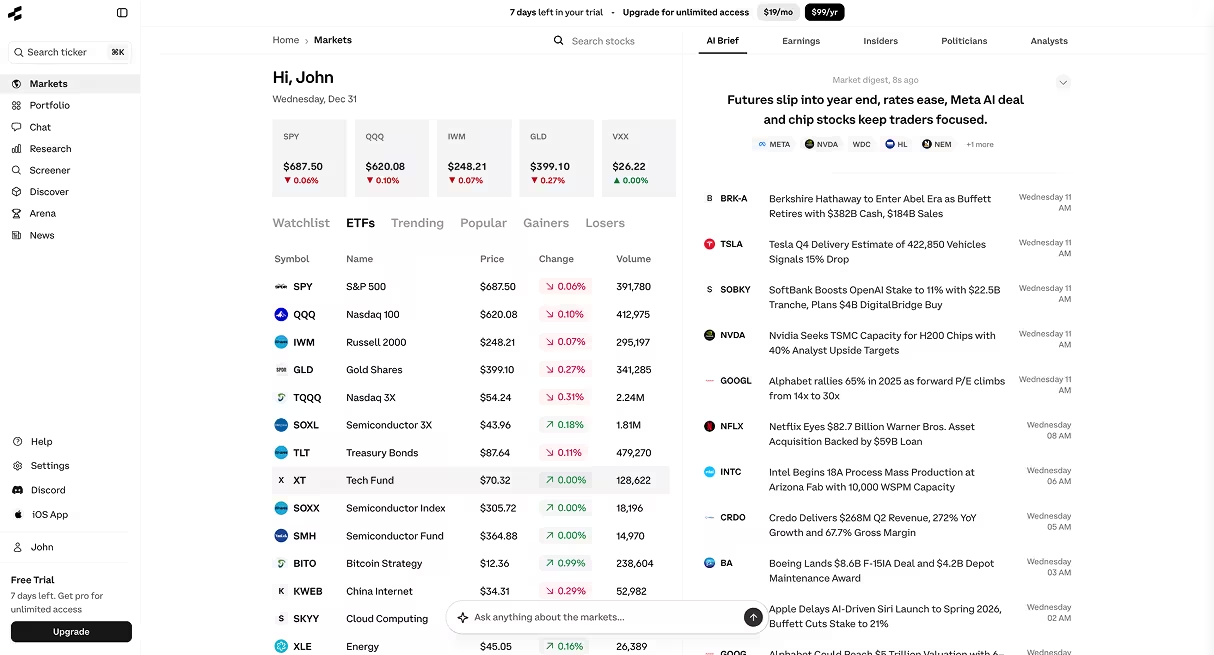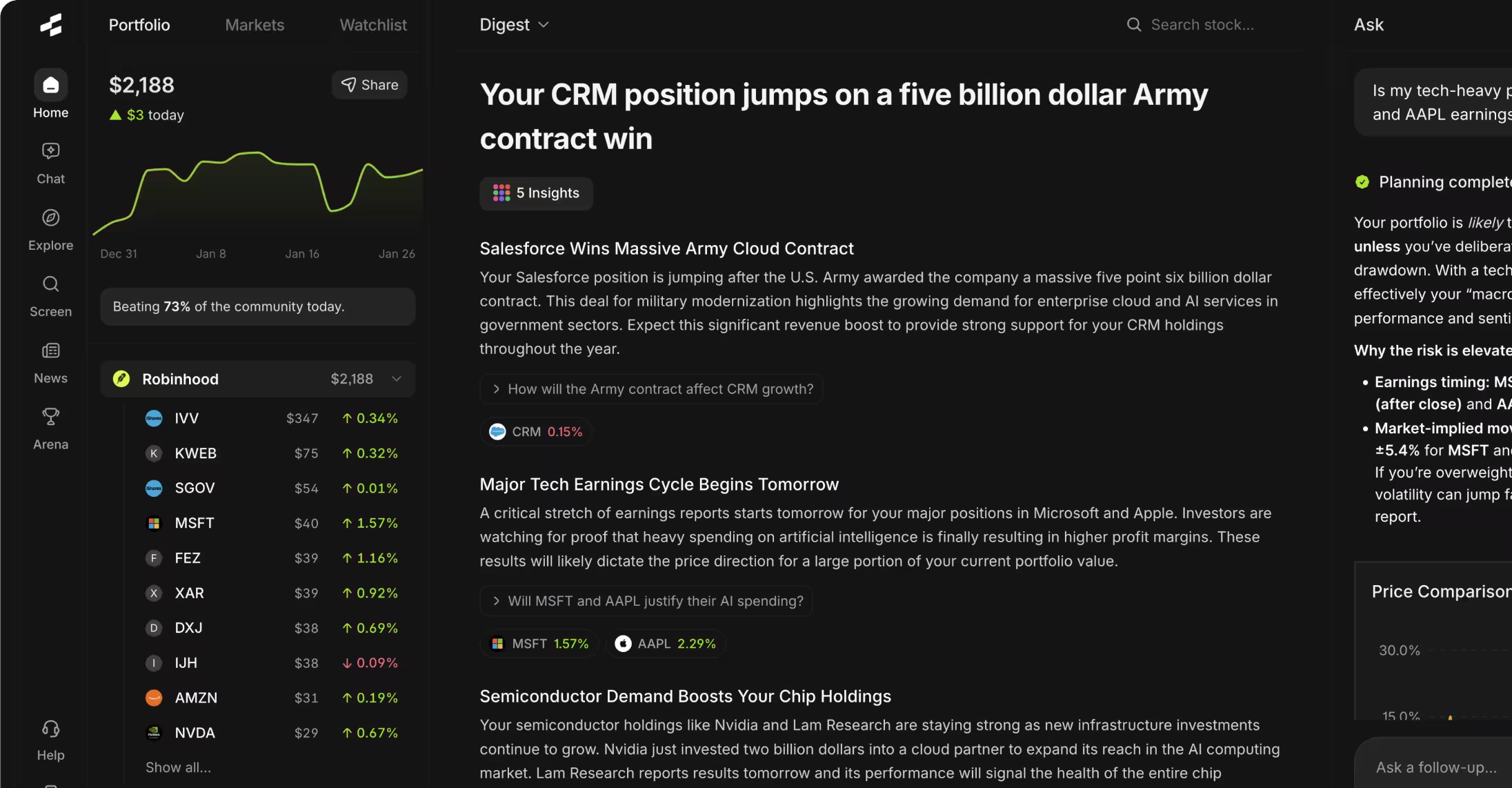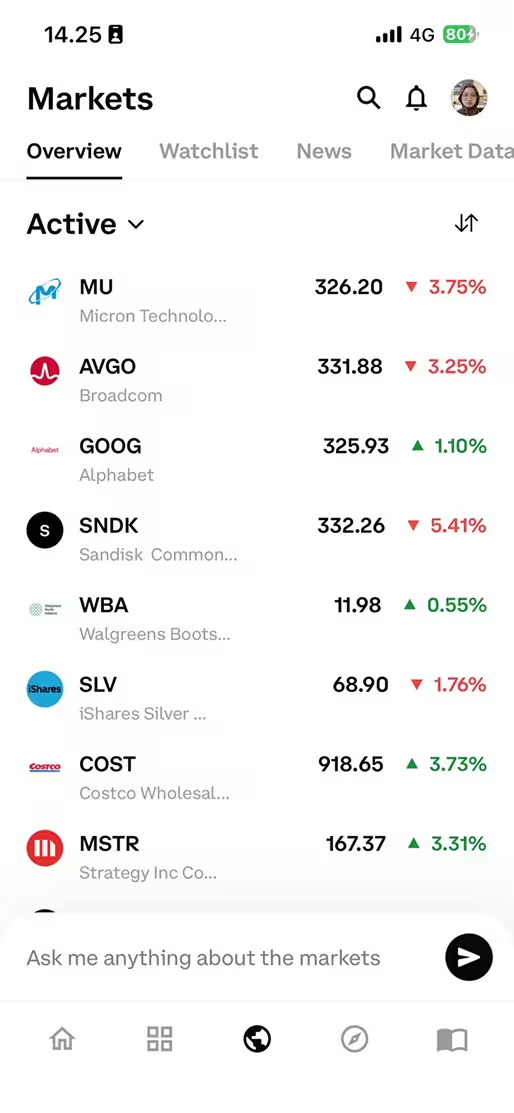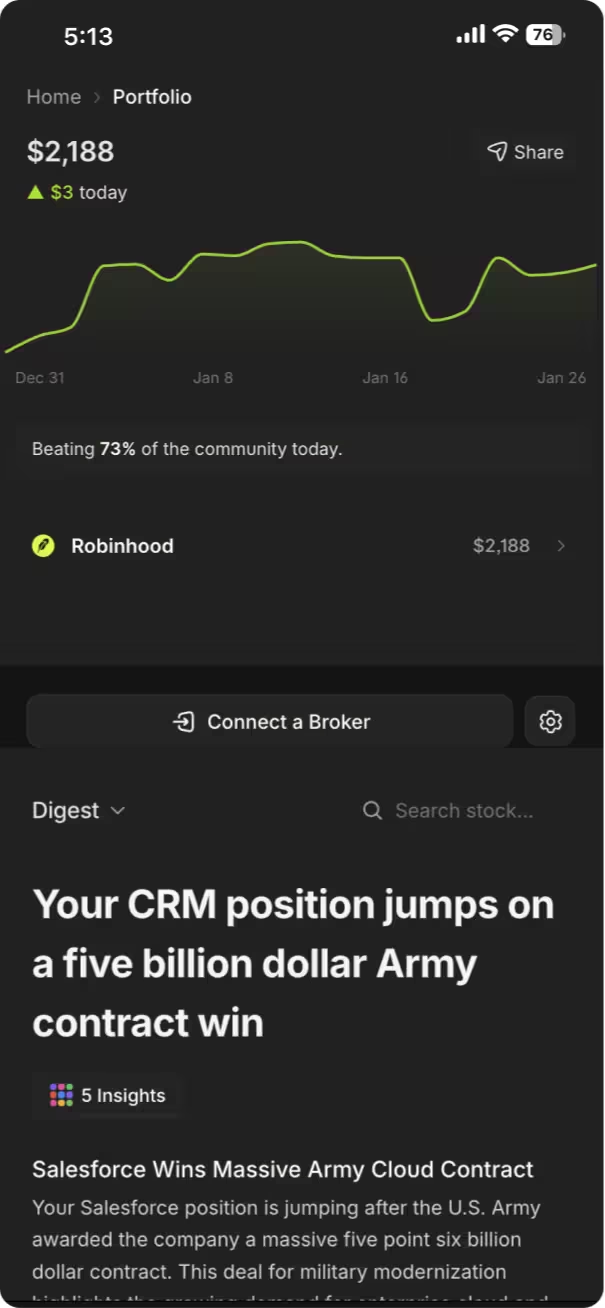



AI stock research uses artificial intelligence and machine learning algorithms to analyze financial data, market trends, and company fundamentals at speeds and scales impossible for human analysts. These systems process earnings reports, SEC filings, news sentiment, and price patterns to surface insights, answer investment questions in natural language, and identify stocks matching specific criteria—though they complement rather than replace human judgment and traditional due diligence.
Key Takeaways
- AI stock research tools process millions of data points in seconds, analyzing 10-Ks, earnings calls, and market data that would take human analysts days to review
- Natural language interfaces let you ask questions like "Which tech stocks have profit margins above 20%?" without learning complex screening syntax
- Machine learning models identify patterns in historical data, but past performance doesn't guarantee future results—AI tools work best when combined with fundamental analysis
- Automated stock research covers quantitative metrics well but may miss qualitative factors like management quality, competitive moats, and industry disruption risks
- Most AI investing tools require you to interpret their outputs—they provide data and insights, not buy/sell recommendations or personalized investment advice
Table of Contents
- What Is AI Stock Research?
- How AI Analyzes Stocks
- AI vs Traditional Research Methods
- Benefits of AI-Powered Research
- Limitations of AI in Investing
- How to Use AI for Stock Analysis
- Best Practices for AI Research
- The Future of AI Investing
- Frequently Asked Questions
- Conclusion
What Is AI Stock Research?
AI stock research applies artificial intelligence and machine learning to investment analysis tasks traditionally performed by human analysts. These systems read financial statements, parse earnings call transcripts, monitor news sentiment, track price movements, and answer investor questions using natural language processing. The technology automates data collection and pattern recognition while presenting findings in formats investors can use for decision-making.
Natural Language Processing (NLP): A branch of AI that enables computers to understand, interpret, and generate human language. In stock research, NLP powers conversational interfaces where you can ask "What's Tesla's debt-to-equity ratio?" instead of navigating spreadsheets.
Unlike traditional financial databases that require specific queries or manual spreadsheet work, AI-powered tools accept conversational questions. You might ask "Show me healthcare stocks with revenue growth above 15% and P/E ratios under 25"—the system translates your request into database queries, retrieves the data, and presents results with context.
The core advantage is speed and scale. An AI system can analyze every 10-K filing from the past decade in hours. It can monitor real-time news across thousands of companies simultaneously. It can backtest screening criteria against 20 years of market data to show historical performance. These capabilities make comprehensive research accessible to individual investors who lack Bloomberg terminals or analyst teams.
AI stock research encompasses several specific applications: automated financial statement analysis, sentiment analysis of news and social media, pattern recognition in price charts, portfolio screening based on multiple criteria, and conversational research assistants that answer specific questions about companies or markets. Tools like AI research assistants combine these capabilities into unified interfaces.
How AI Analyzes Stocks
AI systems analyze stocks by ingesting structured financial data and unstructured text, applying algorithms to identify patterns, calculate metrics, and extract insights. The process typically involves four stages: data collection, processing, analysis, and presentation.
Data Collection and Ingestion
AI tools pull data from multiple sources simultaneously. They access SEC EDGAR databases for official filings (10-Ks, 10-Qs, 8-Ks), earnings call transcripts from company investor relations pages, real-time price feeds from exchanges, analyst ratings from financial data providers, and news articles from thousands of publications. This happens continuously—most systems update their datasets within minutes of new information becoming public.
Natural Language Processing for Text Analysis
When you file a 10-K with 200+ pages of dense financial and business description, AI systems parse the entire document. NLP algorithms extract revenue figures, identify risk factors, pull out management discussion sections, and even detect tone changes that might signal concern. Sentiment analysis scores whether language in earnings calls sounds confident or defensive. These same techniques apply to news articles, analyst reports, and social media to gauge market sentiment around specific stocks.
Sentiment Analysis: Using AI to determine whether text expresses positive, negative, or neutral attitudes. Applied to news and earnings calls, it helps gauge market mood toward a stock beyond just price movements.
Quantitative Analysis and Pattern Recognition
Machine learning models identify patterns in numerical data that human analysts might miss. An algorithm might notice that stocks with specific combinations of metrics—say, rising free cash flow, decreasing share count, and P/E ratios in the 15-20 range—have historically outperformed their sectors by 3-4% annually. These patterns become screening criteria or alert triggers.
Technical analysis applications use computer vision techniques to recognize chart patterns. The AI scans price and volume data looking for head-and-shoulders formations, support and resistance levels, or momentum indicators across thousands of stocks simultaneously.
Conversational Interfaces and Query Understanding
Modern AI research tools understand questions posed in plain English. When you ask "Which semiconductor companies have the highest gross margins?", the system parses your intent, identifies that you want companies in NAICS code 334413, retrieves gross margin data from recent financial statements, ranks results, and presents a formatted answer. This happens in seconds and requires no knowledge of database query languages.
More sophisticated systems handle follow-up context. After the semiconductor query, you might ask "How have their margins trended over five years?"—the AI remembers you're discussing the semiconductor companies from the previous query and pulls historical data for that same group.
AI vs Traditional Research Methods
Traditional stock research relies on human analysts manually reviewing financial statements, building models in spreadsheets, reading news, and synthesizing information into investment theses. AI-powered approaches automate data gathering and initial analysis while presenting information differently. Each method has distinct strengths.
Dimension Traditional Research AI Stock Research Speed Hours to days per company Seconds to minutes across hundreds of companies Scale Deep analysis of 10-20 companies Broad screening of entire markets (5,000+ stocks) Cost $20,000-40,000/year for professional tools; significant time investment $0-500/month for retail tools Qualitative Assessment Strong—evaluates management, competitive positioning, industry dynamics Limited—struggles with nuanced judgment calls Pattern Recognition Based on analyst experience and mental models Identifies statistical patterns across decades of data Bias Subject to confirmation bias, anchoring, recency bias Free from emotional bias but may inherit biases from training data Customization Fully customizable based on investment philosophy Limited to tool capabilities and available data fields
Where Traditional Methods Excel
Human analysts understand context that AI systems miss. When a pharmaceutical company's lead drug candidate fails a clinical trial, an experienced analyst knows this might actually benefit the company if it frees resources for a more promising pipeline. They recognize when management teams are credible or evasive during earnings calls based on subtle cues beyond word choice.
Traditional research also adapts to unique situations. Special situations investing—spinoffs, bankruptcies, activist campaigns—requires understanding complex corporate actions and legal proceedings that don't fit neatly into algorithmic analysis. Deep value investing often involves assessing hidden assets or turnaround potential that financial statements don't fully capture.
Where AI Investing Tools Excel
Automated stock research handles comprehensive screening at scale. Want to find every stock in the Russell 3000 with return on equity above 18%, debt-to-equity below 0.5, and earnings growth above 12% for three consecutive years? An AI tool returns results in seconds. Doing this manually would take weeks.
AI systems also maintain consistency. They apply the same criteria to every company without fatigue or distraction. They monitor portfolios 24/7, alerting you when stocks hit predefined thresholds or when news breaks that meets your criteria. This systematic approach prevents the oversight errors that occur in manual processes.
The Hybrid Approach
Most sophisticated investors combine both methods. Use AI-powered screening to narrow 5,000 stocks down to 50 candidates that meet quantitative criteria. Then apply traditional research techniques to those 50—reading annual reports, assessing competitive positioning, evaluating management. This approach leverages the strengths of each method while mitigating their weaknesses.
Benefits of AI-Powered Research
AI stock analysis delivers specific advantages that improve research efficiency, expand analytical capabilities, and reduce certain types of errors. These benefits matter most for individual investors and small firms that lack the resources of institutional research departments.
Time Efficiency and Faster Analysis
Financial statement analysis that once required 2-3 hours per company now takes minutes. AI tools extract key metrics from 10-Ks automatically, calculate ratios, compare results to historical averages and peer companies, and present findings in digestible formats. A 2023 analysis by McKinsey found that AI tools reduced the time analysts spent on data gathering and routine analysis by 40-60%, freeing time for higher-value interpretation work.
This time savings compounds when researching multiple companies or monitoring portfolios. Instead of manually checking whether 30 portfolio holdings released earnings, an AI system monitors all releases, summarizes key changes, and flags items requiring your attention.
Comprehensive Coverage Across Markets
Individual investors can now analyze international stocks, small-cap companies, and emerging markets with the same depth as large-cap U.S. stocks. AI research platforms aggregate data from exchanges worldwide, translate foreign-language filings, and normalize accounting standards for comparison. This levels the playing field—retail investors access similar data breadth as institutional investors, though interpretation still requires skill.
Pattern Recognition at Scale
Machine learning excels at finding patterns in large datasets. An AI model might discover that companies increasing R&D spending while maintaining stable profit margins outperform peers by 2.1% annually over subsequent three-year periods—a pattern not obvious from casual observation. These insights can inform screening strategies or alert criteria.
Real-time AI data processing also catches emerging patterns quickly. When an AI system notices unusual options activity, insider buying, and positive earnings revisions all occurring simultaneously across semiconductor stocks, it can surface this confluence of signals for your evaluation.
Reduced Emotional Bias
AI systems don't experience fear during market crashes or euphoria during rallies. They apply the same analytical framework regardless of market conditions. This consistency helps counter behavioral biases that plague human investors—panic selling at bottoms, overconfidence at tops, anchoring to purchase prices, or confirmation bias when evaluating existing holdings.
For example, an AI-driven research approach might flag that a stock you own has deteriorating fundamentals even when you're emotionally attached to the position. The system presents objective data without the cognitive dissonance that makes selling losers psychologically difficult.
Accessibility for Newer Investors
Conversational AI interfaces lower the barrier to entry for stock research. New investors can ask questions in plain English and receive structured answers without first learning financial terminology or spreadsheet modeling. This educational scaffolding helps people learn investing concepts while conducting actual research, rather than requiring months of study before making informed decisions.
Tools like natural language stock screeners let you describe what you're looking for conceptually—"stable dividend stocks in consumer staples"—and translate that into specific screening criteria automatically.
Limitations of AI in Investing
AI stock research has meaningful constraints that investors must understand to use these tools appropriately. These limitations aren't temporary technical problems—they reflect fundamental differences between statistical pattern recognition and human judgment.
Struggles with Qualitative Assessment
AI systems excel at analyzing numbers but struggle with qualitative factors that drive long-term success. They can't assess whether a CEO has the vision to pivot a business model when markets shift. They can't evaluate whether a company's culture supports innovation or whether its competitive moat will withstand technological disruption. These judgment calls require understanding business context, industry dynamics, and human behavior in ways that current AI can't replicate.
When Warren Buffett invested in Apple, the decision wasn't purely quantitative. It involved assessing the strength of the Apple ecosystem, customer loyalty dynamics, and management's capital allocation discipline. These factors exist in financial results but require interpretation beyond pattern matching.
Historical Data Bias
Machine learning models train on historical data and assume past patterns will continue. This creates problems when market structures change. A model trained on 2010-2020 data learned that low interest rates and quantitative easing were normal—it might fail to adjust when monetary policy shifts dramatically. Similarly, patterns that worked in less efficient markets may not persist as more investors adopt similar AI-driven strategies.
Overfitting: When a machine learning model memorizes patterns specific to its training data rather than learning generalizable rules. An overfitted stock prediction model might perform brilliantly on historical data but fail on new data because it learned noise rather than signal.
Black Box Problem
Complex AI models often operate as "black boxes"—they produce outputs without explaining their reasoning in ways humans can verify. A deep learning model might flag a stock as a buy candidate, but when you ask why, the system can't articulate its logic beyond "these input patterns historically correlated with outperformance." This makes it difficult to assess whether the model identified genuine insights or spurious correlations.
For investors who want to understand the rationale behind their decisions—both for learning and for evaluating when conditions change—this opacity creates problems. You can't develop investing judgment by following recommendations you don't understand.
Limited Understanding of Causation
AI identifies correlations but doesn't understand causation. A model might notice that stocks with rising short interest sometimes outperform, but it doesn't understand that this occurs specifically when short sellers are wrong about deteriorating fundamentals—not in all cases. Without causal understanding, AI systems can't determine when patterns will hold versus when they'll break down.
Data Quality Dependencies
AI research tools are only as good as their data sources. Garbage in, garbage out applies fully. If a system uses inaccurate financial data, misclassifies companies by sector, or includes survivorship bias in its historical analysis, its outputs will be flawed regardless of algorithm sophistication. Individual investors often can't audit the data quality of the tools they use.
Can't Replace Due Diligence
AI tools accelerate research but don't eliminate the need for thorough investigation. They might flag that a company has strong financials, but they won't catch that its major customer is about to switch suppliers or that its patents expire next year. Material information lives in conference call Q&As, industry publications, customer reviews, and supplier relationships—not just structured financial data.
What AI Research Does Well
- Process large volumes of structured financial data quickly
- Identify statistical patterns across thousands of stocks
- Monitor news and filings in real-time
- Calculate financial ratios and screen stocks systematically
- Present data in multiple formats for analysis
What AI Research Struggles With
- Assessing management quality and corporate culture
- Evaluating competitive positioning and industry disruption risk
- Understanding when historical patterns will break down
- Recognizing unique situations requiring judgment
- Explaining its reasoning in verifiable ways
How to Use AI for Stock Analysis
Effective use of AI investing tools requires understanding their capabilities and integrating them into a broader research process. These systems work best as research accelerators and analytical assistants, not as autopilot investment decision-makers.
Step 1: Define Your Investment Criteria
Start with a clear investment thesis or screening criteria. AI tools execute your strategy—they don't create it for you. Decide what you're looking for: growth stocks with specific revenue acceleration patterns, value stocks with low P/E ratios and strong balance sheets, dividend stocks with payout sustainability, or momentum stocks with technical setups.
Be specific. Instead of "good growth stocks," define criteria like "companies with revenue growth above 20% for three years, gross margins above 40%, and positive free cash flow." Specificity produces actionable screening results.
Step 2: Use AI for Initial Screening
Apply your criteria using AI-powered screening tools to narrow thousands of stocks to a manageable list. If you're screening the Russell 3000, you might reduce it to 50-100 candidates that meet your quantitative requirements. This initial filter saves hours of manual elimination.
Natural language screeners let you describe requirements conversationally: "Show me healthcare stocks with returns on equity above 15%, debt-to-equity under 1.0, and earnings growth above industry average." The system translates this into specific queries and returns ranked results.
Step 3: Deep-Dive with AI Research Assistants
For promising candidates, use conversational research tools to gather detailed information. Ask specific questions about each company: "What's been driving Amazon's operating margin expansion?" or "How does Microsoft's cloud revenue growth compare to Google's?" AI assistants pull relevant data from financial statements, earnings transcripts, and filings to answer.
This stage is about rapid information gathering. You're collecting facts, metrics, and context faster than manual research allows. Some platforms offer deep research modes that automatically analyze 100+ data points across financial health, growth trends, valuation metrics, and competitive positioning.
Step 4: Apply Human Judgment
Review AI-generated insights critically. Read the actual 10-K sections the AI referenced. Listen to portions of earnings calls to assess tone and management credibility. Research the competitive landscape and industry trends. Evaluate whether the quantitative patterns make sense given qualitative factors.
This is where your judgment matters most. The AI might flag strong financials, but you need to assess whether those financials are sustainable given competitive threats, regulatory risks, or technological change. Ask yourself: "Does this company have a durable competitive advantage?" and "What could go wrong that the numbers don't show?"
Step 5: Monitor with AI Alerts
After building positions, use AI monitoring tools to track holdings. Set up alerts for material events: earnings releases, insider transactions, analyst rating changes, significant price movements, or news mentions. AI systems can monitor your entire portfolio 24/7 and notify you only when predefined conditions trigger.
This monitoring prevents oversight. You'll catch important developments without manually checking every holding daily. Configure alert thresholds based on your trading style—active traders might want immediate price alerts, while long-term investors might only want notifications for material business changes.
Step 6: Backtest and Refine Your Approach
Use AI tools to backtest your screening criteria and see how stocks meeting those criteria performed historically. If you screen for specific metric combinations, check how that screen would have performed over the past 5-10 years. This helps validate whether your criteria identify characteristics that actually correlate with outperformance.
Be cautious about overfitting—don't keep tweaking criteria until you find a combination that worked perfectly in hindsight. Look for robust patterns that make intuitive sense, not just statistical artifacts.
Best Practices for AI Research
Using AI stock research effectively requires specific practices that maximize accuracy while avoiding common pitfalls. These guidelines help you extract value from automated research tools while maintaining appropriate skepticism.
Verify AI Outputs Against Primary Sources
Always check important facts against original sources. If an AI tool reports that a company's revenue grew 25% last quarter, verify that figure in the actual 10-Q filing. AI systems occasionally misparse data or pull outdated information. For material investment decisions, spend 5-10 minutes confirming key metrics rather than trusting AI outputs blindly.
This practice also helps you learn. Reviewing actual financial statements improves your understanding of how companies report results and what footnotes might matter—knowledge that makes you a better investor over time.
Use Multiple Data Points, Not Single Metrics
AI tools make it easy to screen on individual metrics like P/E ratio or revenue growth. Resist the temptation to make decisions based on single data points. Strong companies typically show multiple positive indicators: growing revenues AND expanding margins AND improving returns on capital AND manageable debt levels.
Conversely, be skeptical when a company looks attractive on one dimension but problematic on others. A stock with a low P/E ratio might be cheap for good reason—deteriorating competitive position, declining margins, or unsustainable business models.
Understand the AI's Training Period
If possible, learn what historical period an AI model used for training. Models trained primarily on 2010-2020 data learned during an unprecedented period of low interest rates and technology dominance. Their patterns may not apply when interest rates rise or market leadership rotates. This context helps you assess when to trust AI recommendations versus when to apply greater skepticism.
Combine Quantitative AI Analysis with Qualitative Research
Use AI for what it does well—processing financial data at scale—but supplement with qualitative research AI can't perform. Read industry analysis from domain experts. Evaluate products and services yourself when possible. Research management teams' track records. Assess whether companies have sustainable competitive advantages.
A practical workflow: Use AI to screen for quantitative characteristics, then spend your limited time on qualitative evaluation of the filtered candidates. This division of labor leverages each method's strengths.
Set Realistic Expectations
AI research tools won't consistently identify ten-baggers or help you time the market. They help you conduct thorough analysis more efficiently and systematically. The edge comes from better information organization and faster pattern recognition, not from predictive superiority that overcomes market efficiency.
According to research from AQR Capital Management, quantitative factors identified through algorithmic analysis provide modest but consistent edges—typically 1-3% annual alpha before costs—not the dramatic outperformance sometimes suggested in marketing materials.
Keep Learning Investment Fundamentals
Don't let AI tools become a crutch that prevents you from developing investing knowledge. Learn what financial ratios mean, how to read cash flow statements, what drives business cycles, and how valuation multiples relate to growth and risk. This foundational knowledge helps you interpret AI outputs intelligently and recognize when they might be misleading.
Use AI research assistants as educational tools—when they present data, ask follow-up questions to understand context. "Why does return on equity matter?" or "What's considered a healthy debt-to-equity ratio in this industry?" Curiosity accelerates learning.
AI Research Quality Checklist
- ☐ Verified key metrics against primary sources (10-Ks, 10-Qs)
- ☐ Checked multiple related metrics, not just one attractive number
- ☐ Reviewed actual qualitative sections (risk factors, MD&A) in filings
- ☐ Researched competitive landscape and industry trends
- ☐ Assessed whether AI-identified patterns make intuitive business sense
- ☐ Confirmed data is current and not stale
- ☐ Considered what the AI analysis might be missing
- ☐ Documented your investment thesis beyond just AI outputs
The Future of AI Investing
AI stock research capabilities continue expanding as natural language models improve, data sources multiply, and computational power increases. Several developments in artificial intelligence investing are likely to reshape how both retail and institutional investors conduct research over the next 3-5 years.
Multimodal Analysis Integration
Next-generation AI systems will analyze not just text and numbers but also images, videos, and audio. An AI might assess retail companies by analyzing satellite imagery of parking lot traffic patterns, evaluate manufacturing companies by processing drone footage of facilities, or gauge consumer sentiment by analyzing product review videos at scale. This multimodal approach captures signals that traditional financial analysis misses.
Some hedge funds already use these techniques. Orbital Insight analyzes satellite images to estimate retailer foot traffic before earnings. These capabilities will become accessible to individual investors as costs decline and platforms integrate diverse data sources.
Real-Time Continuous Analysis
Current AI tools typically analyze data when you query them. Future systems will continuously monitor thousands of stocks, instantly detecting material changes and surfacing them to investors. Instead of running screens periodically, you'll receive proactive alerts when companies meet your criteria or when holdings show concerning changes.
This shift from query-based to continuous monitoring changes the research dynamic. You'll spend less time checking on stocks and more time evaluating opportunities the AI surfaces automatically.
Improved Explanation Capabilities
AI systems are becoming better at explaining their reasoning. Instead of just flagging a stock as attractive, future tools will articulate: "This company appears undervalued because its P/E ratio of 14 is 30% below its five-year average and 25% below industry peers, while revenue growth has accelerated from 8% to 12% over the past three quarters, and insider buying increased 40% this quarter."
These detailed explanations help investors understand the AI's logic, evaluate whether it makes sense, and learn analytical patterns they can apply independently.
Personalized Research Assistants
AI research tools will learn individual investor preferences, risk tolerance, and investment style over time. A personalized system might recognize you prefer companies with consistent dividend growth and automatically filter results through that lens. It might learn which types of alerts you act on versus ignore and adjust its notifications accordingly.
This personalization makes research more efficient—the AI handles routine filtering based on your established preferences while surfacing exceptions that warrant attention.
AI Model Competition and Transparency
Some platforms are implementing AI model competitions where multiple algorithms analyze stocks and investors can see which approaches perform best over time. AI Arena concepts let you observe how different AI strategies would have performed, helping you assess which analytical approaches align with your investment philosophy.
This transparency addresses the black box problem—instead of trusting a single opaque algorithm, you see multiple approaches competing and can choose which to rely on based on demonstrated performance and methodology.
Regulatory Adaptation
As AI-driven investing tools become more prevalent, regulators will likely develop specific guidelines for their use. The SEC and FINRA may require disclosures about how AI tools reach conclusions, mandate testing for bias in algorithms, or set standards for data quality. These regulations could improve AI research reliability while potentially limiting some capabilities.
Investors should expect AI tool providers to become more transparent about their methodologies, data sources, and limitations as regulatory scrutiny increases.
Frequently Asked Questions
1. Can AI stock research tools predict which stocks will go up?
No AI tool can reliably predict future stock prices with consistent accuracy. AI research platforms analyze historical data and current fundamentals to identify patterns and screen for specific characteristics, but markets are influenced by countless unpredictable factors—economic changes, geopolitical events, technological disruptions, and shifting investor sentiment. AI tools help you research more efficiently and systematically, but they don't overcome the fundamental uncertainty inherent in investing.
2. Are AI investing tools better than human financial advisors?
AI tools and human advisors serve different functions. AI excels at processing large amounts of data quickly, screening thousands of stocks, and monitoring portfolios systematically. Human advisors provide personalized guidance based on your complete financial situation, help with behavioral coaching during market volatility, and handle complex planning needs like tax optimization and estate planning. For most investors, the combination works better than either alone—use AI for research efficiency and human advisors for personalized financial planning.
3. How much does AI stock research software cost?
AI-powered research tools range from free basic versions to $20-50/month for retail-focused platforms to $300-2,000/month for professional-grade systems. Many platforms including Rallies.ai offer free tiers with basic AI research capabilities, allowing you to test functionality before committing to paid subscriptions. Professional Bloomberg Terminal alternatives with AI features typically cost $300+ monthly and target institutional users.
4. Do I need coding skills to use AI stock research tools?
No. Modern AI stock research platforms use natural language interfaces where you ask questions in plain English. You might type "Which technology stocks have profit margins above 25%?" and receive results without writing any code. Some advanced users do employ Python or R to build custom analyses using AI libraries, but conversational research tools eliminate the coding requirement for typical investment research needs.
5. Can AI research help with cryptocurrency investing?
AI research capabilities for cryptocurrency are more limited than for stocks because crypto assets lack the standardized financial reporting required for traditional fundamental analysis. Some AI tools monitor crypto news sentiment, analyze blockchain transaction data, and track price patterns, but they can't analyze earnings, cash flows, or balance sheets the way they do for companies. Crypto investing involves additional risks and speculation compared to equity investing with established fundamentals.
6. How accurate is AI-powered financial data analysis?
Accuracy depends on data source quality and AI implementation. Reputable platforms pulling data directly from SEC filings typically achieve 95%+ accuracy on standardized financial metrics. However, AI systems can misparse complex footnotes, misclassify special items, or use outdated data if not properly maintained. Always verify critical numbers against original sources before making investment decisions. Think of AI analysis as a highly efficient research assistant that still requires supervision.
7. Will AI replace human stock analysts?
AI is changing analyst roles rather than eliminating them. According to a 2024 CFA Institute survey, 73% of investment professionals report using AI tools in their workflow, primarily for data gathering and initial screening. This frees analysts to focus on qualitative assessment, sector expertise, and complex situations requiring judgment. The analysts who thrive combine AI capabilities with deep industry knowledge and critical thinking—skills that remain distinctly human.
8. What's the difference between AI stock research and robo-advisors?
AI stock research tools help you conduct your own analysis and make individual stock decisions. Robo-advisors are automated portfolio management services that build and maintain diversified portfolios of ETFs based on your goals and risk tolerance. Research tools give you information; robo-advisors make investment decisions for you using algorithms. Some investors use both—researching individual stocks for a portion of their portfolio while maintaining robo-advisor ETF holdings for diversified core exposure.
9. Can AI research tools help me avoid losses?
AI tools can help you identify warning signs like deteriorating financial metrics, negative news sentiment, or technical breakdowns more quickly than manual monitoring. However, no system prevents investment losses. Markets are inherently risky, and even companies with strong fundamentals can decline due to factors AI doesn't predict. AI research helps you make more informed decisions and respond faster to changing conditions, but it doesn't eliminate investment risk or guarantee profits.
10. How do I know if an AI research platform is trustworthy?
Evaluate platforms based on: transparency about data sources (do they cite SEC filings or vague "proprietary data"?), clear explanations of methodology, realistic claims about capabilities (avoid promises of guaranteed returns), security measures for your data, responsive customer support, and third-party reviews. Reputable platforms clearly state their limitations and frame outputs as educational information rather than investment advice. Start with free trials to test accuracy before committing to paid subscriptions.
Conclusion
AI stock research transforms how investors access and analyze financial information, making comprehensive research that once required institutional resources available to individual investors. These tools process financial statements in seconds, screen thousands of stocks systematically, monitor portfolios continuously, and answer investment questions in plain English. The technology genuinely improves research efficiency and analytical breadth.
The key to effective use is understanding what AI does well—quantitative analysis at scale, pattern recognition, systematic monitoring—and what it doesn't—qualitative judgment, causal reasoning, understanding unique situations. Successful investors combine AI-powered research with traditional analysis, using automated tools to identify candidates quickly while applying human judgment to assess business quality, competitive positioning, and sustainability of results.
As AI capabilities advance, these tools will become more sophisticated in explanation, multimodal analysis, and personalization. Investors who learn to integrate AI research effectively into disciplined investment processes gain a meaningful advantage in information gathering and analysis speed, though no technology eliminates the fundamental challenges and risks inherent in investing. For educational purposes, experiment with different AI research approaches to discover which capabilities add the most value to your specific investment style and research workflow.
Want to explore AI-powered research yourself? Read our complete guide to AI investing or try the AI Research Assistant to ask your specific stock questions.
References
- U.S. Securities and Exchange Commission. "EDGAR—Search and Access." sec.gov
- McKinsey & Company. "The State of AI in 2023: Generative AI's Breakout Year." mckinsey.com
- CFA Institute. "AI Pioneers in Investment Management." 2024. cfainstitute.org
- AQR Capital Management. "Can Machines Learn Finance?" 2023. aqr.com
- Financial Industry Regulatory Authority. "Artificial Intelligence in the Securities Industry." finra.org
- Dimensional Fund Advisors. "The Size and Value Premium: A Long-Term Perspective." 2023. dimensional.com
Disclaimer: This article is for educational and informational purposes only. It does not constitute investment advice, financial advice, trading advice, or any other type of advice. Rallies.ai does not recommend that any security, portfolio of securities, transaction, or investment strategy is suitable for any specific person.
Risk Warning: All investments involve risk, including the possible loss of principal. Past performance does not guarantee future results. Before making any investment decision, you should consult with a qualified financial advisor and conduct your own research.
Written by: Gav Blaxberg
CEO of WOLF Financial | Co-Founder of Rallies.ai