


When you compare Microsoft to its competitors across revenue growth, profit margins, and valuation, a clear picture emerges: MSFT trades at a premium to most peers, and the question is whether that premium is justified. A thorough Microsoft peer comparison on metrics like operating margin, free cash flow yield, and forward earnings multiples helps investors decide if the stock deserves its valuation or if competitors offer better value for the growth they deliver.
Key takeaways
- Microsoft's operating margins consistently rank among the highest in large-cap tech, often exceeding 40%, which separates it from many competitors that struggle to maintain margins above 30%.
- Revenue growth at MSFT is driven heavily by its cloud segment (Azure), but several competitors are growing their cloud businesses at faster percentage rates from smaller bases.
- Valuation multiples for MSFT tend to sit at the upper end of its peer group, meaning investors pay more per dollar of earnings compared to names like Alphabet or Oracle.
- Microsoft's competitive moat comes from product lock-in across enterprise software, but that moat faces real pressure from AI-native competitors and open-source alternatives.
- No single competitor matches Microsoft across all dimensions. Some win on growth, others on valuation, and others on margin expansion potential.
Who are Microsoft's closest competitors?
Before you can compare Microsoft to competitors in any meaningful way, you need to define the peer set. MSFT operates across cloud infrastructure, productivity software, gaming, and enterprise services, which means no single company is a perfect apples-to-apples match. The most common names in a Microsoft peer comparison include Alphabet (GOOGL), Amazon (AMZN), Apple (AAPL), Salesforce (CRM), and Oracle (ORCL).
Each of these overlaps with Microsoft in different ways. Amazon competes directly in cloud through AWS. Alphabet competes in cloud (Google Cloud) and AI. Salesforce and Oracle compete in enterprise software and CRM. Apple competes less directly but matters for overall large-cap tech valuation comparisons. The right peer set depends on which part of Microsoft's business you care about most.
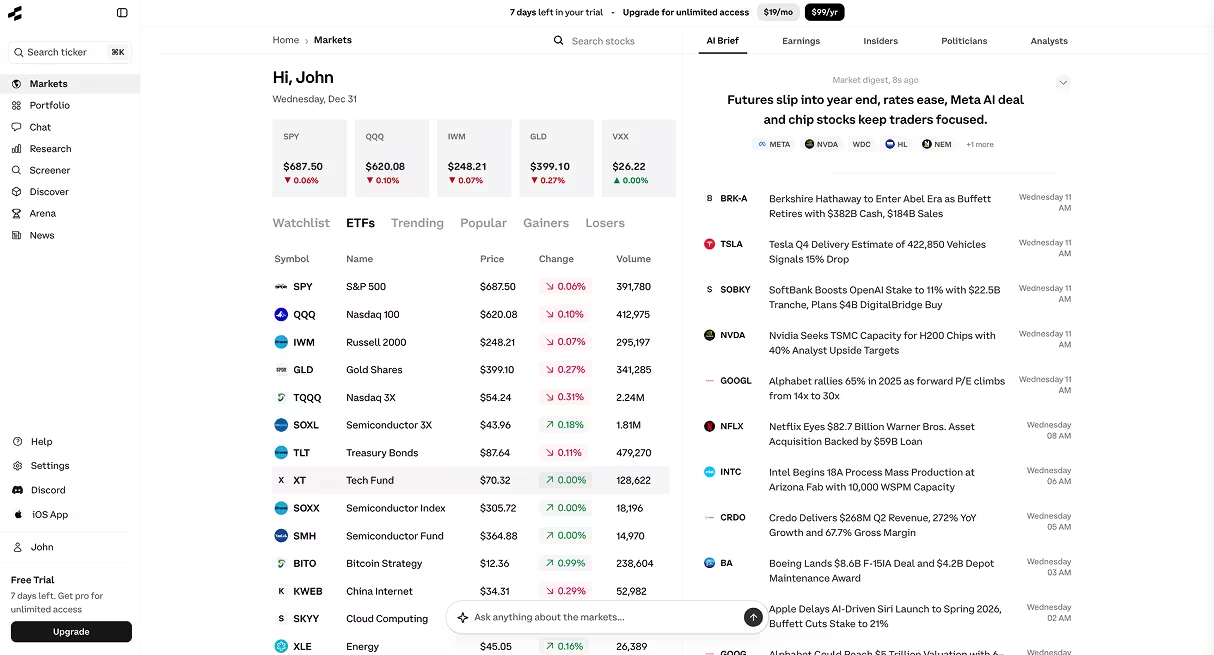
You can pull up a side-by-side view on the MSFT research page on Rallies.ai to see how these competitors stack up on the metrics that matter to you.
How does Microsoft's revenue growth compare to peers?
Revenue growth is where the MSFT vs peers debate gets interesting. Microsoft has consistently delivered double-digit annual revenue growth, driven largely by Azure and its Microsoft 365 suite. But here's the thing: percentage growth rates depend heavily on base size. A company generating $50 billion in cloud revenue will naturally grow slower in percentage terms than one generating $10 billion.
Amazon's AWS has historically been the largest cloud provider by revenue, but its growth rate has decelerated as the business has matured. Google Cloud, starting from a smaller base, has often posted faster percentage growth. Oracle's cloud infrastructure push is newer still, with potentially higher growth rates but far less scale.
Revenue growth rate: The percentage increase in a company's total revenue over a specific period, typically measured year-over-year. Faster growth can justify higher valuations, but investors should check whether growth is organic or driven by acquisitions.
When you compare Microsoft to competitors on growth, the picture shifts depending on the time horizon. Over trailing twelve-month periods, MSFT typically lands in the middle of its peer group: faster than Apple and Oracle on a total-company basis, but often slower than the cloud-specific growth rates posted by smaller competitors. What makes Microsoft's growth notable is its consistency. Few companies of its size maintain double-digit revenue growth year after year.
Microsoft vs competitors on profit margins
This is where Microsoft genuinely stands apart. MSFT's operating margin frequently exceeds 40%, which is remarkable for a company of its scale. For context, most large-cap tech companies operate with margins between 20% and 35%. Microsoft's margin advantage comes from the high-margin nature of software licensing and cloud subscriptions, combined with the operating leverage of serving hundreds of millions of users on shared infrastructure.
Amazon, despite its massive revenue, runs on much thinner margins because its e-commerce segment operates at near-breakeven. AWS carries high margins, but the blended company-wide figure is far lower than Microsoft's. Alphabet sits somewhere in between, with strong margins from advertising but dilution from experimental "Other Bets" segments. Salesforce has improved its margins significantly in recent periods after years of prioritizing growth over profitability, but it still trails MSFT.
Oracle is the closest competitor on margin profile. Its legacy database and enterprise software businesses throw off substantial cash, and its margins often approach Microsoft's range. But Oracle's revenue base is considerably smaller, which limits the absolute dollar generation.
Operating margin: Operating income divided by revenue, expressed as a percentage. It shows how much profit a company keeps from each dollar of sales after covering operating costs but before interest and taxes. Higher margins generally indicate pricing power and operational efficiency.
If margin durability matters to your analysis, Microsoft has one of the strongest profiles in all of large-cap tech. That said, margins can compress. Heavy AI infrastructure spending could pressure margins across the industry, and Microsoft is investing aggressively in data centers and AI capacity. Whether those investments pay off in higher future margins or drag on profitability for several years is a real open question.
Does MSFT deserve its valuation premium?
Here's where a Microsoft peer comparison gets uncomfortable for bulls. MSFT typically trades at a forward P/E ratio at the higher end of its peer group. Alphabet, for instance, often trades at a noticeable discount to Microsoft on both forward P/E and price-to-free-cash-flow, despite posting comparable revenue growth and strong margins.
The valuation gap usually gets justified by a few arguments: Microsoft has more diversified revenue streams, stronger enterprise lock-in, and a dominant position in both cloud and productivity software. Those are fair points. But a premium valuation also means there's less room for error. If Azure growth decelerates or AI monetization takes longer than expected, the multiple could compress quickly.
Forward P/E ratio: The current stock price divided by estimated earnings per share for the next twelve months. It reflects what investors are willing to pay today for expected future profits. A higher forward P/E suggests the market expects stronger growth or more durable earnings.
When you compare Microsoft to competitors on valuation, also look at enterprise value to free cash flow (EV/FCF). This metric accounts for debt and cash on the balance sheet and uses actual cash generation rather than accounting earnings. Microsoft's EV/FCF multiple tends to run above most peers, reflecting the market's confidence in its cash flow durability. Whether that confidence is warranted depends on how you assess competitive threats and reinvestment needs.
You can explore valuation comparisons and run custom screens using the Rallies.ai Vibe Screener to filter stocks by P/E, margins, and growth rates side by side.
Where is Microsoft's competitive moat strongest?
Microsoft's moat is built on switching costs and ecosystem integration. If your company runs on Microsoft 365, Azure, Dynamics, and Teams, the cost of migrating to a competitor is enormous, both in dollars and in operational disruption. That kind of lock-in creates predictable, recurring revenue that investors love.
The enterprise software moat is arguably deeper than the cloud infrastructure moat. In cloud, AWS and Google Cloud offer comparable services, and workloads can be designed to run across multiple providers. In productivity and collaboration software, Microsoft's dominance is harder to challenge. Google Workspace is the main alternative, but it has struggled to gain serious traction in large enterprises.
AI adds another dimension. Microsoft's partnership with OpenAI and the integration of AI tools across its product suite (Copilot in Office, GitHub Copilot, Azure OpenAI Service) could deepen the moat by making Microsoft's tools more valuable and harder to replace. But this is also where the risk lies. If open-source AI models reach parity with proprietary ones, or if competitors build equally compelling AI integrations, the moat advantage from AI could prove temporary.
For deeper research on competitive positioning and business model analysis, the Rallies AI Research Assistant can help you break down individual companies in the peer set.
What are the biggest risks when comparing MSFT to peers?
Every comparison has blind spots, and a Microsoft vs competitors analysis is no exception. A few risks worth flagging:
- Capital expenditure intensity: Microsoft, Amazon, Alphabet, and Meta are all spending heavily on AI infrastructure. These spending levels could weigh on free cash flow for years. Comparing margins today without accounting for the reinvestment cycle can be misleading.
- Segment opacity: Microsoft doesn't break out Azure revenue as a standalone figure the way Amazon reports AWS. This makes precise cloud-to-cloud comparisons harder than they should be.
- Regulatory risk: Large-cap tech companies face varying degrees of antitrust and regulatory scrutiny across different jurisdictions. The impact is hard to quantify but could affect competitive dynamics.
- AI monetization uncertainty: Everyone in this peer group is investing in AI, but nobody has fully proven the revenue model yet. The gap between AI hype and AI revenue generation is a risk across the board, not just for Microsoft.
- Valuation compression risk: If the overall market reprices growth stocks lower, Microsoft's premium multiple means it could fall further in percentage terms than cheaper peers like Alphabet or Meta.
Honest peer comparisons account for these unknowns rather than assuming current trends continue indefinitely. The evidence on several of these points is genuinely mixed, and reasonable investors can disagree on how to weigh them.
How to build your own Microsoft peer comparison
If you want to compare Microsoft to competitors yourself, here's a practical framework:
- Define the peer set. Pick 4-6 companies that overlap with Microsoft in the segments you care about (cloud, enterprise software, AI, or all three).
- Choose your metrics. At minimum, look at revenue growth (trailing and forward estimates), operating margin, free cash flow margin, forward P/E, and EV/FCF.
- Normalize for size. A company growing revenue at 25% from a $30 billion base is doing something different than one growing 25% from a $200 billion base. Absolute dollar growth matters too.
- Assess the moat. For each competitor, ask: how easy is it for customers to switch? What would it cost? How differentiated is the product?
- Factor in reinvestment. High capital spending today can mean higher or lower margins tomorrow. Check the ratio of capex to revenue and how it's trending.
You can run this kind of multi-dimensional comparison quickly by exploring thematic portfolios on Rallies.ai or using the screener to pull up side-by-side metrics.
Try it yourself
Want to run this kind of analysis on your own? Copy any of these prompts and paste them into the Rallies AI Research Assistant:
- Compare Microsoft to its top competitors on revenue growth, profit margins, and valuation multiples — which companies are winning in cloud, AI, and enterprise software, and where does MSFT stand out or fall behind?
- Compare Microsoft to its closest competitors side by side — revenue growth, margins, valuation, and competitive position.
- What are Microsoft's biggest competitive advantages over Amazon and Alphabet in cloud and enterprise software, and are those advantages reflected in its valuation?
Frequently asked questions
How does MSFT compare to peers on profitability?
Microsoft's operating margins consistently rank near the top of large-cap tech, often exceeding 40%. Most direct peers operate in the 20-35% range on a blended basis. This margin advantage stems from the high-margin nature of software subscriptions and cloud services, combined with massive scale. Oracle is the closest peer on margins, while Amazon's blended margins are significantly lower due to its e-commerce segment.
Who are Microsoft's biggest competitors in cloud computing?
Amazon Web Services (AWS) is the largest cloud infrastructure provider by market share, followed by Microsoft Azure and Google Cloud. Each has different strengths: AWS has the broadest service catalog, Azure benefits from tight integration with Microsoft's enterprise software, and Google Cloud has strengths in data analytics and AI/ML tooling. Smaller players like Oracle Cloud Infrastructure are also growing but operate at a fraction of the scale.
Is Microsoft overvalued compared to competitors?
Microsoft typically trades at a higher forward P/E and EV/FCF multiple than peers like Alphabet, Meta, and Amazon. Whether this premium is justified depends on how you value Microsoft's margin profile, revenue diversification, and enterprise lock-in. Investors who believe those advantages are durable may view the premium as reasonable. Those who think AI competition or capex spending will pressure returns may see better value elsewhere in the peer group.
How do you compare Microsoft to competitors effectively?
Start by defining which business segments matter most to your analysis, since Microsoft competes in cloud, productivity software, gaming, and more. Then select 4-6 peers with meaningful overlap. Compare on revenue growth rates, operating and free cash flow margins, valuation multiples, and qualitative factors like switching costs and ecosystem strength. Normalizing for company size is important because percentage growth rates can be misleading across companies with very different revenue bases.
What is Microsoft's competitive moat?
Microsoft's moat is primarily built on switching costs and ecosystem integration. Enterprise customers using Microsoft 365, Azure, Dynamics, and Teams face high costs to migrate to alternatives. This creates sticky, recurring revenue. The moat is reinforced by network effects in products like Teams and LinkedIn, as well as a large developer ecosystem around Azure and GitHub. AI integrations through Copilot could strengthen this moat further if they prove difficult for competitors to replicate.
Does Microsoft grow faster than Alphabet or Amazon?
On a total-company basis, growth rates among Microsoft, Alphabet, and Amazon are often within a few percentage points of each other, though the ranking shifts depending on the period. At the segment level, Azure frequently grows faster than AWS in percentage terms but slower than Google Cloud. The more useful comparison is growth relative to valuation: if two companies grow at similar rates but one trades at a lower multiple, the cheaper one may offer more upside per dollar invested. Investors should weigh both absolute growth and the price they pay for it.
What's the best way to do a Microsoft peer comparison?
The most practical approach is to use a standardized set of metrics applied consistently across 4-6 competitors. Focus on revenue growth, operating margin, free cash flow yield, and forward valuation multiples. Qualitative factors matter too: assess each company's moat, reinvestment cycle, and exposure to structural tailwinds or headwinds like AI adoption. Tools like the Rallies.ai stock screener can speed up the quantitative side of this work.
Bottom line
A thorough Microsoft vs competitors analysis shows that MSFT earns its reputation for margin strength and business diversification, but it also carries a valuation premium that not every investor will be comfortable paying. Competitors like Alphabet and Amazon offer comparable or faster growth in certain segments at lower multiples, while Oracle and Salesforce present narrower but meaningful competitive overlap in enterprise software. The right call depends on which factors you weight most heavily: margin durability, growth trajectory, valuation discipline, or moat depth.
To go deeper on any of these dimensions, explore more stock analysis frameworks and comparisons and build your own peer comparison using real data. Do your own research before making any investment decisions.
Disclaimer: This article is for educational and informational purposes only. It does not constitute investment advice, financial advice, trading advice, or any other type of advice. Rallies.ai does not recommend that any security, portfolio of securities, transaction, or investment strategy is suitable for any specific person. All investments involve risk, including the possible loss of principal. Past performance does not guarantee future results. Before making any investment decision, consult with a qualified financial advisor and conduct your own research.
Written by Gav Blaxberg, CEO of WOLF Financial and Co-Founder of Rallies.ai.